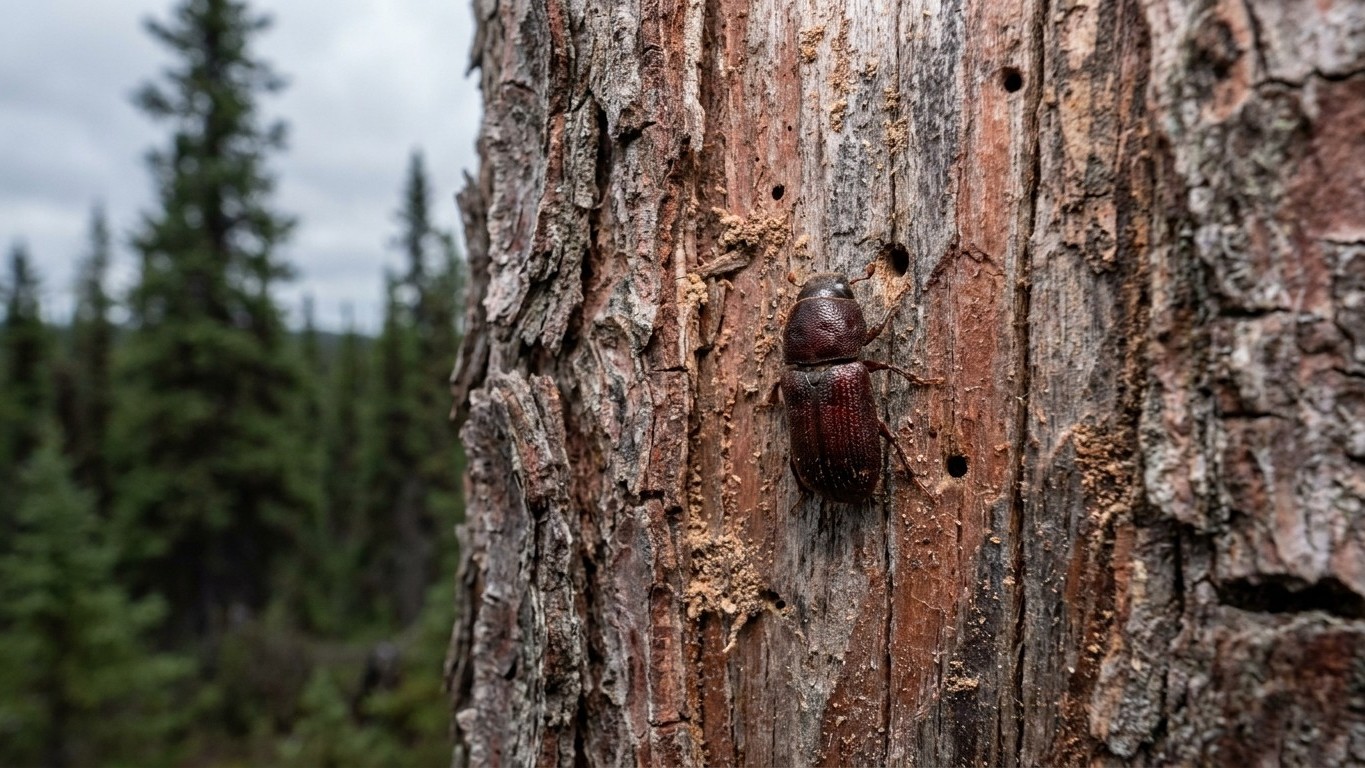

Spruce beetle activity in the Northwest Territories tends to spike in years following drought stress, windthrow events, or unusually warm summers, roughly mid-June through August when adults fly to find new host trees. What stops it isn’t one single tactic but a combination of cold winters, natural predators, and fast removal of downed or weakened spruce before beetles can breed in them. Once you know the timing and the triggers, spotting trouble early becomes a lot more manageable.
What the Spruce Beetle Is and Why It Targets NWT’s Forests

The spruce beetle (Dendroctonus rufipennis) is a native bark beetle found across the boreal forest, from Alaska through Yukon and into the Northwest Territories. Adults measure about a quarter to three-eighths of an inch, reddish-brown to nearly black, roughly the size of a grain of rice. Small, yes. But a beetle that size doesn’t need to be big when it works in numbers.
White spruce dominates much of the territory’s forested land, especially along the Mackenzie Valley and in the southern Dehcho and South Slave regions. That matters because spruce beetle populations build fastest in large-diameter, mature white spruce, the exact kind of tree that makes up a lot of NWT’s older stands. Younger, thinner spruce generally offers less bark surface and less phloem, the nutrient-rich inner layer beetles feed on, so it’s less attractive to breeding adults.
Stressed trees are the real draw. Drought, root damage, fire scarring, or wind-thrown logs left lying on the forest floor all create conditions where bark is easier to penetrate and defenses are weaker. A single blown-down spruce from a summer storm can become a breeding ground for thousands of beetles within one season, and those beetles then disperse to attack standing, healthy-looking trees nearby the following year.
The Seasonal Timeline: When Spruce Beetle Activity Peaks
Cold-climate insects live on a tight schedule, and spruce beetle in the NWT is no exception. Adults typically emerge and fly during a window from late spring into midsummer, when daytime temperatures climb consistently into the range that triggers flight behavior. In much of the territory, that translates to mid-June through late July, though a warm spring can push the window earlier.
Under typical northern conditions, spruce beetle completes its life cycle over two years: eggs laid under bark in summer, larvae feeding through the following winter and into the second summer, then pupation and adult emergence the second spring after attack. In warmer years, or in southern pockets of the territory with milder microclimates, some populations can compress that into a single year, which lets numbers build faster than a two-year cycle would allow.
That semivoltine-to-univoltine shift (going from a two-year cycle to a one-year cycle) is the exact pattern that has driven larger outbreaks farther south in British Columbia and Alaska over recent decades, according to long-term forest health monitoring by Canadian and US agencies. It’s one reason forest managers in the NWT keep an eye on winter temperature trends as much as summer beetle counts.
Warning Signs to Watch For on Your Property or Woodlot
Spruce beetle damage is easy to miss at first glance because the tree often looks fine from a distance while the real action happens under the bark. By the time needles turn reddish-brown, the beetles that caused the damage have usually already moved on. Catching it earlier means looking closer.
- Reddish-brown boring dust collecting in bark crevices or at the base of the trunk, especially after a dry, windy day
- Small pitch tubes on the bark, though spruce produces less obvious pitch than pine, so this sign can be subtle
- Fine, vertical egg galleries visible when bark is peeled back, running with the wood grain
- Blue-gray staining in the sapwood, caused by a fungus the beetles carry and introduce during attack
- Increased woodpecker activity, since birds strip bark to reach larvae underneath, a sign that’s often noticed before anything else
Fading needle color, from green to yellow-green to red, generally shows up a full year after the initial attack. That lag is worth remembering: a tree that looks red this August was likely infested the previous summer, and any beetles that developed inside it may have already emerged and dispersed.
What Actually Stops a Spruce Beetle Outbreak
Natural Limits: Cold, Predators, and Host Depletion
Extreme winter cold remains one of the most reliable checks on spruce beetle populations in northern climates. Sustained temperatures well below freezing during early winter, before larvae have built up cold tolerance, can kill a significant share of a local population. This is exactly why researchers watch warming winter trends so closely: fewer deep-cold events mean fewer natural die-offs, and that’s part of why outbreaks have expanded northward and to higher elevations across the boreal forest in recent decades.
Natural predators also play a role, though a smaller one than winter cold. Woodpeckers, certain predatory beetles, and parasitic wasps all feed on spruce beetle life stages, and healthy mixed-age forests tend to support more of these natural enemies than single-species, single-age stands. Outbreaks also tend to slow on their own once beetles have used up the supply of large, susceptible spruce in an area, since younger regrowth simply doesn’t offer the same breeding conditions.
Active Management: What Landowners and Communities Can Do
Sanitation is the single most effective human intervention. Removing and either burning, chipping, or debarking downed or windthrown spruce before the following spring flight period denies beetles the breeding material they need. Left in place over a winter, a single fallen tree can turn into a launch point for a much larger local infestation.
Prompt harvest of freshly attacked trees, before beetles complete development and emerge, also cuts off the next generation. Foresters sometimes refer to this as a “brood tree” removal strategy, since the goal is targeting trees currently housing developing larvae rather than waiting until visible red-crown symptoms confirm the attack is old news.
Semiochemical tools, synthetic versions of the beetle’s own anti-aggregation pheromone (commonly known by the compound MCH), can be applied to high-value trees or stands to discourage beetles from settling there. These pheromones work by signaling that a tree is already “full,” pushing incoming beetles toward less desirable hosts instead. It’s a targeted approach used more for protecting specific high-value trees or small stands than for controlling beetles across large forested areas.
For homeowners and woodlot owners, the practical takeaway is straightforward: don’t leave cut spruce logs, storm-damaged trees, or firewood piles sitting through spring and summer if the bark is still intact. Getting bark off, or getting the wood off the property entirely, before beetle flight season removes the single biggest self-created risk. The Canadian Forest Service and territorial forest health programs also encourage reporting unusual fading or dying spruce stands, since early detection at the landscape level helps target sanitation efforts before a localized problem spreads.
Standing dead or heavily attacked trees near buildings carry a secondary risk worth noting: beetle-killed spruce dries out and becomes more prone to snapping in wind, which is a separate hazard from the infestation itself and one more reason removal shouldn’t wait for a full season of visible red needles.