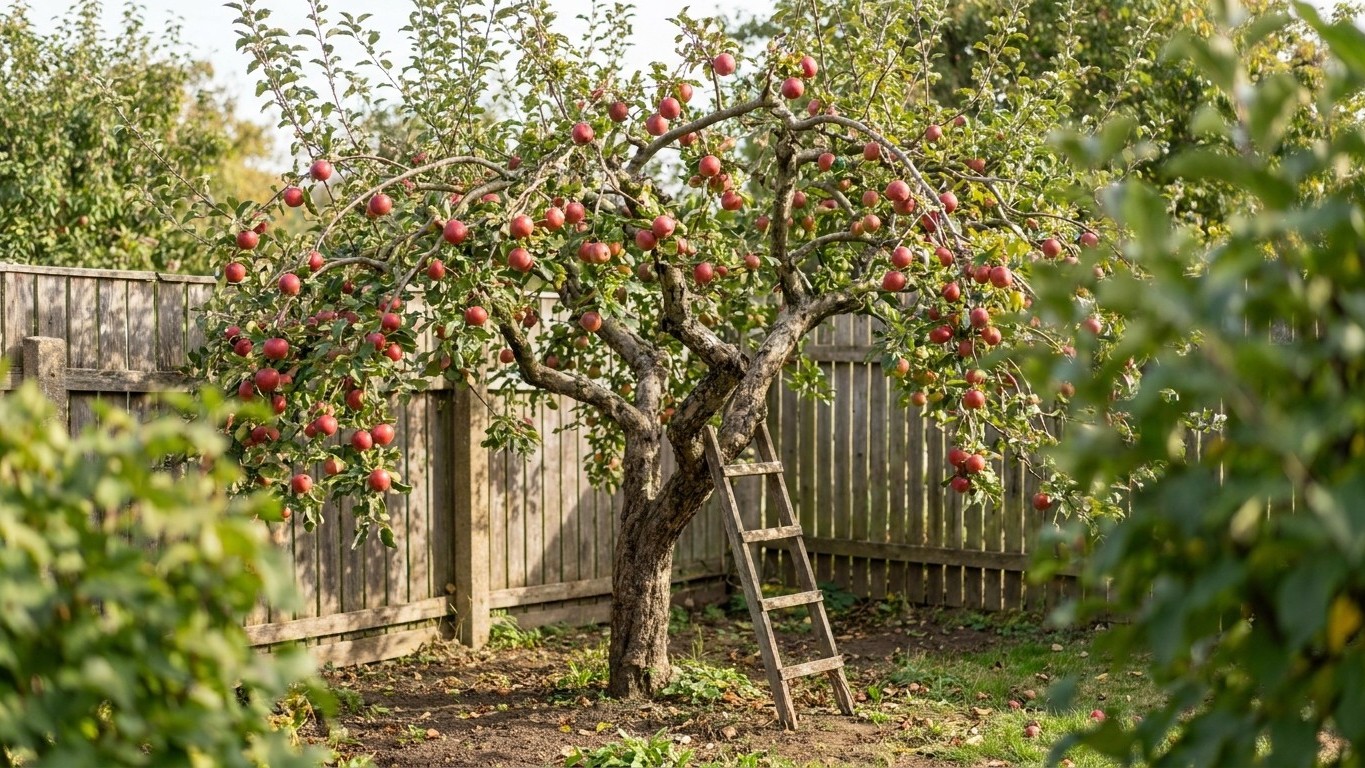

In Alberta, apples come off the tree once background skin color shifts from green to yellow or the variety’s mature color, seeds turn brown, and fruit separates from the spur with a gentle twist. That stage usually lands in late August through mid-September, ahead of the region’s average first fall frost. Because winters run long and deep, most cold-hardy varieties grown here are short-storage apples best used within weeks, not months.
When apples are ready to pick in Alberta
Reading the tree, not the calendar
A calendar date tells you nothing about what a specific tree, in a specific yard, is doing that year. What matters is the stage of the fruit: skin color under any red blush turning from green to cream or yellow, seeds gone from white to brown, and the apple lifting away from the branch without tearing bark. Taste is the tiebreaker. Starchy and sour usually means a week or two more on the tree, if frost allows it.
What frost allows is the real constraint in Alberta. The average last spring frost at Calgary Int’l A runs to May 21, and the average first fall frost lands on September 16, both figures from Environment and Climate Change Canada’s 1981-2010 climate normals. Those are averages, not guarantees: in roughly half of all years, frost arrives later than the date on either end. That leaves a frost-free window of about 118 days on average, and it can run shorter. Every apple variety planted in Alberta has to flower, set fruit, and ripen inside that stretch, or close to it.
Frost dates and the season they define
That short window is why the varieties commonly planted across Alberta ripen early, often through August and into the first half of September, rather than the late-October harvest typical of milder growing regions. A tree that needs an extra month to finish ripening simply doesn’t get it here before the average frost date arrives.
Hardiness and winter chill are separate questions, and Alberta growers need both answered correctly. Hardiness is about survival: the mean daily minimum of the coldest month at Calgary sits at -13.2°C (8.2°F), per the same ECCC normals, and that’s an average for the coldest month, not the record low a cold snap can reach. Varieties without adequate cold hardiness for that threshold, or for the colder extremes recorded in a given winter, can suffer trunk and graft damage even if they survive most years. Winter chill, by contrast, is about flowering: it’s the accumulated cold hours a tree needs before it can bloom normally. Alberta winters supply chill in abundance, so chill accumulation is rarely the limiting factor here the way it is in mild-winter regions. The bottleneck in Alberta is heat and season length, not a shortage of cold.
Southern Alberta around Calgary and Lethbridge deals with chinook winds that push temperatures up sharply in the middle of winter, then drop again fast. Further north, toward the Peace River region, winters run colder and more consistent, but the frost-free season is shorter still. Neither pattern matches the Calgary station exactly, so treat these dates as a starting point and adjust by watching your own site.
Which ones keep, and which must be eaten
How long an apple keeps after picking depends heavily on when it ripened and how dense its flesh is. Early-ripening apples, thin-skinned and softer at harvest, tend to be short-storage fruit meant for fresh eating, sauce, or baking within a few weeks. Later-ripening, firmer varieties generally hold longer in cold storage, sometimes for months, because their cell structure breaks down more slowly.
Alberta’s short frost-free season pushes most locally viable varieties toward the early end of that spectrum. Cold-hardy apples bred for prairie conditions are selected first for surviving winter and finishing their ripening before the average September frost, and storage life is a secondary consideration behind that. That trade-off means a grower here should plan to use most of the harvest within a reasonable window rather than count on a long-keeping crop, unless the specific variety is documented otherwise by the nursery that supplied it.
| Ripening timing in Alberta | Typical keeping quality | Best use |
|---|---|---|
| Early (August) | Short, best used soon after picking | Fresh eating, sauce, baking |
| Mid-season (early to mid-September) | Several weeks under cold, humid storage | Fresh eating, baking, short-term storage |
| Late-ripening types | Longer if the season lets fruit fully mature | Storage, but Alberta’s frost-free window rarely allows full maturity for these |
If a tree is producing fruit that still tastes starchy and hard right as the average frost date approaches, that’s a sign the variety is pushing past what the local season can finish. Those apples will still be edible, just less sweet, and they should go toward cooking rather than long storage, since immature fruit doesn’t hold well regardless of variety.
There’s no published local source breaking down exact keeping-weeks by variety for Alberta specifically, so the safest approach is to store a portion of any new variety and check it weekly the first year, rather than assume it matches a keeping time quoted for a milder growing region.
Storing them through a Alberta winter
Once apples are picked, the goal is a spot that stays cold, humid, and dark, and stays that way consistently. A temperature hovering just above freezing, ideally close to 0 to 4°C, slows the ripening enzymes that soften fruit and turn starch to sugar too fast. High humidity keeps skins from shriveling. Light speeds spoilage, so a box or bin beats an open shelf.
An unheated attached garage or an enclosed porch can work in early fall, but Alberta’s coldest month averages a mean minimum of -13.2°C, and cold snaps go well past that. Fruit left in an uninsulated space during a hard freeze will turn to mush once it thaws. A proper root cellar, built below the frost line or in an insulated basement corner, is the traditional prairie solution because it buffers against both the deep midwinter cold and, in southern Alberta, the chinook swings that can send outdoor temperatures up and down by 20 degrees or more within a couple of days. That instability is harder on stored produce than steady cold ever is.
Where a root cellar isn’t practical, a refrigerator crisper drawer holds a modest quantity well, and it’s often the more realistic option for the short-storage varieties common in Alberta anyway, since they’re meant to be used up over weeks rather than kept until spring. Wrapping fruit loosely, keeping varieties separate since some release more ethylene gas than others, and checking every week or two for soft spots all extend usable storage time regardless of where the fruit sits.
For general guidance on produce storage and on which crops the province tracks for Alberta growing conditions, Alberta’s agriculture and irrigation ministry publishes resources at alberta.ca/agriculture-and-irrigation. It doesn’t break out apple keeping-times by variety, but it’s the relevant provincial source for storage practices more broadly.
What goes wrong here
The two failure points in Alberta sit at opposite ends of the growing season. In spring, blossoms open on a schedule set by accumulated heat, and since the average last frost falls on May 21, roughly half of all years bring a frost after that date. A tree that blooms early loses its crop for the year to a late frost, with no fruit to show for it regardless of how well the tree itself survived winter.
In fall, the reverse problem shows up: an early frost, arriving weeks ahead of the September 16 average, can catch fruit that hasn’t finished ripening, especially after a cool or short summer. That fruit is often still usable for cooking but won’t have developed full sweetness or storage quality.
Winter cold itself causes damage beyond the average the normals describe. The -13.2°C mean minimum for the coldest month is just that, a mean; a single cold snap dropping well below it can split bark, kill graft unions, or damage roots on marginally hardy stock. In southern Alberta, chinooks add a distinct hazard: a warm afternoon that wakes up bark tissue, followed by a hard overnight freeze, can cause sunscald or bark splitting on the trunk’s south and west sides. Wrapping young trunks going into winter is the common response to that specific risk.
Site selection matters as much as variety choice. Low spots collect cold air and frost first, so a slope with air drainage, away from the bottom of a yard or a fence line that traps cold, reduces both spring bloom losses and fall frost damage.
Common questions
What’s the best month to pick apples in Alberta?
Most varieties grown in Alberta ripen from late August through mid-September, ahead of the average first fall frost of September 16 at Calgary Int’l A. Exact timing depends on the variety and the specific site, so check fruit stage rather than relying on the calendar alone.
Can apples survive an Alberta winter on the tree?
Fruit left unpicked won’t survive a hard freeze in usable condition, but the tree itself can survive winter if it’s a variety hardy enough for the region’s cold. The mean daily minimum of Calgary’s coldest month is -13.2°C, and varieties need to tolerate that and occasional deeper cold snaps to come through reliably.
Do Alberta-grown apples need a root cellar?
Not strictly, but a cellar or insulated cold space extends usable storage well beyond what an unheated porch or garage allows once winter cold sets in. Given that most locally viable varieties are short-storage types, a refrigerator works for smaller quantities meant to be used within a few weeks.
Why do apple blossoms freeze in Alberta some springs?
Because the average last spring frost falls on May 21, and in about half of all years frost occurs after that date. Trees that bloom before the frost risk has passed lose that year’s crop to a late freeze, even though the tree itself typically survives undamaged.