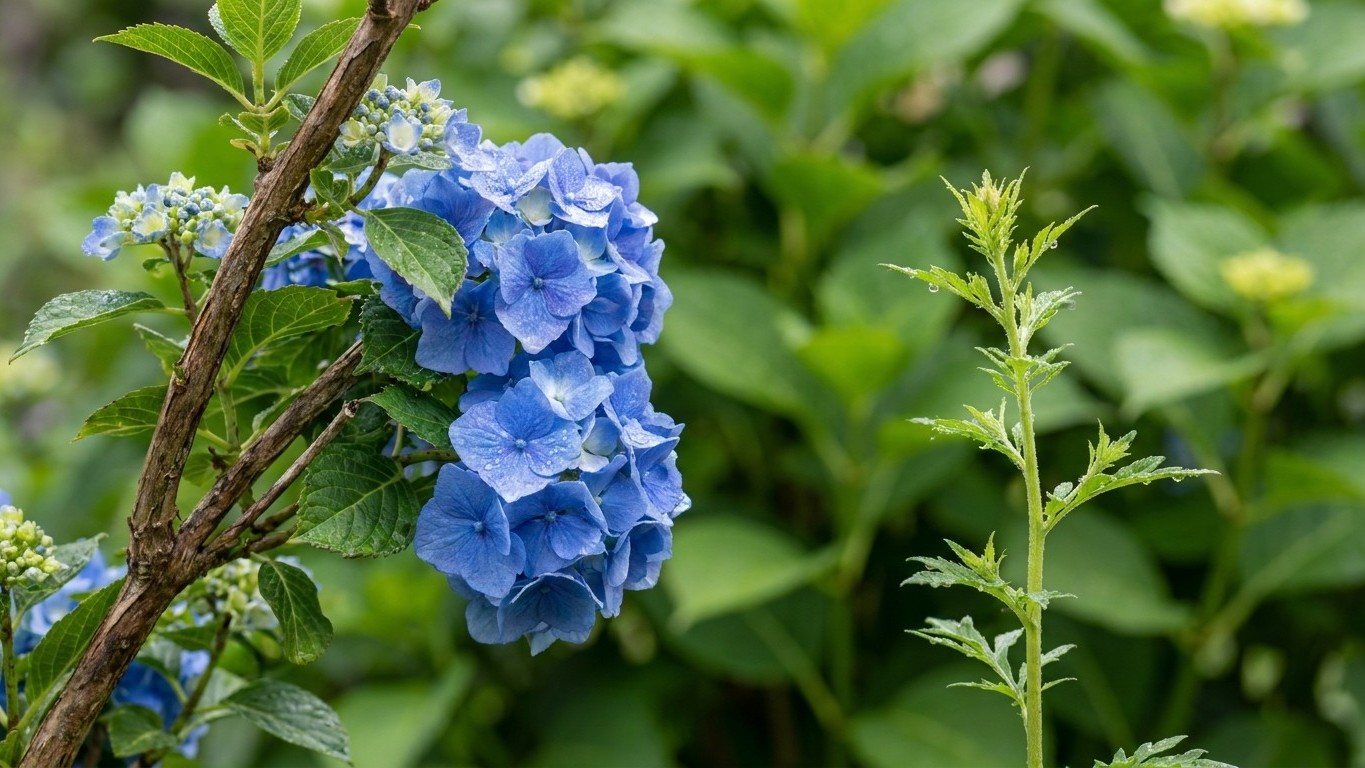

Alberta hydrangeas stay pink for two separate reasons that get lumped together: the province’s alkaline, calcium-rich soils lock up the aluminum that turns blooms blue, and many of the hydrangeas that actually survive an Alberta winter belong to species that never change color at all, no matter what you do to the ground beneath them. Turning blue means fixing both problems, not just one.
What this comes down to in Alberta

Around Calgary, the growing season runs from an average last spring frost on May 21 to an average first fall frost on September 16, and the region sits in Canadian hardiness zone 4a. Neither figure is a color rule by itself. But together they explain why a soil-pH fix that works in a milder climate often disappoints an Alberta gardener who tries the same thing.
The soil chemistry behind the color
Hydrangea color, where it’s chemically possible at all, comes down to whether the plant’s roots can take up aluminum. In acidic soil, aluminum stays soluble and available, and the bloom pigment shifts toward blue. In alkaline soil, aluminum binds to other minerals and becomes unavailable, and the same genetic variety produces pink or red flowers instead. Southern Alberta’s prairie soils, formed largely over calcareous glacial till, tend to sit on the alkaline side of neutral, which is the baseline reason pink shows up by default rather than blue.
Why Alberta’s hardiness zone limits your options
The second reason is species, not chemistry. Bigleaf hydrangea (Hydrangea macrophylla), the variety most known for dramatic pink-to-blue shifts, is only marginally hardy in zone 4a and frequently dies back to the ground or fails outright over an Alberta winter. To get reliable blooms, many gardeners in the province plant panicle hydrangea (Hydrangea paniculata) or smooth hydrangea (Hydrangea arborescens) instead, both of which tolerate zone 4a far better. The problem: neither species responds to soil aluminum the way bigleaf hydrangea does. Their color range runs from white through green to pink depending on variety and age of bloom, but no amount of soil acidification will turn them blue. If your hydrangea is pink and won’t budge no matter what you add to the soil, checking the species first can save a season of wasted effort.
Working it out for your own garden
Start by identifying which hydrangea you actually have, since that decides whether soil treatment can do anything at all. If it’s bigleaf hydrangea, or one of the reblooming bigleaf types bred for colder climates, soil chemistry is worth pursuing. If it’s panicle or smooth hydrangea, skip the aluminum sulfate and accept the color the variety was bred to produce.
Testing and adjusting your soil
For a bigleaf hydrangea, the next step is a soil pH test rather than guesswork, since adding acidifying products to soil that’s already on the acidic side can stress roots without shifting color further. A pH reading above roughly 6.5 generally keeps blooms pink; getting it down toward 5.5 is what typically shifts flowers toward blue. Products such as aluminum sulfate or elemental sulfur are the usual tools, applied around the root zone and watered in, with the change showing up gradually over one growing season rather than overnight.
Timing the treatment within Alberta’s frost window
Here’s where Alberta’s frost dates matter directly. The average frost-free window, from May 21 to September 16, works out to roughly four months, a little under 120 days, minus whatever margin you want to keep for safety on either end, since the May 21 date is a mean, not a guarantee, and frost arrives later than that in half of all years historically. That leaves a realistic working season of something closer to three and a half months once you subtract a couple of weeks of buffer at each end for a cautious gardener. Soil treatments need time to take effect and time for the plant to recover before winter, so applying aluminum sulfate as soon as soil is workable after the average last frost, then stopping applications roughly a month before the average first fall frost, in mid-August by that same math, gives the plant a recovery window instead of pushing new root activity right into the cold.
What changes across the state
Alberta is not one climate, and neither its frost dates nor its soil chemistry apply evenly from Medicine Hat to Grande Prairie. Calgary’s numbers come from an airport weather station on the prairie edge of the foothills; areas at higher elevation toward the Rockies, or districts further north toward the Peace Country, run their frost-free season shorter and their effective hardiness zone colder, sometimes by several weeks on the frost dates alone. Chinook winds, common through southern Alberta in winter, add another layer: they can thaw and refreeze soil repeatedly, which stresses marginally hardy bigleaf hydrangeas even in a winter that looks mild on paper. Soil alkalinity also isn’t uniform. Areas with heavier clay and glacial till tend to run more strongly alkaline than sandier or more organic soils, which means the amount of acidifying product needed to shift a bigleaf hydrangea’s color can vary meaningfully from one yard to the next even within the same town. None of this changes the basic mechanism, aluminum uptake still drives color, cold hardiness still limits species choice, but it does mean a Calgary-area frost date or a single soil test from one part of the province shouldn’t be treated as a province-wide constant.
Where the line typically falls
As a rough pattern, gardeners closer to the foothills and further north should expect a shorter effective season and colder practical zone than the Calgary reference figures suggest, while southern and lower-elevation districts run closer to, or slightly milder than, those numbers.
The mistakes this state punishes

The costliest mistake is planting a bigleaf hydrangea outdoors, unprotected, and expecting it to perform like a panicle or smooth variety through an Alberta winter; even a mild-looking season can kill it back past the point of blooming the following year. A second common error is applying aluminum sulfate too late in the season, after the point where roots have time to recover before frost, which stresses the plant heading into winter without improving the following year’s color.
Reading the May frost date correctly
A third mistake is treating May 21 as a safe planting or fertilizing date rather than the midpoint it actually is. Because that date is an average, frost arrives later in roughly half of all years on record, and a warm early spring followed by a late cold snap can undo soil work or damage new growth on a hydrangea that was treated too early. The safer approach is to watch the local forecast in the weeks around that average date rather than circling it on a calendar, and to hold off on the final round of soil acidification until the plant shows active growth rather than the first mild week.
Checking this against your county
The figures here come from a single reference station near Calgary and a single hardiness zone reading for that same location, useful as a starting point but not a substitute for local conditions. Before committing a hydrangea bed to a soil treatment plan, check with your county’s agricultural extension office and Alberta’s own Agriculture and Irrigation resources, which can point to more localized frost and soil guidance for your specific district.
Common questions
Will aluminum sulfate turn a panicle or smooth hydrangea blue?
No. Those species don’t take up soil aluminum the way bigleaf hydrangea does, so their color range stays limited to white, green, and pink shades regardless of soil treatment.
How long does it take to see a color change after treating the soil?
Expect a gradual shift over one growing season rather than an immediate change, since the plant needs to take up the aluminum through its roots and produce new blooms with it present.
Is Alberta’s soil always too alkaline for blue hydrangeas?
Not universally. Alkalinity varies by soil type and district, so a soil test on your specific site is more reliable than assuming a province-wide condition.
Can I keep a bigleaf hydrangea blue if it survives an Alberta winter?
Yes, provided the soil stays acidic enough, but the bigger challenge in zone 4a is usually keeping the plant alive through winter at all, which often matters more than the color question itself.