
Roses in Arizona live or die by heat, not cold. Across the low desert, frost barely counts as a factor: Phoenix normals show a 365-day frost-free season, with a rare cold snap dipping to 32F in only 6 of the last 30 winters, mostly between late December and mid-January. That flips the usual planting calendar on its head. In the desert, you plant to dodge summer, not frost. Higher elevations run an entirely different game.
When to plant Roses in Arizona
Most planting guides start with a frost date and count forward or backward from it. That approach does not work for roses in the low desert around Phoenix, and NOAA’s own data explains why: the station record (USW00023183) shows essentially no reliable freeze most years, and when one does show up, it is a minor, short-lived dip rather than a hard freeze. Frost is not the limiting factor here. Summer heat is. Once daytime highs push past the mid-90s and stay there for months, roses stop producing new growth cleanly, buds blast before opening, and root systems planted too late never get a chance to establish before the stress hits.
That reality points to a planting window built around the cool season rather than a frost table. In the Phoenix area and similar low-desert elevations, bare-root and dormant potted roses go in during the cool months, roughly December through February, while soil temperatures are mild and the plant can push root growth before the heat arrives. Gardeners who wait until March or April are racing the calendar: the rose needs eight to twelve weeks of cool-to-mild weather to settle in before 100-degree days start punishing anything with a shallow, unestablished root system.
Container-grown roses bought later in spring can still go in the ground, but they need extra attention: deeper planting holes, a thick mulch layer from day one, and closer watering through their first summer, since they never got that quiet establishment window the bare-root plants had.
Higher elevations run on a different clock
Flagstaff and the high country of northern Arizona are not the same climate as Phoenix, and treating them the same is a mistake. Those areas do freeze hard, with real winter cold and a genuine last-frost, first-frost cycle that shapes planting the way it does in most of the country. The specific frost dates for those higher elevations are not published in the data available for this guide, so rather than guess at a number, the honest answer is to check with a local source before planting bare-root roses in Flagstaff, Prescott, or similar elevations. Waiting until the ground has fully thawed and the hard freezes have passed is the safe default until you have that local figure in hand.
For everyone else in the low and mid desert, think of the calendar in three blocks: cool-season planting from December through February, an establishment and bloom stretch through spring before the heat locks in, and a defensive posture through the brutal months once summer arrives.
Soil and site preparation
Roses want six or more hours of direct sun, but in the low desert that ideal needs an asterisk. Afternoon sun in June and July is punishing enough to scorch petals and stress foliage even on heat-tolerant varieties, so a spot that gets full morning sun and a break from the harshest late-afternoon rays often performs better over a full year than one baking from noon to sunset.
Desert soils tend to run alkaline and low in organic matter, and they often drain either too fast, in sandy pockets, or too slowly, where caliche layers sit underground. Neither extreme suits roses, which want soil that holds moisture without staying soggy around the roots. The fix is the same one gardeners have used for decades: work several inches of compost or other organic matter into the bed weeks before planting, not the day of, so it has time to start integrating into the native soil rather than sitting as a separate layer the roots avoid.
Dig planting holes wide rather than deep, generally twice the width of the root ball, and check drainage before committing a plant to the spot: fill the hole with water and see how long it takes to disappear. If water sits for hours, that location needs raised beds or significant amendment before it is worth planting into.
Spacing depends on the type of rose. Compact shrub and groundcover roses can sit two to three feet apart, while larger hybrid teas and grandifloras want three to four feet of breathing room to allow air movement through the foliage, which matters more in humid microclimates or years with a wetter monsoon season, since still, damp air around dense foliage invites fungal problems.
Varieties that suit Arizona
The traits that matter most here are heat tolerance, disease resistance, and how much water and attention a variety demands once summer settles in. A rose that needs cool nights to color well or that sulks above 100 degrees is fighting the climate every single day it is in the ground, and no amount of extra watering fully compensates for that mismatch.
Shrub roses bred for landscape toughness tend to handle Arizona’s swings better than delicate hybrid teas bred for cut-flower form. Widely available landscape shrub roses, sold under names like Knock Out and similar repeat-blooming shrub lines, carry strong disease resistance and keep flowering through heat that would stall out a fussier variety. They are a reasonable starting point for anyone who wants color without a demanding spray schedule.
Old garden roses and certain antique varieties also have a track record of tolerating heat and poor soil better than modern hybrid teas, partly because they were bred before intensive irrigation and chemical support were standard practice. Their tradeoff is usually a single strong bloom flush rather than continuous repeat flowering.
Groundcover and polyantha types earn their keep in smaller yards or as border plantings, since their lower, spreading habit needs less staking and tends to shrug off wind and heat stress better than tall, upright canes.
| Type | Heat tolerance | Bloom habit | Best use |
|---|---|---|---|
| Landscape shrub roses | High | Repeat bloomer | Low-maintenance color, hedges |
| Old garden / antique roses | High | Single strong flush | Tough spots, poor soil |
| Hybrid tea | Moderate | Repeat bloomer | Cut flowers, needs more care |
| Groundcover / polyantha | High | Repeat bloomer | Borders, small spaces |
What to plant alongside
Roses share bed space reasonably well with a handful of companions that genuinely help. Lavender, catmint, and other Mediterranean herbs like the same lean, well-drained soil and dry-side watering, and they draw in pollinators without competing hard for the same nutrients roses need. Alliums and garlic planted at the base of rose bushes have a long-standing reputation among gardeners for discouraging aphids, though the evidence behind that claim is more folk wisdom than tested science, so treat it as a low-cost experiment rather than a guaranteed fix.
Low, dense groundcovers planted around the base of rose canes can help shade the soil and cut down on evaporation, which matters more in a desert climate than almost anywhere else in the country. Just keep them a few inches back from the crown so they are not trapping moisture directly against the stem.
What to avoid is planting roses near anything that wants constant moist soil, since overwatering to satisfy a thirsty neighbor is one of the fastest ways to invite root rot in a rose that actually prefers to dry slightly between waterings. Heavy feeders like large vegetables planted too close will also pull nutrients away from the roses, leaving both plants undersized. And skip planting roses near black walnut or other trees known to produce root exudates that stunt nearby ornamentals; while walnut toxicity is best documented in vegetables, there is no upside to testing it with an established rose bed.
Watering, feeding and support
Depth matters more than frequency. A rose watered deeply, so moisture reaches 18 inches or more down to the main root zone, and then left to dry slightly at the surface before the next watering, develops a stronger root system than one given frequent shallow sips that only wet the top few inches. In the low desert during peak summer, that often means watering two to three times a week, but with real volume each time, rather than a daily light sprinkle that never reaches the roots that matter.
Mulch is not optional here. A three- to four-inch layer of organic mulch, kept a few inches clear of the stem, cuts soil temperature and evaporation dramatically, which in a climate where afternoon soil surface temperatures can be brutal, directly protects the root zone from cooking.
Feeding follows the bloom cycle rather than a fixed monthly schedule. A balanced or rose-specific fertilizer applied as new growth starts in late winter, then again after the first bloom flush, gives the plant fuel when it is actually building new canes and buds. Feeding hard through the worst of summer heat tends to push tender new growth right when the plant is least equipped to support it, so many experienced growers ease off fertilizer through July and August and resume as temperatures moderate in fall.
Larger hybrid tea and climbing roses benefit from staking or a simple cage early, before canes get heavy with growth, since trying to corral an established, thorny cane later is a frustrating and painful job. Pruning in late winter, while the plant is still semi-dormant, removes dead and crossing wood and shapes the plant before the spring growth surge. Suckers, the fast-growing shoots that sometimes emerge from below a graft union, should be removed at the base as soon as they appear, since left alone they draw energy away from the grafted variety and can eventually take over the plant entirely.
Common problems
Iron chlorosis shows up as yellowing leaves with the veins staying green, and it is one of the most common complaints among desert rose growers because the alkaline soil common across much of Arizona locks up iron the plant needs. A chelated iron soil drench or foliar spray corrects it faster than trying to acidify the entire bed.
Powdery mildew appears as a grayish-white coating on leaves and buds, usually when nights cool down but humidity rises, often during the milder shoulder seasons rather than deep summer. Improving air circulation through proper spacing and pruning, along with avoiding overhead watering late in the day, cuts the problem down significantly.
Bud balling or bud blast, where flower buds fail to open and turn brown or mushy instead, often traces back to a stretch of unusually humid weather during monsoon season combined with water sitting on the buds. There is not much to do once it happens beyond removing the affected buds; prevention means watering at the base rather than overhead during humid stretches.
Cane dieback, where a cane turns black or brown from the tip downward, usually signals either a hard pruning cut that did not heal, a borer entry point, or root stress from over- or underwatering. Cutting back to healthy, white pith and disposing of the removed wood keeps the problem from spreading into the rest of the plant.
Stippled, dusty-looking leaves that eventually turn bronze or drop are the classic sign of spider mites, which thrive in the hot, dry stretches of an Arizona summer and multiply fast enough to strip a plant of vigor within weeks if ignored.
Pests that actually show up in Arizona
The University of Arizona Cooperative Extension’s home garden pest guide names a specific lineup for the state, and several of those are the ones rose growers actually deal with rather than pests that mostly bother vegetable beds.
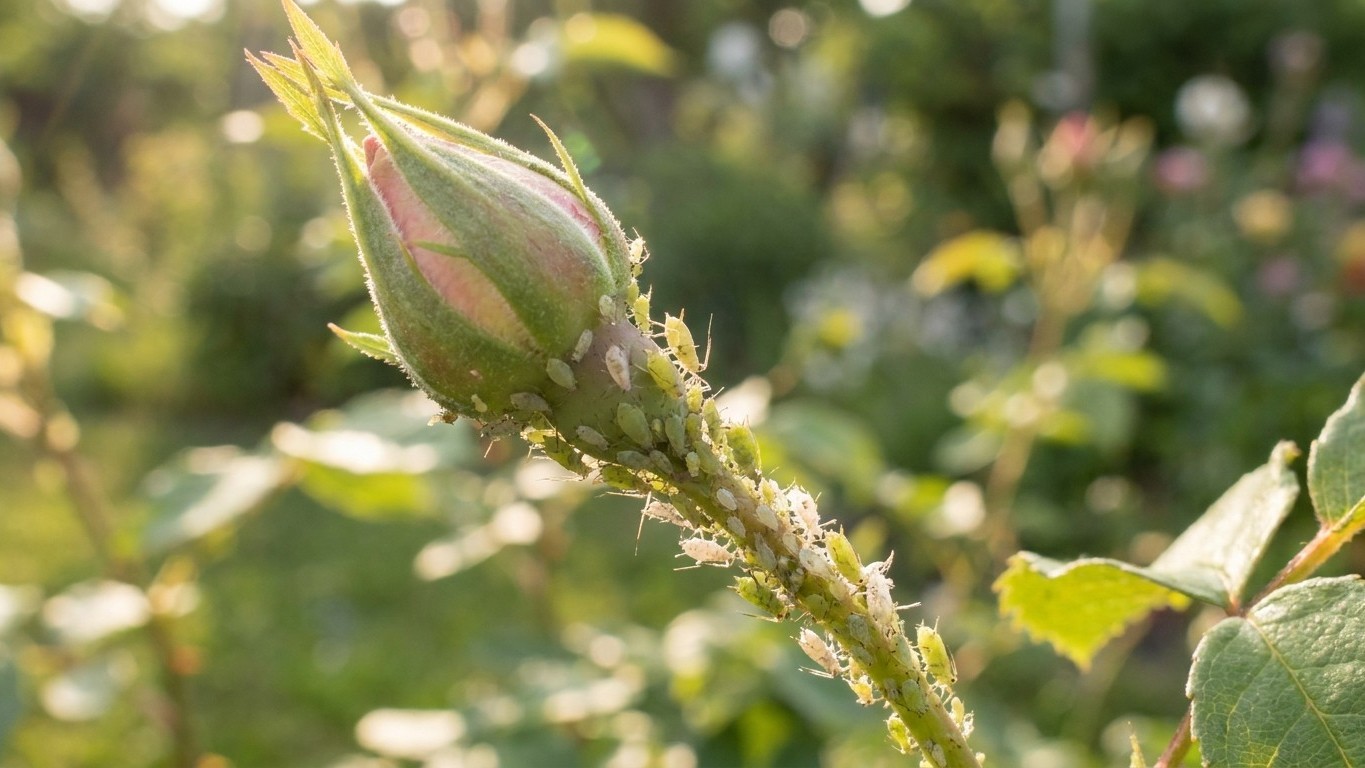
Aphids cluster on new growth and flower buds, distorting them and leaving a sticky residue behind. They build up fastest in spring as tender new growth flushes out, and a strong blast of water from a hose, repeated every few days, knocks populations down without reaching for a spray.
Spider mites are the summer problem, thriving as temperatures climb into the 90s and beyond. The first sign is fine stippling on leaves, sometimes with faint webbing on the undersides in a bad infestation. Regular overhead rinsing of foliage, done early in the day so leaves dry before evening, disrupts their populations since mites prefer dusty, dry conditions on unwashed leaves.
Thrips peak in spring and decline as the extension guide notes once summer heat rises above the 90s, and on roses they show up as streaked, discolored petals and buds that fail to open cleanly. Because they hide inside the bud itself, contact sprays have limited reach; removing and discarding affected buds is often the most practical control for a home garden.
Grasshoppers hatch in spring and can strip foliage fast once populations build later in the season, chewing ragged holes through leaves and sometimes into buds. Physical barriers like fine netting around young or prized plants, along with hand removal when numbers are still low, work better than trying to spray a moving, wide-ranging pest.
Whiteflies round out the list that matters for roses, showing up as a cloud of tiny insects that scatter when a branch is disturbed, leaving sticky honeydew behind. Yellow sticky traps placed near affected plants catch adults and give a good early read on whether a population is building.
Harvest and end of season
Roses are grown for the bloom, not a harvest crop in the traditional sense, but cutting stems for indoor arrangements works best in the cool of early morning, when stems hold more water and flowers are less stressed. Cut just above an outward-facing leaf node with five leaflets, at an angle, and get cut stems into water within minutes for the longest vase life.
Deadheading spent blooms through the growing season, rather than letting them fade and drop naturally, pushes the plant to keep producing new flushes instead of putting energy into seed hip production. Stop deadheading in early fall if you want the plant to slow down and harden off before any cooler weather arrives, since a rose that is still pushing soft new growth going into fall is more vulnerable if temperatures do dip.
With no reliable fall freeze in the record for the low desert, there is no hard end-of-season cutoff the way there is in colder states. What matters more is easing off nitrogen fertilizer by late summer or early fall so the plant is not carrying tender new growth into the cooler, shorter days ahead. In the rare years when a cold snap does bring temperatures near or below freezing, a layer of mulch pulled up around the base of the plant protects the crown, and covering tender new growth overnight during that unusual cold stretch is worth the trouble for the few days it typically lasts.
Local help
Frost dates, soil behavior, and pest pressure all shift across Arizona’s elevations, and the numbers in this guide reflect one Phoenix-area station, not the whole state. For county-specific planting dates, soil testing, and pest identification help, the University of Arizona Cooperative Extension is the right first call before you commit a season’s worth of work to a bed.
Common questions
Do roses actually need a dormant winter to bloom well in Arizona?
Most modern shrub and hybrid tea roses do not need a hard freeze to perform, and in the low desert they rarely get one. What they do need is a real slowdown in growth through the coolest months, which pruning and reduced feeding help encourage even without frost.
Can I plant roses in July if I find a good sale?
Technically yes, but it stacks the odds against the plant. A rose planted in the low desert’s peak heat has to build roots and survive triple-digit stress at the same time, and losses run much higher than for the same plant put in during the December-to-February window.
Why does my rose keep getting yellow leaves even though I water regularly?
That pattern, especially with green veins on yellow leaf tissue, points to iron chlorosis from alkaline desert soil rather than underwatering, and it needs an iron supplement rather than more water.
Is it worth spraying preventively for pests before I see any damage?
Most experienced desert growers wait for the first sign of a specific pest and treat that one directly, since broad preventive spraying also knocks back the beneficial insects that keep aphids and mites in check on their own.
Should I prune roses differently in Arizona than in cooler states?
The timing shifts earlier since there is no hard freeze to wait out, but the technique, cutting to an outward-facing bud and removing dead or crossing wood, stays the same regardless of climate.