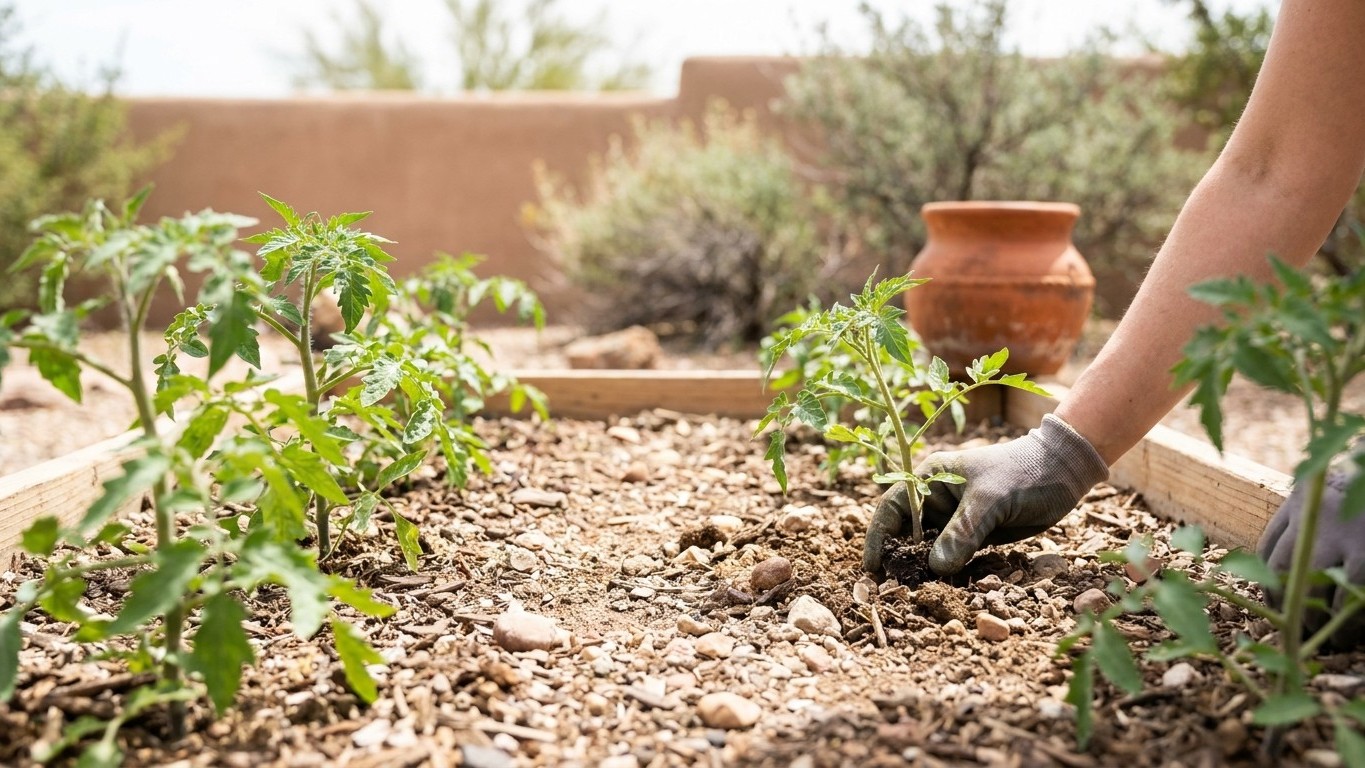

Phoenix freezes so rarely, and so far outside spring, that the whole exercise of counting backward from a last-frost date falls apart before it starts. Six winters out of the past thirty dipped to freezing, and every one of those cold snaps landed between late December and mid-January, nowhere near the weeks when a frost calculation would matter. What actually sets your tomato dates in the low desert is the opposite edge of the year: the heat that arrives and shuts fruit set down for good.
What this comes down to in Arizona

In Phoenix, there is effectively no spring frost to count back from. NOAA’s 1991-2020 climate normals list a 365-day frost-free season at the Phoenix station, and NOAA’s RCC ACIS daily records show a freeze reaching 32°F in only 6 of the last 30 years, always in the late December to mid-January stretch, months before a typical last-spring-frost date would fall on a calendar built for a colder climate. That means the planting-date math this title asks about, counting weeks back from a frost date, does not run in the low desert. There is no frost date to count from, so the low desert’s real planting calendar is built around the season’s other hard limit: heat that shuts down fruit set for months once summer arrives.
The state’s tomato guide already covers growing tomatoes in Arizona in general, soil prep, watering, and staking, while the calendar itself is the focus here. Two related pieces live elsewhere: Tomato Varieties That Ripen in Time in Arizona covers which cultivars actually finish before heat cuts them off, and Tomato Pests in Arizona: Which Ones Actually Show Up Here covers what shows up once plants are in the ground.
Away from Phoenix, in the parts of the state at real elevation, frost is not a formality. USDA’s Plant Hardiness Zone map puts Arizona’s statewide range at zone 4b at the cold end to 10b at the warm end, a spread wide enough that a frost-based calculation is exactly the right tool for those counties, just not with Phoenix’s numbers. Which calculation applies to you depends on which Arizona you garden in, and the next section walks through both versions of the arithmetic.
Working it out for your own garden
Because Phoenix has no reliable last frost, there is nothing to subtract days-to-maturity from in the usual way. The number that actually limits the low desert’s growing window is not a NOAA figure, it belongs to your county extension office. That office sets the local transplant window around leaving enough weeks of mild weather for fruit to set before daytime heat gets high enough to stop it. Once you know that local window, the arithmetic runs the same as it would anywhere else: subtract a cultivar’s days to maturity from the end of the window to see how early you need to transplant, and add it to the start of the window to see roughly when harvest begins.
Running the numbers on two cultivars
Take Sun Gold, a cherry tomato that reaches maturity in 57 days from transplant. If a county’s low-desert transplant window opens toward the end of winter, as most do, a plant set out then starts ripening a little under two months later, comfortably inside the stretch before summer heat typically arrives. Now take Amish Paste, a paste tomato at 85 days from transplant, nearly a month longer. The same start date pushes its harvest a full four weeks later, and in most low-desert years that lands the plant in the weeks when heat has already stopped fruit set, so it may still be flowering with nothing to show for it. The gap between 57 days and 85 days is the whole story: a short-season cultivar clears the window with room to spare, and a long-season one usually does not.
The table below lines up days-to-maturity for several cultivars in this catalogue, so you can see roughly where each one sits before doing the arithmetic for your own county.
| Variety | Days from transplant | Habit | Margin before low-desert heat |
|---|---|---|---|
| Sakura | 55 | Indeterminate | Widest margin of the group |
| Sun Gold | 57 | Indeterminate | Wide margin |
| Juliet | 60 | Indeterminate | Comfortable |
| Celebrity Plus | 78 | Determinate | Tight, needs an early transplant |
| San Marzano II | 78 | Indeterminate | Tight, needs an early transplant |
| Amish Paste | 85 | Indeterminate | Narrowest margin, often runs into heat |
In the state’s higher counties, where a real last-spring-frost date exists, run the same subtraction against your own NOAA station’s frost range instead of Phoenix’s, and build in the extra one to two weeks growers typically add for a young transplant to recover from cold-soil shock before doing the days-to-maturity math off that later date.
What changes across the state
Every figure here is measured at the Phoenix station, and Phoenix sits at the bottom of a wide elevation range. Elevation is what actually changes the calendar across Arizona, far more than latitude does within the state. USDA’s Plant Hardiness Zone map spans zone 4b to 10b across the state, and that six-zone range is the clearest single number for how different the growing season gets between the low desert floor and the high country.
At the cold end of that range, a real spring frost date exists, and it can fall well into the stretch most low-desert gardeners already associate with warm weather. Anyone gardening at elevation should pull their own station’s last-frost range from NOAA rather than borrowing Phoenix’s, because the two numbers are not close enough to substitute for each other. A frost calculation built on Phoenix’s data puts a high-country transplant in the ground weeks too early.
Between those extremes sit the mid-elevation valleys and the transition zone, where the calendar has to account for both hazards at once: a real, if mild, frost risk in winter and a shorter but still meaningful heat shutdown in summer. Gardeners in those counties usually end up with a narrower planting window than either the low desert or the high country, not a wider one, because both ends of their season are constrained.
The mistakes this state punishes

The most common mistake in the low desert is treating the near-absence of frost as permission to ignore timing altogether. Because NOAA’s data shows Phoenix freezes in only a minority of years, it is tempting to transplant on any warm day that shows up. A cold snap that reaches 32°F, when it happens, lands specifically in the late December to mid-January stretch, so a transplant set out earlier in that window still carries real risk even though the season as a whole rarely freezes. Warm weather in December or early January is not a signal that cold risk has passed.
The second mistake is choosing a long-season cultivar for a low-desert garden without checking the arithmetic first. Amish Paste at 85 days from transplant and San Marzano II at 78 days are both excellent tomatoes, but in a climate where the growing window is set by heat rather than frost, every extra week of days-to-maturity is a week that has to come out of an already tight window. A gardener who plants a 78-to-85-day paste tomato on the same date they would plant a 55-to-60-day cherry tomato like Sakura or Sun Gold is not comparing like with like, and only one of the two has real room for error.
The third mistake is applying the low desert’s numbers to a high-country garden, or the reverse. These figures come from the Phoenix station specifically, and a gardener in the state’s cooler counties who borrows them will transplant far too early for their real frost risk. The fix in all three cases is the same: work the arithmetic from the section above with your own county’s numbers, not a date remembered from somewhere else in the state.
Checking this against your county
Everything above is anchored to one weather station in Phoenix, and Arizona’s county extension offices exist precisely because a single station cannot speak for the whole state. Before committing to a transplant date, check your county’s own office through the University of Arizona’s extension directory at extension.arizona.edu, which can point you to local frost data and tested transplant windows for wherever you actually garden. Treat every number here as a Phoenix starting point, not an instruction for your own yard. If your county sits at a different elevation, in the transition zone, or in the high country, its figures should override these.
Some gardeners also time this by the Moon: when to plant tomatoes by the moon, as almanac tradition rather than fact.
Common questions
Do I even need to worry about frost dates for tomatoes in Phoenix?
Rarely. NOAA’s 1991-2020 climate normals list a 365-day frost-free season for the Phoenix station, and a freeze only reached 32°F in 6 of the last 30 years, always in the late December to mid-January stretch. Heat, not frost, is what actually limits the low-desert calendar.
Can I just plant tomatoes year-round since it never freezes?
No. A frost-free winter does not mean fruit sets year-round. Once summer heat arrives, tomatoes drop blossoms and stop setting fruit for months regardless of how mild the previous winter was, which is why low-desert growers plan around two separate windows rather than one continuous season.
Does this planting window apply to Tucson or Flagstaff too?
Not directly. Check your own county extension office for the numbers that actually apply where you garden.
Why did my tomato plant stop flowering in the middle of summer?
That is almost certainly heat, not a disease or a watering problem. Once the low desert’s summer heat sets in, tomato blossoms fail to set fruit for an extended stretch, and the plant can look otherwise healthy while producing nothing until conditions ease later in the year.