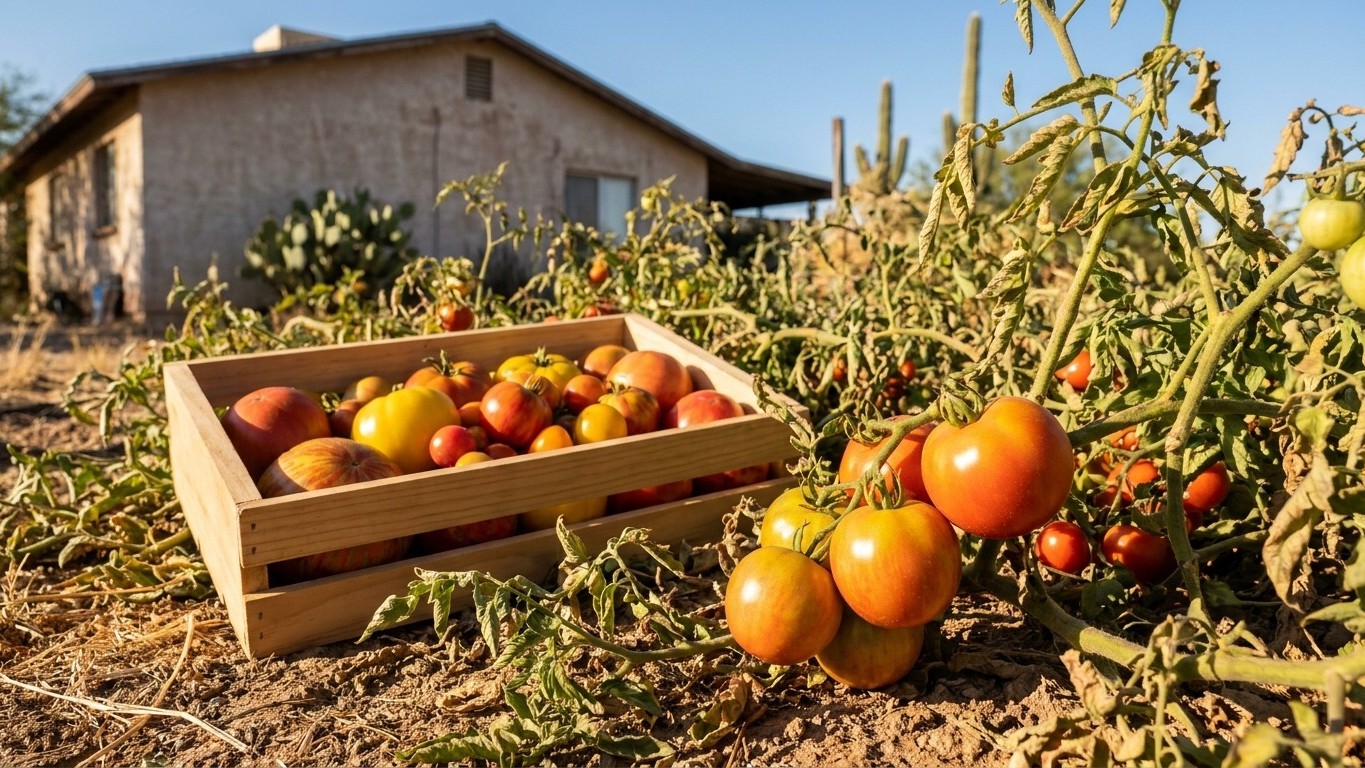

Phoenix’s low desert almost never sees a killing frost. NOAA’s 1991-2020 climate normals list the frost-free season at the Phoenix station as a full 365 days, and NOAA’s NCEI and RCC ACIS daily records show a freeze reached only 6 of the last 30 winters, always somewhere between late December and mid-January. That means “ripening in time” here has nothing to do with outrunning frost. It means matching a variety’s days to maturity to the mild stretch before summer heat shuts fruit set down, or aiming it at a short fall window instead. Start by checking a cultivar’s days-to-maturity number against that reality, not against a frost date that mostly doesn’t apply.
What this comes down to in Arizona

In most of the country, tomato variety choice is a frost problem. In Phoenix and the rest of the low desert, it is a heat problem: once temperatures climb through late spring, blossoms stop setting fruit for months, and they don’t reliably start again until the heat breaks in fall. A tomato that needs 85 days from transplant has to find those days somewhere in a calendar that is short on mild weather at both ends. This page assumes you’ve already worked through the basics of growing tomatoes in Arizona and just want to know which named varieties actually finish before that heat, or before the rare cold snap on the other end, catches them.
The list below runs from the shortest catalogue days-to-maturity to the longest, so you can see where the line falls for your own setup. All of these figures are the seed packet’s count from transplant, not from seed, and they shift by a week or two depending on the season, so treat them as a starting point rather than a guarantee.
Sakura
Sakura is a cherry tomato listed at 55 days from transplant, the shortest on this list, which makes it one of the safest bets for either end of the Arizona season. It carries intermediate resistance to nematodes and high resistance to Tomato Mosaic Virus and Fusarium Wilt races 1 and 2. Because it finishes so fast, it can slot into a narrow spring window or a compressed fall one without much risk of running out of mild weather.
Sun Gold
Sun Gold needs about 57 days from transplant and produces small, sweet fruit in long clusters, good for snacking rather than sauce. It resists Tobacco Mosaic Virus and Fusarium Wilt race 1, both at high levels. Its short season gives it the same flexibility as Sakura, and it’s usually the first thing ripening in a low-desert garden once fruit set finally kicks in.
Jasper
Jasper comes in at 60 days from transplant and carries high resistance to Late Blight plus intermediate resistance to Early Blight, useful if humidity spikes during monsoon season. The fruit is a uniform, deep red cherry tomato good for salads. At 60 days it still fits comfortably inside a short window, with more margin for error than anything past 70 days.
Amalfi
Amalfi is a determinate paste tomato at 68 days from transplant, bred for sauce rather than slicing. It carries intermediate resistance to nematodes, Late Blight and Early Blight. Being determinate, it sets most of its fruit in one flush, which can work in Arizona’s favor if that flush lands squarely inside the mild window rather than getting spread out into the heat.
Cherokee Purple
Cherokee Purple is an heirloom beefsteak at 72 days from transplant, prized for its dusky, dark-shouldered fruit and rich flavor, but it carries none of the disease resistance bred into the hybrids on this list. At 72 days it’s already pushing into territory where the spring window in the low desert can run out before the fruit finishes, so it rewards an early, healthy transplant more than most.
Big Beef Plus
Big Beef Plus is a 72-day indeterminate slicer with intermediate resistance to nematodes and high resistance to Gray Leaf Spot and Tomato Mosaic Virus. It’s a workhorse variety for a full-size sandwich tomato, and its disease package gives it an edge over an heirloom at the same days-to-maturity when the season runs tight.
San Marzano II
San Marzano II is a classic Italian paste type at 78 days from transplant, indeterminate, with no listed disease resistance on this list. Seventy-eight days is a long ask in a climate where the mild window is the scarce resource, so this one needs a transplant date on the early side of whatever range your garden allows, with little room to slip.
Amish Paste
Amish Paste is an heirloom paste tomato at 85 days from transplant, the longest on this list, valued for its size and flavor in canning. Eighty-five days is genuinely difficult to fit into either the spring or fall side of Arizona’s calendar without the fruit still ripening as heat or the rare winter cold snap arrives. It’s worth growing if you have the patience and a favorable microclimate, but go in knowing it’s the variety most likely to run out of season here.
Working it out for your own garden
The one date range NOAA actually gives Phoenix growers is the rare freeze window itself: late December to mid-January, when a cold snap has shown up in 6 of the last 30 winters according to NOAA’s NCEI and RCC ACIS station records. You can use that range as an anchor to check whether a fall crop of a given variety has any real chance of finishing before that risk period opens, even though it only materializes some years.
The arithmetic, shown in weeks
Take a variety’s days-to-maturity, convert it to weeks, and count back from both ends of the freeze window to get a transplant range, not a single date.
| Variety | Days to maturity | Roughly in weeks | Transplant range counted back from the freeze window | Fits before the risk window? |
|---|---|---|---|---|
| Sun Gold | 57 days | about 8 weeks | late October to mid-November | Yes, with margin |
| Big Beef Plus | 72 days | about 10 weeks | mid to late October | Tight, little margin |
| Amish Paste | 85 days | about 12 weeks | late September to mid-October | Falls where heat still lingers |
Sun Gold’s required transplant range lands in weather that has usually cooled off, so there’s real slack in the calculation. Amish Paste’s required range falls right where the low desert is often still too hot for tomato transplants to establish well, which squeezes an already tight fall window from both sides. This is exactly the method to run for any variety, not just the three named here, and it’s the same arithmetic covered in more depth on our Tomato Planting Dates in Arizona: Counting Back From Your Frost Window page if you want the full calendar worked out.
What changes across the state
Every figure above is anchored to the Phoenix station, and Phoenix is only one point in a state that runs from below sea level to well over ten thousand feet. The USDA’s 2023 Plant Hardiness Zone Map, built on the 1991-2020 normals, puts Arizona’s range at zones 4b through 10b, which is one of the widest spans of any state and reflects that elevation swing more than latitude.
Flagstaff and the rest of the high country sit in a completely different climate from the low desert. They get real, hard freezes on a normal schedule, and the growing season there is short and frost-bound in the way most of the country experiences tomatoes, nothing like the heat-limited calendar described above.
Even within the low desert, elevation and distance from the valley floor shift things by degrees that matter for a marginal variety. Higher-elevation desert towns tend to see summer heat arrive a little later and ease off a little earlier, which can buy a long-season variety like Amish Paste a bit more usable window than it would get directly in Phoenix. None of that changes the arithmetic method, only the numbers you feed into it, and those numbers should come from your own nearest station rather than an average pulled from across the state.
The mistakes this state punishes

The two mistakes that cost Arizona gardeners a crop both come from importing habits that make sense somewhere else.
- Treating the rare freeze window as either a guarantee or a non-event, instead of the 6-in-30-years risk NOAA’s records actually show it to be.
- Choosing a long-season variety like San Marzano II or Amish Paste for a fall crop without running the days-to-maturity arithmetic first.
- Assuming a mild stretch during the freeze-risk period means it’s safe to transplant tender seedlings.
- Ignoring the pests that show up right as fruit set resumes after the heat breaks.
The biggest one is planting a long-season slicer or paste variety for a fall harvest and only realizing the timing doesn’t work once green fruit is sitting on the vine as the calendar runs out. Running the arithmetic before you buy transplants, the way the table above does, catches this before it costs a season. The second is trusting that because a freeze hasn’t shown up in years, it never will. A cold snap inside that window can still damage a plant that’s already carrying young fruit, so keep some frost cloth on hand through the risk period rather than assuming the odds are in your favor.
The third mistake is a timing one shared with the crop’s other seasonal pressures: whatever pest shows up as the plant resumes fruiting after the heat break can undo a whole fall crop if you’re not watching for it, which is covered in more detail on our Tomato Pests in Arizona: Which Ones Actually Show Up Here page.
Checking this against your county
Everything above is built from a single Phoenix-area weather station, and Arizona’s counties differ enough in elevation and microclimate that a Yuma garden and a Prescott garden can be running two different calendars entirely. Before locking in a variety and a planting date, check your county’s cooperative extension office through the University of Arizona’s extension directory at extension.arizona.edu, which is the right first stop for local frost and heat data specific to your area.
Common questions
Can I even grow an 85-day tomato in Phoenix?
You can, but the arithmetic above shows why it’s the hardest variety on this list to fit in. Amish Paste’s transplant window lands right where the low desert is often still too hot to establish seedlings well, so expect less margin for error than with anything under 70 days.
Do I really not need to worry about frost in Phoenix?
Mostly no. NOAA’s NCEI and RCC ACIS records show a freeze reached the Phoenix station in only 6 of the last 30 winters, always between late December and mid-January, so it’s a real but infrequent risk rather than a yearly event worth building a whole calendar around.
What if I’m gardening in Flagstaff instead of Phoenix?
The high country sits in a much colder USDA hardiness zone within the state’s overall 4b-10b range, gets hard freezes on a predictable schedule, and needs its own frost-based calculation, which your county extension office can help pin down.
Which variety on this list gives me the best shot at a quick fall crop?
Sakura, at 55 days from transplant, gives the most slack of anything named here. Its short season means it can still finish even if lingering heat delays your transplant date past what a longer-season variety like Big Beef Plus or San Marzano II could tolerate.