
Arizona’s tomato pest list runs to about half a dozen insects plus one soil-borne nematode, and which ones you’re fighting depends on the month more than the county. Near Phoenix, NOAA’s 1991-2020 climate normals show almost no reliable winter freeze, so pest populations carry over from one season into the next instead of dying back. Check the undersides of leaves every week starting at the seedling stage, since most of these pests do their real damage before they’re visible from across the row.
What this comes down to in Arizona

Arizona winters don’t kill much. That’s the difference nobody mentions when they hand you the standard tomato pest list built for places with a hard frost to reset the clock every year. Here, aphids and whiteflies can ride out a mild December in a weedy corner of the yard and be back on your transplants by February, while flea beetles just wait out the cold and start chewing the moment seedlings go in. The cast is short, but it never fully leaves.
The pests that matter here are the ones that can either survive a mild winter outdoors or move in on their own once the weather warms. The list is short, but it doesn’t sit still through a long Arizona growing season, and it changes character from spring through fall.
Aphids
Aphids show up first, often on the tender new growth of transplants set out while nights are still cool. They’re pear-shaped, soft-bodied insects about 1/16 to 1/8 inch long, colored pale green or black, clustered on leaf undersides and stem tips. Both nymphs and adults feed by sucking sap, which curls new leaves and coats them in sticky honeydew that grows black sooty mold. A strong jet of water knocks small colonies off, and insecticidal soap handles the rest without harming pollinators.
Flea Beetles
Flea beetles arrive around the same time, chewing tiny round holes through the leaves of young seedlings before the plants have much size to spare. The adults are shiny black beetles barely 1/16 inch long, with enlarged back legs that let them jump the moment a leaf is disturbed. The shot-hole feeding rarely kills an established plant, but it can stunt a transplant badly enough to push back the whole fruiting timeline. Floating row cover over the bed until plants have four or five true leaves keeps the beetles off during the vulnerable stage.
Whiteflies
Whiteflies build as the weather warms, and by midsummer they can be the dominant pest in an Arizona tomato patch. Adults are tiny, pure white, moth-like insects about 1/16 inch long that cluster on leaf undersides and rise in a visible cloud when a branch is shaken. Both the immobile nymphs and the winged adults feed on sap, and whiteflies also spread certain viruses between plants as they move through a planting. Yellow sticky traps give an early warning, and insecticidal soap or horticultural oil applied to the leaf undersides breaks up an established colony.
Spider Mites
Spider mites, mainly the two-spotted spider mite, hit hardest during the hottest, driest stretch of the season, when heat suppresses their natural predators. They’re barely visible without a hand lens, pale yellow to reddish-tan and clustered on leaf undersides, and a heavy infestation leaves fine silk webbing across the foliage. Feeding by both nymphs and adults shows up first as a dull, stippled or bronzed look on the upper leaf surface. Regular overhead water in the early morning disrupts the dry conditions mites favor, and horticultural oil or insecticidal soap controls an active infestation once confirmed.
Tomato Hornworm
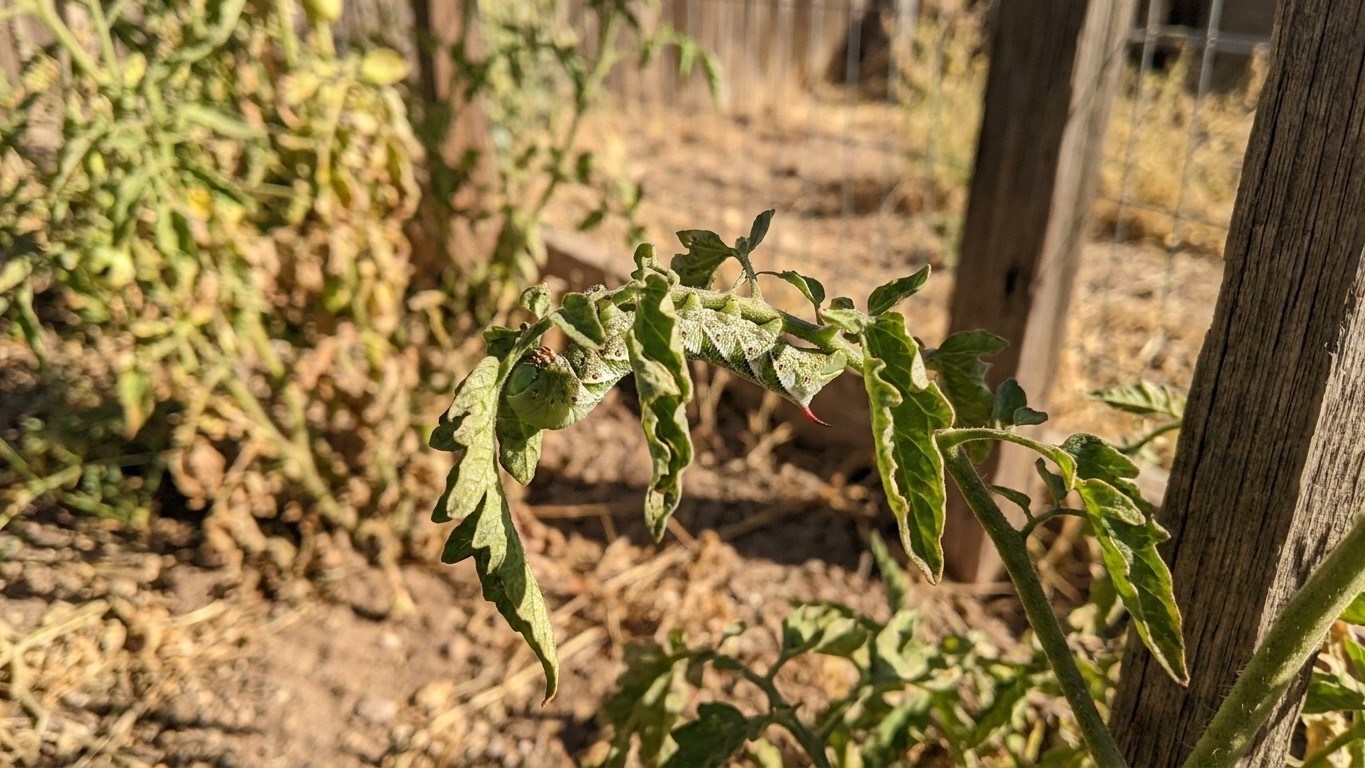
Tomato hornworms feed through the hottest part of summer and into early fall, and one caterpillar can strip a branch of foliage in a couple of nights. It’s a large, plump caterpillar up to 4 inches long, pale green with white diagonal stripes down each side and a curved dark horn at the tail, and it’s this larval stage that does all the damage. Look for dark green or black droppings on the leaves below before you spot the caterpillar itself, since its coloring blends into the foliage almost perfectly. Handpicking works well on a home planting, and Bacillus thuringiensis controls larger outbreaks without harming the parasitic wasps that also keep hornworms in check.
Leaffooted Bug
Leaffooted bugs move in as fruit starts to ripen, usually the last pest to arrive in an Arizona tomato season and often the hardest to control once established. The adult is brownish-gray, about 3/4 to 1 inch long, with a flattened, leaf-shaped widening on each hind leg that gives the insect its name. Adults and nymphs both pierce ripening fruit to feed, leaving hard, pale spots or cloudy patches under the skin that only show up when the tomato is cut. They’re strong fliers moving in from nearby weeds or wild hosts, so clearing that vegetation and hand-picking early in the morning while they’re sluggish does more than spraying an established group.
Root-Knot Nematode
Root-knot nematode isn’t an insect at all, and it’s common in Arizona’s sandy, fast-warming garden soil regardless of what’s happening above ground. The nematode itself is microscopic, so the tell isn’t a sighting but small, round knots or swellings along the roots when a struggling plant is pulled and rinsed clean. Above ground, an infested plant wilts in the heat of the day even when the soil is moist, and it yields less fruit than a healthy plant beside it. Since resistance is bred into the plant rather than sprayed on, choosing a variety with nematode resistance coded on the packet, such as Celebrity Plus, Big Beef Plus, or Granadero, works better than any soil treatment, an approach covered in more depth at Tomato Varieties That Ripen in Time in Arizona.
Working it out for your own garden
The fastest way to work out which pest you actually have is to work backward from the plant part that’s damaged and the point in the season, rather than trying to match a photo of an insect glimpsed for half a second. Aphids and flea beetles turn up on new transplants set out early in the season, the same window covered on Tomato Planting Dates in Arizona: Counting Back From Your Frost Window, while whiteflies and spider mites build once the days get properly hot. Hornworms and leaffooted bugs are a mid-to-late-season problem, showing up once the plant has real size and fruit on it. Root-knot nematode is the outlier: it’s present in the soil from the day of transplant, and it only becomes visible above ground once summer heat pushes a compromised root system past its limit.
| Pest | Where damage shows | What you see | When it shows up |
|---|---|---|---|
| Aphids | New leaves, stem tips | Curled leaves, honeydew, sooty mold | Early season |
| Flea beetles | Young leaves | Small round shot-holes | Early season, on seedlings |
| Whiteflies | Leaf undersides | Cloud of tiny white insects when disturbed | As heat builds |
| Spider mites | Leaf surface and undersides | Stippled, bronzed leaves, fine webbing | Hottest, driest weeks |
| Tomato hornworm | Whole branches | Stripped foliage, droppings below | Mid to late summer |
| Leaffooted bug | Ripening fruit | Cloudy or pale spots under the skin | Once fruit is ripening |
| Root-knot nematode | Roots | Round knots or swellings on roots | All season, worse in heat |
Once the plant part and the timing line up with one row of that table, confirm it by actually looking: aphids and whiteflies wash off onto a white sheet of paper held under the leaf, hornworm droppings are hard to miss once you know to check the ground, and a root pulled from a wilting plant either has smooth roots or it doesn’t. The one that’s easy to misdiagnose is a virus carried by whiteflies rather than the whitefly feeding itself. A plant with mottled, curling new growth despite no visible insects has probably already been infected, and no spray reverses that. At that point, starting the next planting with a virus-resistant cultivar matters more than any pest control step taken now.
What changes across the state
Every figure above comes from the Phoenix area, and Arizona’s elevation range means the pest calendar shifts hard as you move away from the low desert. USDA’s hardiness zone map puts the state anywhere from zone 4b in the high country down to 10b in the low desert, a spread of nearly six full zones, and that changes which pests can survive winter at all in a given spot.
Flagstaff and the rest of the high country freeze hard every winter, unlike Phoenix’s near frost-free run, and that freeze does the job Phoenix’s mild winters can’t. It knocks back overwintering aphid and whitefly populations and shortens the window root-knot nematode has to build up in the soil before the ground cools. Gardeners at elevation generally see a shorter pest season overall, compressed into the frost-free months, while low-desert gardeners deal with the same pests moving in and out over a much longer stretch of the year.
Distance from open desert or weedy ground matters too. Leaffooted bugs and their relatives breed on wild hosts nearby, and a garden backed up against undeveloped desert or an unmowed field tends to see heavier late-season pressure than one surrounded by other irrigated yards. Spider mites favor dry, dusty conditions and are usually worse next to a gravel yard or unpaved lot than in a garden with more surrounding vegetation and humidity. None of this changes which species show up statewide, but it changes how early they arrive and how long they stay a problem.
The mistakes this state punishes

The biggest mistake is treating a mild Arizona winter as a clean slate. Because Phoenix rarely gets a real freeze, whitefly and spider mite populations built up on a fall planting can carry straight through into spring on old plant debris, nearby weeds, or a volunteer plant left in the ground. Pulling old plants and clearing weedy borders at the end of each season matters more here than in a climate with a hard winter to do that work automatically.
A second mistake is spraying a broad-spectrum insecticide the moment a hornworm or aphid shows up, which also wipes out the parasitic wasps and lady beetles that would otherwise keep both in check through the rest of the long Arizona season. Because the growing season here runs longer than in most states, killing off the beneficial insects early means facing every later generation of the same pest with no natural help left.
A third is ignoring root-knot nematode until a plant is wilting in the afternoon heat, then blaming the heat itself. By the time above-ground symptoms show, the root system is already damaged and nothing reverses that mid-season. Checking the roots of one struggling plant early, rather than waiting for the whole row to decline, leaves enough time to plan a resistant variety for the next planting instead of losing the same bed to the same problem again.
Checking this against your county
Everything above is a starting point built from the Phoenix area, and it won’t match every county exactly. Cochise County’s higher elevation, Yuma’s earlier heat, and the cooler nights around Flagstaff all shift the pest calendar in ways a single weather station can’t capture. The University of Arizona Cooperative Extension, at extension.arizona.edu, keeps county offices that track local pest pressure and can confirm an identification from a sample or a photo. Before treating anything based on a guide like this one, a call to the county office is the fastest way to check whether what’s described here matches what’s actually established in your area.
Common questions
My tomato leaves are curling but I don’t see any bugs, what is it?
Check for stippling, webbing, or sticky honeydew first, since aphid or spider mite feeding can taper off before you spot the insects themselves. If the leaves are curling uniformly with no stippling, sooty mold, or webbing anywhere on the plant, it’s more often heat or watering stress than a pest, especially during the hottest stretch of an Arizona summer.
Do ladybugs actually work against aphids in an Arizona garden?
Purchased ladybugs mostly fly off within a few days of release and rarely stay long enough to control an established aphid colony. A more reliable approach is leaving a few aphids uncontrolled on a sacrificial plant early in the season, which draws in and holds native predator populations for the rest of the year.
Can I compost a tomato plant that had root-knot nematode?
It’s safer not to. A home compost pile rarely reaches the sustained heat needed to kill nematodes reliably, so an infested plant can reintroduce the problem when that compost goes back into the garden. Bagging and trashing the plant, then rotating that bed or container to a different crop, is the more dependable route.
Should I cover my tomatoes with insect netting for the whole season?
Netting earns its keep early, over seedlings that are vulnerable to flea beetles and aphids, but it should come off once the plant starts flowering. Tomatoes pollinate themselves, but netting still traps heat and blocks the air movement that helps fruit set, so leaving it on through summer usually costs more than it saves.