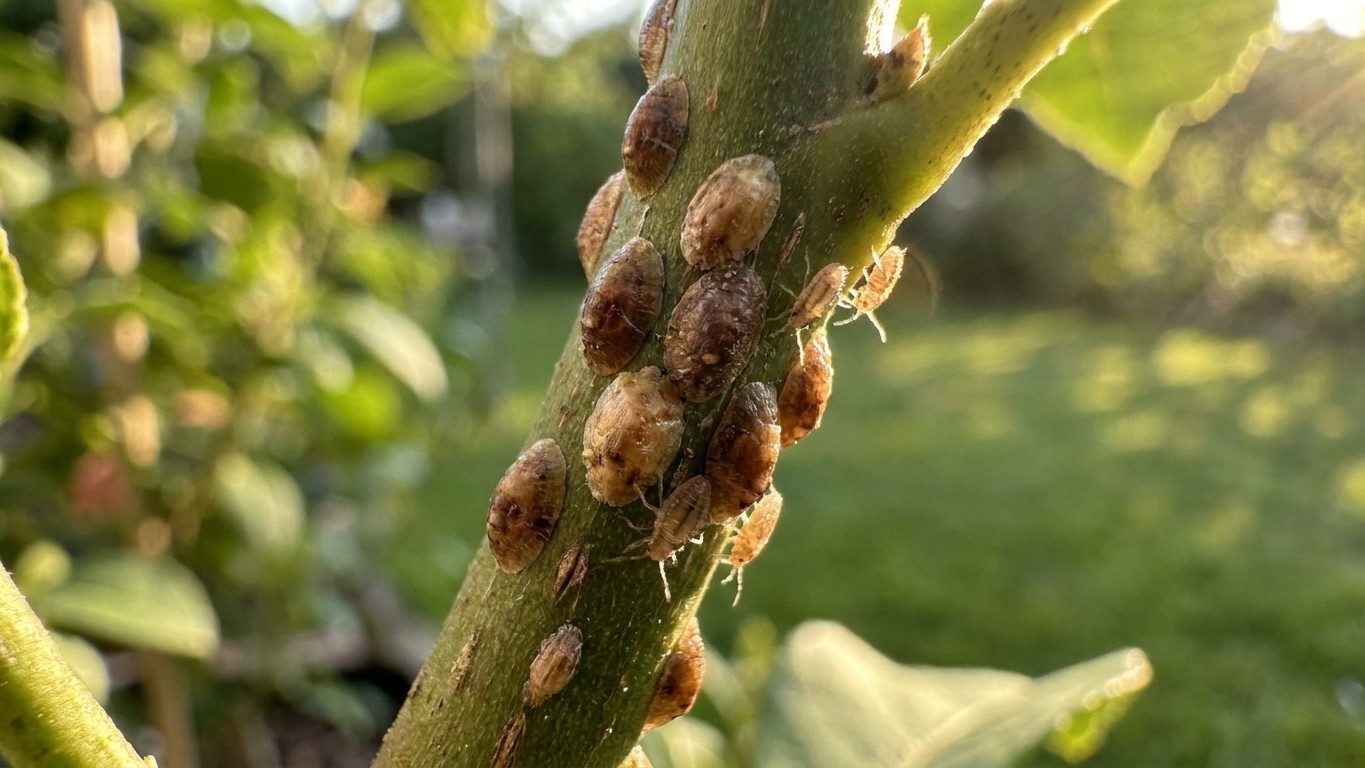

Scale insects show up in Arkansas from late spring through summer, a much longer stretch than the tidy few-week windows tracked for other yard pests. The University of Arkansas Division of Agriculture Cooperative Extension publishes a clear summer calendar for Japanese beetles, squash vine borers, and squash bugs, but nothing built specifically around scale. What actually stops scale insects isn’t a calendar date at all. It’s catching the crawler stage before the waxy shell hardens, and cutting out the branches where they spend the winter.
The weeks to watch

Scale insects in Arkansas stay active from spring green-up straight through fall, with no single named flight the way squash vine borers or Japanese beetles have. The University of Arkansas Division of Agriculture Cooperative Extension lays out a summer window for Japanese beetle (June through August), Squash vine borer (adults in June, a second generation in August), and squash bugs (present all summer), but that page does not name a window for scale insects specifically. That gap matters for how you plan: scale doesn’t follow a printed schedule here, it follows plant growth and temperature.
Spring crawler emergence
The first mobile stage, called the crawler, moves out from under the mother scale’s covering once new growth starts pushing on host plants. This is the only period when the insect isn’t protected by a wax or shell, and it’s the stage every effective home treatment targets. Without a state-specific date, the practical move is to watch the plant, not the month: check tender new shoots as soon as they appear.
Summer generations
Some scale species produce one generation a year, others produce two or three, overlapping through the same June-to-August stretch that the extension service flags for other summer pests. That overlap means a plant can carry crawlers, immature scale, and mature adults all at once by midsummer, which is part of why scale infestations often look worse in August than they did in June.
Reading the calendar from your last spring frost
Scale insects answer to soil and air warmth, not to a fixed date, so an early or late spring shifts everything by a couple of weeks either direction. NOAA’s 1991-2020 climate normals put the last spring frost for this part of Arkansas somewhere between March 12 and March 28, a range, not a single day. For tender plants, the National Weather Service in Little Rock uses a tighter 36-degree threshold instead, giving April 3 in spring and October 31 in fall.
- Mark your frost window: March 12 to March 28 for a hard freeze, or April 3 if you’re protecting tender growth by the 36-degree standard.
- Once nighttime lows stay reliably above that mark, host plants push new growth and scale crawlers become active in the weeks that follow, not on a set day. There’s no published week-count for scale specifically, so check new shoots regularly rather than counting off a calendar.
That means a cover, a prune, or a dormant-oil application timed to the frost window still has to be adjusted plant by plant. A crapemyrtle leafing out two weeks early after a mild March will show crawler activity two weeks earlier than the same tree the following year.
What it attacks, and what the damage looks like

Most Arkansas gardeners notice scale before they ever see the insect itself. Leaves turn yellow and drop out of season, branches die back one at a time, and a sticky film called honeydew coats leaves and anything sitting underneath, often followed by a black sooty mold growing on top of that residue. Look closer at the stems and you’ll find small waxy or shell-like bumps that don’t brush off easily, since that covering is what protects the feeding insect underneath.
The bumps themselves rarely move. That’s because only the crawler stage travels; once a scale settles in to feed, it stays fixed in one spot for the rest of its life, protected by its shell while it draws sap through piercing-sucking mouthparts. That single detail decides what still works: contact treatments only reach the insect while it’s an exposed crawler, before that covering forms.
Host plants across Arkansas landscapes and homes commonly include:
- Crapemyrtle, holly, and magnolia in the yard
- Apple, peach, and other fruit trees
- Citrus, ferns, and other houseplants brought indoors for winter
How Arkansas sits in this pest’s range

Scale insects are documented on this site for one territory so far, which is Arkansas itself. That’s a narrow slice of coverage, not a claim about where the insect is common or rare. Biologically, scale insects turn up across nearly every state, on ornamentals, fruit trees, and houseplants alike, so there’s no reason to treat Arkansas as an edge case for the pest itself. What’s missing is a side-by-side timing comparison, since no neighboring state’s data has been published here yet to set against the University of Arkansas Division of Agriculture Cooperative Extension’s own summer pest calendar.
That absence of a species-specific state window ties back to the same gap noted earlier: the extension service names peak periods for Japanese beetle, Squash vine borer, and squash bugs, but not for scale. Until that changes, the most reliable local guidance stays plant-by-plant observation paired with the general frost-date arithmetic above, rather than a printed date on a state map.
What actually works against it

- Prune out heavily infested twigs and branches during dormant season. Removing the wood where females overwinter cuts next spring’s crawler population directly, and it costs nothing but time.
- Apply dormant-season horticultural oil before bud break. Oil smothers the overwintering scale by coating its shell, which is the one stage still reachable before new growth starts.
- Monitor for crawlers with sticky tape or a hand lens as new growth appears. This is the narrow window when contact sprays and insecticidal soaps can still reach the insect, since the protective covering hasn’t formed yet.
- Hold off on broad-spectrum treatments and let natural predators work. Lady beetles and parasitic wasps feed on scale, and knocking them back with unnecessary spraying tends to make outbreaks worse the following season.
- Wipe visible scale off houseplants by hand. Many gardeners use rubbing alcohol on a cotton swab for houseplant scale; it’s a common practice, though controlled trials on how well it works aren’t conclusive.
Once a scale has settled and grown its waxy or armored covering, sprays and wipes mostly stop working, since the shell blocks contact treatments from reaching the insect underneath. At that point, pruning out the affected wood is the only measure left that actually removes the problem rather than working around it.
Common questions
Does the University of Arkansas Division of Agriculture Cooperative Extension name a treatment date for scale insects?
No. Its published summer pest calendar covers Japanese beetle, squash vine borer, and squash bugs by name, but it does not give a specific window for scale insects, so timing has to come from watching new growth on the affected plant instead.
Can I use the same frost date for scale that I use for my vegetable garden?
The frost window itself, March 12 to March 28 for a hard freeze or April 3 for tender growth by the 36-degree standard, applies statewide regardless of the plant. But scale crawler activity follows how quickly your specific host plant leafs out afterward, which varies year to year.
Is scale on a houseplant the same problem as scale on a crapemyrtle outdoors?
The insect group and the basic biology, an immobile shelled adult and a brief exposed crawler stage, are the same either way. The difference is mainly host plant and setting: indoor infestations tend to run year-round since there’s no winter dormancy indoors, while outdoor scale in Arkansas follows the seasonal pattern described above.