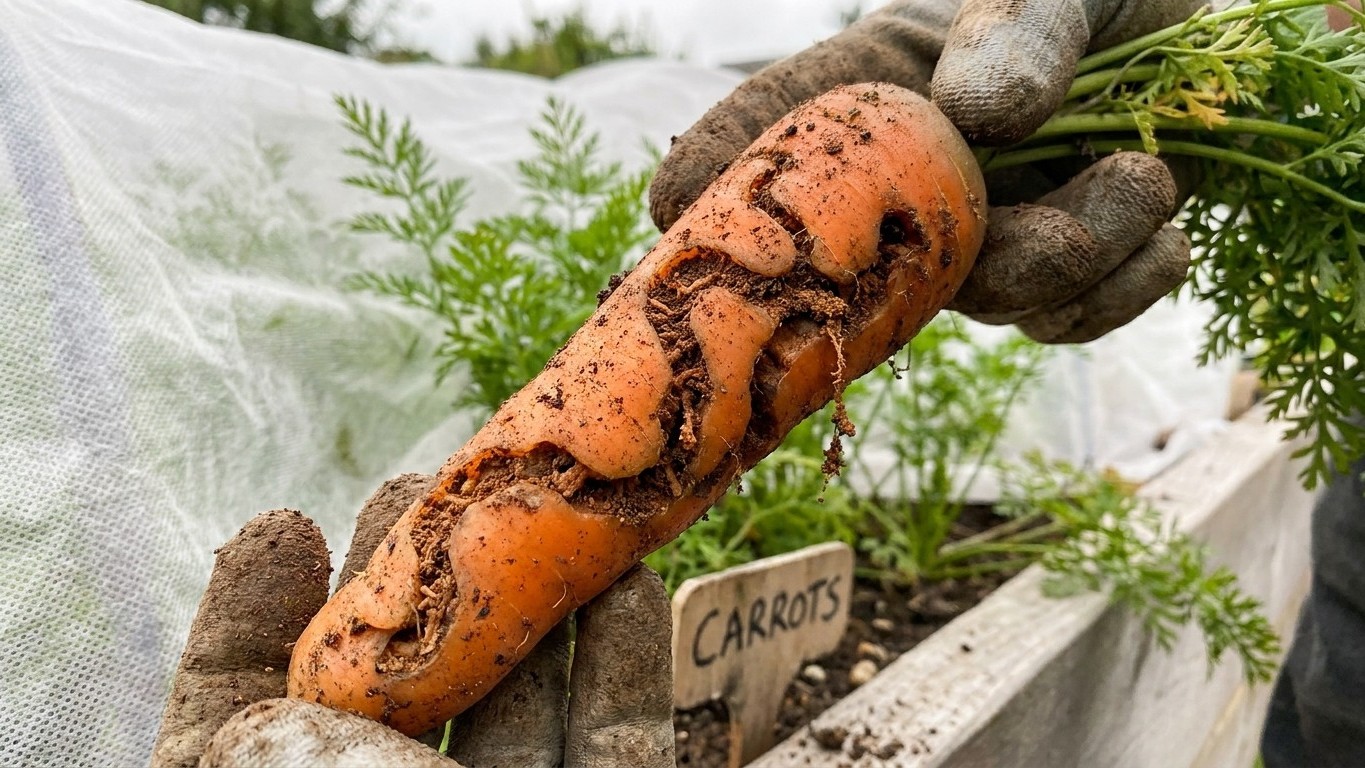

Carrot rust fly larvae start feeding on BC roots as early as May along the coast, with a second wave of maggots showing up in August and September. The fly itself is small and easy to miss: a shiny black body about a fifth of an inch long, topped with a yellow-orange head and matching legs. What gardeners actually notice is the damage weeks later, when carrots pulled from the ground show rusty brown tunnels running through the flesh. Row covers installed before the first flight, tight crop rotation, and harvest timing that dodges the second generation are what actually keep this pest out of the root cellar.
When Carrot Rust Fly Shows Up in BC Gardens

Timing depends heavily on where in the province you’re gardening. Coastal areas, including the Fraser Valley, the Lower Mainland, and Vancouver Island, run mild and damp for most of the growing season, and that’s exactly the combination this insect prefers. Adult flies emerge from overwintering pupae once soil temperatures hold around 53-57°F (12-14°C) for a stretch of days, which on the coast often lands in mid-to-late April or early May. A second generation follows in late July through September, feeding on later-planted carrots, parsnips, and celery right through fall.
Interior BC tells a different story. The Okanagan and similar drier, hotter zones see lower pest pressure overall, and some seasons produce only a single generation rather than two. Heat above roughly 77°F (25°C) slows adult activity and egg-laying, so the hot, dry stretches common in July and August in the interior actually work against the fly. That doesn’t mean interior gardeners are off the hook. It means the window of risk is narrower and tends to cluster around spring planting rather than stretching across the whole season.
The insect overwinters as larvae or pupae just below the soil surface, often right where last year’s carrot bed sat. That’s the detail that makes crop rotation so effective and so frequently ignored: the next generation is quite literally waiting in the same dirt.
Spotting the Damage Before You Pull the Root
Above ground, infested plants sometimes show subtle reddish or yellowing foliage, a stress response to root feeding that’s easy to write off as nutrient deficiency. It’s the root itself that gives the clearest verdict. Split a suspect carrot lengthwise and look for narrow, winding tunnels stained rust-brown, sometimes with a small cream-colored maggot still inside if you catch it early enough in the damage cycle.
Secondary rot is the bigger problem for storage. Those tunnels open the root to soil bacteria and fungi, so a carrot that looked merely cosmetically damaged at harvest can turn to mush in the root cellar a month later. Growers who’ve lost a stored crop this way usually didn’t see it coming, because the surface damage looked minor at pull time.
Carrots aren’t the only target. Parsnip, celery, celeriac, parsley, and dill all belong to the same plant family (Apiaceae) and all host this fly’s larvae. Wild carrot and Queen Anne’s lace growing along fence lines or ditches act as a reservoir too, letting populations persist even in years when nobody’s planting carrots nearby.
What Actually Stops It: Region-Specific Control
No single tactic handles carrot rust fly on its own. Combining a few methods, timed to the local emergence window, is what separates a clean harvest from a wormy one.
Row Covers: Timing Beats Mesh Size Arguments
Floating row covers are the single most reliable barrier, provided they go on before adults emerge and stay sealed at the edges. On the coast, that means covering by mid-April for spring-sown carrots. The mesh needs to be fine enough to block a fly roughly the size of a small housefly, and the edges need to be buried or weighted, since females will find any gap. Covers left loose at one corner are a common failure point growers report after the fact.
For fall crops meant to dodge the second flight, covers should go back on by late July, before that August emergence gets underway.
Crop Rotation and Spacing
Because pupae overwinter in the soil where the previous crop grew, moving carrots and their relatives to a different part of the garden each year breaks the cycle. A rotation gap of at least two to three years is the general guidance, and distance matters too: planting this year’s carrots even 50 feet from last year’s bed reduces the odds of a fresh generation walking straight into the new crop, since adult flies aren’t strong flyers.
Removing volunteer carrots and cutting back nearby wild carrot or Queen Anne’s lace closes off the backup food source that lets populations survive a rotation gap anyway.
Planting and Harvest Timing
Delaying carrot sowing until after the first spring flight has passed, then harvesting before the second flight lays eggs in late summer, sidesteps a lot of damage without any product or barrier at all. In coastal BC that often means holding off on the main carrot planting until early June and getting the crop out of the ground by mid-to-late August, ahead of the fall emergence. It’s a tighter window than most seed packets suggest, but it lines up with what actually happens in local soil rather than a generic national planting chart.
Soil-Level Controls
Beneficial nematodes, specifically species like Steinernema feltiae, can be applied to moist soil to attack larvae before they reach the root. Timing the application to coincide with egg-laying, rather than after damage is already visible, gives them a fighting chance. Diatomaceous earth worked into the soil surface around the base of plants offers another physical barrier for young larvae trying to burrow down, though it needs reapplying after rain.
Seed catalogs sometimes advertise “resistant” carrot varieties, often marketed under names suggesting fly tolerance. Results in real gardens are mixed at best. These varieties may reduce egg-laying somewhat, but they aren’t a substitute for row covers or rotation, and treating them as a standalone fix is how a lot of gardeners end up disappointed in September.
Coastal vs Interior: Building a Control Plan That Fits Your Climate
A grower in Nanaimo or Chilliwack is fighting a two-generation pest in a climate that barely gives the soil a chance to dry out between rains, which argues for row covers staying on for most of the season and a harvest schedule built around dodging both flights. A grower in Kelowna or Vernon is often dealing with one lighter generation, concentrated in spring, where a shorter cover window and a straightforward rotation plan may be enough.
Raised beds help everywhere, since adult flies generally stay low to the ground and a bed edge that’s elevated even a foot can reduce the number of females that find their way to the plants. Sandy or loose soil, meanwhile, makes life easier for larvae trying to burrow toward roots, so heavier, well-worked soil offers a small mechanical disadvantage to the pest without any extra effort from the gardener.
One detail that surprises a lot of home growers: harvesting a little early, even if the carrots haven’t hit full size, often beats the risk of leaving them in the ground through a second flight. A smaller, undamaged carrot stores far better than a full-size one riddled with rust-colored tunnels, and in coastal BC gardens that second flight in August is usually the more destructive of the two generations, since it has all summer’s accumulated population behind it.