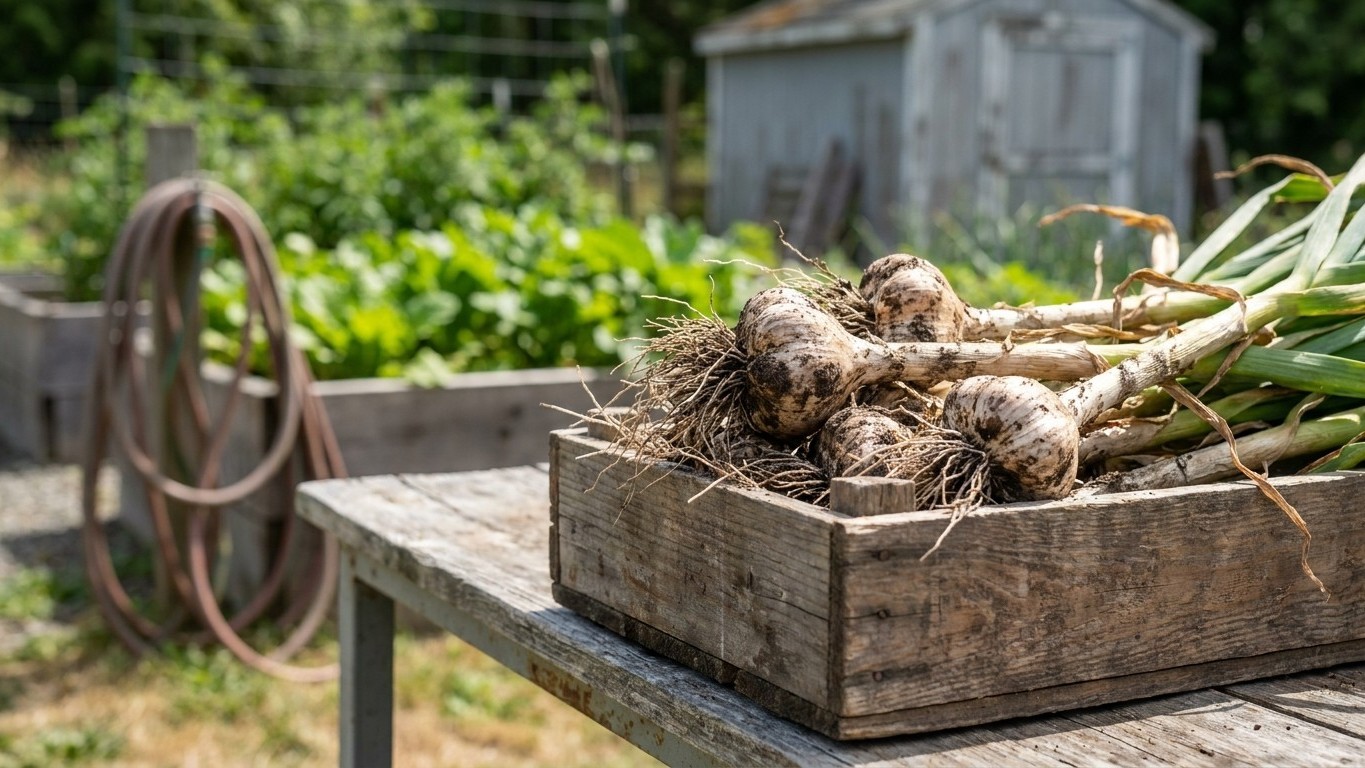

California gardeners growing garlic contend with six pests documented by University of California Agriculture and Natural Resources: aphids (including melon aphid), brown garden snail and slugs, earwigs, root-knot nematodes, spider mites, and whiteflies. Which one shows up first, and how bad it gets, depends on where in the state the garlic grows. Coastal and southern California don’t see a freeze in an average year. The Central Valley and Sierra foothills do. That single difference reshuffles the whole pest calendar.
Which pests attack garlic in California

University of California Agriculture and Natural Resources documents eleven garden pests active across the state’s vegetable plots: aphids including melon aphid, brown garden snail and slugs (Cornu aspersum), corn earworm, cucumber beetles, earwigs, leaffooted bugs, root-knot nematodes, spider mites, stink bugs, tomato hornworm, and whiteflies.
Not all of them have any business on a garlic bed. Corn earworm, cucumber beetles, leaffooted bugs, stink bugs, and tomato hornworm all target fruit, seed pods, or the foliage of tomatoes, cucurbits, and other nightshades, structures garlic never forms. That leaves six pests that actually feed on garlic: aphids and whiteflies pierce leaf tissue and draw sap, leaving sticky honeydew that invites sooty mold. Snails and slugs rasp at tender seedling leaves at ground level, sometimes cutting a shoot down before it establishes. Earwigs cause similar damage to soft new growth, especially near mulch or debris. Spider mites stipple foliage and thrive in dry, dusty conditions. Root-knot nematodes work underground on roots and the bulb itself, and their damage often isn’t obvious until harvest.
In coastal and southern California, where an average year records zero days at or below 32°F, none of these pests get shut down by a hard freeze, so populations can carry over with barely a pause. Further north and at elevation, in the Central Valley and the Sierra foothills, winter cold does interrupt that cycle.
When each one shows up, and what it does first
Garlic in California is planted in autumn and lifted the following summer, and that long stretch in the ground is exactly why the frost question matters. In frost-free coastal and southern zones, there’s no cold snap to pause pest activity between planting and harvest. In the Central Valley and Sierra foothills, a real winter chill interrupts things, so pests there tend to reappear as the ground warms rather than staying active straight through.
The earliest problems usually show up right at emergence. Freshly sprouted shoots are soft and low to the ground, an easy target for brown garden snails and slugs, and for earwigs sheltering nearby in mulch or debris. The first sign is usually a shoot sheared off cleanly near the soil line, or ragged notches along a young leaf edge, rather than a visible pest, since both feed mostly after dark.
As foliage fills in, aphids and whiteflies become the more common complaint. Look for clusters of small, soft-bodied insects on leaf undersides or near the base of the plant, along with a sticky film on foliage and sometimes a black, sooty coating growing on top of it. In frost-free zones, aphid colonies can persist through what would elsewhere be a dormant season.
Spider mites tend to show up later, once weather turns warm and dry and dust builds up on foliage. The first clue is a stippled, dusty-looking leaf surface rather than any visible pest, since individual mites are close to impossible to see without magnification.
Root-knot nematode damage is different because it happens underground and out of sight most of the season. Above-ground symptoms, stunted growth, yellowing, wilting despite adequate water, tend to show up as bulbs are sizing up, and the real evidence, small galls or knots on roots, only becomes visible at harvest.
Telling the damage apart from everything else
Garlic can look stressed for reasons that have nothing to do with any pest above, and mixing them up wastes a season. Nutrient deficiency, inconsistent water, fungal disease, and mechanical damage from tools or foot traffic can all mimic insect or nematode injury.
The detail that separates most pest damage from everything else is pattern: pest feeding tends to be patchy and edge-first, while nutrient and water problems tend to show up evenly across a bed. A sheared-off shoot at the soil line points to snails, slugs, or earwigs, since mechanical damage from a hoe or a foot usually snaps a stem rather than cutting it flush. Stippled, dusty foliage points to spider mites, while a uniformly pale leaf, yellow from the tip down and even across the whole bed, more often points to a nitrogen shortage or uneven irrigation. Sticky residue with a black coating is honeydew from aphids or whiteflies, not a disease on its own. Wilting despite regular watering, paired with stunted bulbs at harvest, can mean root-knot nematodes, but it can just as easily mean a drainage problem, and the only way to tell for certain is to look at the roots for small galls or knots.
| What you see | Possible cause | What tells them apart |
|---|---|---|
| Shoot cut off at soil line | Snails, slugs, or earwigs | Clean, low cut versus a snapped stem from foot or tool damage |
| Stippled, dusty leaves | Spider mites | Fine speckling across the blade, not a uniform yellow color |
| Sticky, shiny residue with black coating | Aphids or whiteflies | Visible small insects on leaf undersides, not a leaf spot or lesion |
| Wilting, stunted bulbs at harvest | Root-knot nematodes | Small galls or knots on roots, versus intact roots in waterlogged soil |
None of this replaces an actual look at the plant in hand. A local farm advisor can confirm what’s driving a specific symptom far faster than guesswork from a photo.
What actually works here, and what is a waste of time
Physical barriers and timing do more for garlic in California than any spray applied after the fact, mainly because a bulb crop spends so many months in the ground that reinfestation is constant.
For snails, slugs, and earwigs, the most reliable step is removing daytime hiding spots, mulch piled against stems, boards, debris, since both groups feed at night and shelter close to the plant during the day. Clearing that shelter before shoots emerge in the fall matters more than anything applied once damage is already visible. Copper barriers around raised beds slow snails down, and hand removal after dark still works better than most people expect for a small home patch.
Aphids and whiteflies respond well to a strong jet of water aimed at leaf undersides, which knocks colonies off before they build up, and to encouraging the predatory insects, lady beetles and lacewings among them, that already show up in most California gardens on their own. Spraying broadly at the first sign of a few aphids usually does more harm than good, since it kills off the predators that would have cleaned up the colony within a week or two.
Spider mites are largely a dry-weather problem, so regular overhead watering of foliage, not the soil, knocks down the dust and low humidity that favor them.
Root-knot nematodes are the hardest of the six to manage after the fact, since there’s no quick fix once they’re established in soil. Rotating out of garlic and other susceptible crops for a season, keeping the bed free of host plants during that gap, does more than anything applied to an already-infested bed.
Whatever the pest, the University of California Agriculture and Natural Resources network is the source for what’s actually registered for use in the state, since recommendations and approved products change and vary by county.
Where to check this for your own county
Everything above describes what UC Agriculture and Natural Resources documents at the state level, which is a starting point, not a diagnosis for any one garden. Pest pressure inside California varies between a coastal garden with mild, damp winters and a Central Valley plot that sees real summer heat and a winter freeze, and it varies just as much between two gardens a few miles apart depending on soil, past crops, and what’s growing nearby.
The most useful single step for anyone unsure what’s feeding on their garlic is contacting the county office of University of California Agriculture and Natural Resources directly, since county-level advisors track what’s actually showing up in local gardens that season, not just what’s possible statewide. Many county offices accept a sample, a photo, or a description over the phone, and can usually narrow down a cause faster than searching online.
University of California Agriculture and Natural Resources publishes its full directory and county contact information at ucanr.edu, and that’s the fastest way to find the office covering a specific address rather than guessing from a nearby city.
A pest documented for the state doesn’t mean it’s present in any specific yard, and a pest absent from this list isn’t necessarily absent from California either, since documentation reflects what’s been formally tracked, not every possible garden problem. For garlic specifically, the six pests covered here, aphids, snails and slugs, earwigs, root-knot nematodes, spider mites, and whiteflies, are the ones with a documented history of feeding on the crop in this state, and that’s the list worth checking against first.
Common questions
Does garlic actually freeze in California?
It depends entirely on region. Coastal and southern California record zero days at or below 32°F in an average year, a frost-free season of 365 days. The Central Valley and Sierra foothills do freeze, so garlic there faces a real winter dormancy that frost-free zones never get.
What’s the earliest sign something is feeding on young garlic?
A shoot cleanly sheared off at the soil line, or ragged notches on a new leaf, usually points to snails, slugs, or earwigs feeding after dark, before any insect is visible in daylight.
Do all six documented pests show up in every California garlic bed?
No. Presence varies by region and by garden. A coastal bed and a Central Valley bed rarely share the same pest pressure, which is why state-level documentation is a starting point, not a forecast for a specific yard.
Who can confirm what’s actually damaging a specific garlic crop?
The county office of University of California Agriculture and Natural Resources, found through the directory at ucanr.edu, tracks what’s showing up locally and can review a sample or photo directly.