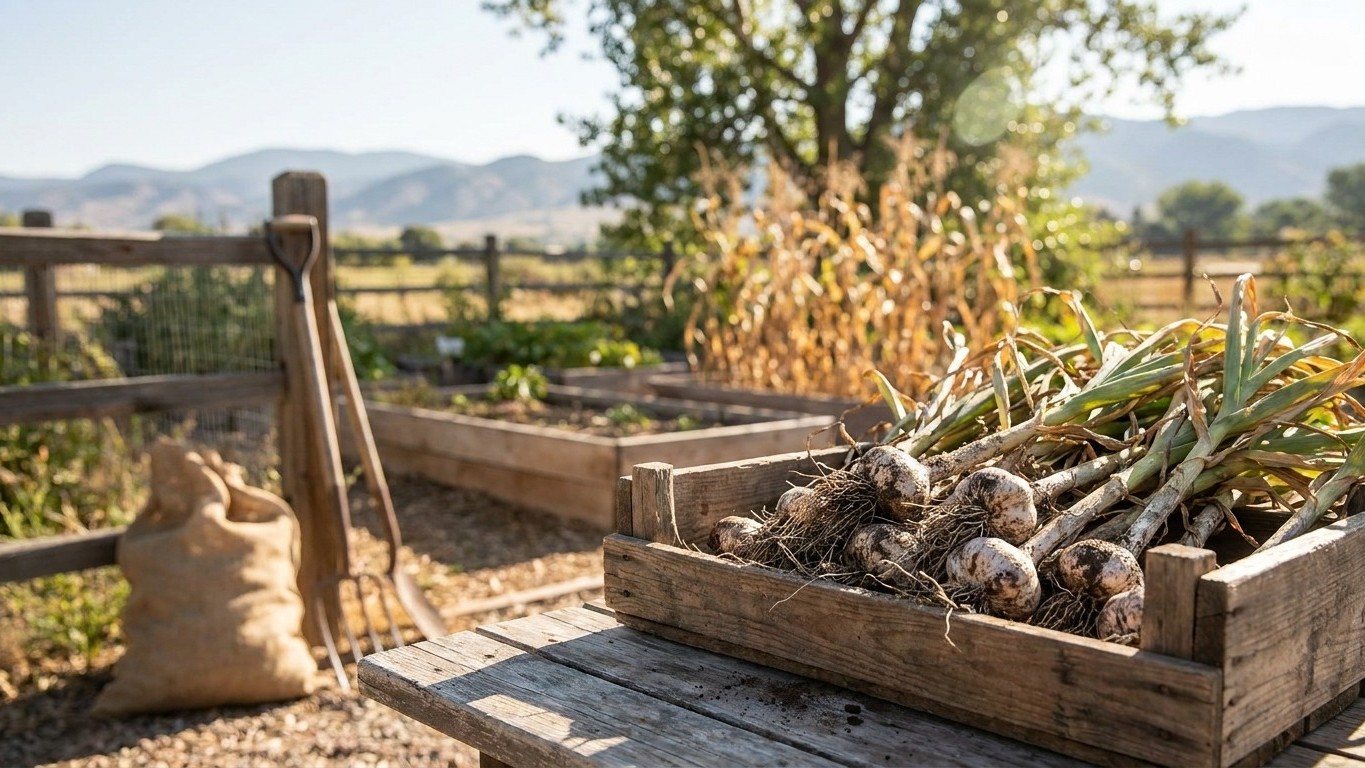

Garlic in Colorado goes into the ground in fall and comes out the following summer, and every proven cultivar for this state, softneck or hardneck, is set out early September to late September. That window is built backward from NOAA’s 1991-2020 Climate Normals, which put the first fall freeze near Denver at September 30 to October 12. Check your own first-freeze range against that one before you commit to a planting week, since a garden a few thousand feet higher or lower will not match it.
The short answer for Colorado

Front Range winters don’t behave like the mild, wet-cold everyone plans for when they say “softneck garlic won’t survive.” Here the ground freezes hard, thaws in a January warm spell, then freezes again — and that swing kills bulbs that would be fine under steady snow cover elsewhere. That’s why hardnecks like Duganski, Chesnok Red, and Georgian Fire dominate Colorado plots, though a few softnecks, Inchelium Red among them, still hold on if you get them into the ground between early and late September.
| Variety | Neck type | Set out |
|---|---|---|
| Early Red Italian | Softneck | Early Sept to late Sept |
| Inchelium Red | Softneck | Early Sept to late Sept |
| Italian Late | Softneck | Early Sept to late Sept |
| Lorz Italian | Softneck | Early Sept to late Sept |
| Bavarian Purple | Hardneck | Early Sept to late Sept |
| Blue Music | Hardneck | Early Sept to late Sept |
| Chesnok Red | Hardneck | Early Sept to late Sept |
| Duganski | Hardneck | Early Sept to late Sept |
| Fall Festival | Hardneck | Early Sept to late Sept |
| Georgian Crystal | Hardneck | Early Sept to late Sept |
| Georgian Fire | Hardneck | Early Sept to late Sept |
| German Red | Hardneck | Early Sept to late Sept |
| German White | Hardneck | Early Sept to late Sept |
| Ivan | Hardneck | Early Sept to late Sept |
Colorado’s winters do the rest of the work. NOAA’s temperature record near Denver shows air spends about 30.4 weeks a year below 40°F, well past the six to eight weeks University of Georgia Extension (publication C854) says a planted clove needs to vernalize and split into a full bulb the following summer. That holds whether you’re growing a softneck meant to braid and store, or a hardneck grown mainly for flavor.
Remember that a frost date is a midpoint, not a guarantee. In roughly half of the years on record, the first freeze near Denver lands after October 12, and in the other half it lands before September 30. Plan around the whole range, not a single day pulled from its middle, and expect to shift your planting by a week or so depending on the fall you get.
Working it out for your own garden
The arithmetic
The September window above is built on one number, NOAA’s freeze range of September 30 to October 12 measured at the Denver-area station. Work backward from whichever end of that range fits your county, not from a date pulled out of its middle. Planting in early September puts a clove in the ground roughly three to four weeks ahead of the September 30 opening of that freeze window. Planting in late September closes the gap to something closer to two weeks ahead of the October 12 close. Either end gives the clove enough time to grow roots into cooling soil before a hard freeze locks the ground, without pushing so much top growth that an early freeze burns back young leaves. For a fuller walkthrough of counting back from your own frost date, see When to Plant Garlic in Colorado: Counting Back From the First Frost.
Elevation and cold-air drainage
That arithmetic only holds at the elevation and location NOAA measured it at. Elevation is the biggest variable in Colorado, more than latitude or soil type. Denver sits at 5,280 feet on the plains. A garden a few thousand feet higher in the foothills or a mountain valley will see its first freeze arrive measurably earlier than the Denver-area range, and one on the Western Slope or in a lower river valley may run behind it.
Low ground compounds the elevation effect. Cold air is heavier than warm air and drains downhill overnight, so a bed at the bottom of a slope or a valley floor can frost a week or two before a bed on a gentle rise nearby, even at similar elevation. If your garlic bed sits in a natural low spot, plan for the earlier end of your local freeze range rather than the later one, and get cloves in the ground sooner instead of later.
A heavy mulch of straw or leaves, applied once the soil starts to cool but before it freezes hard, buys a little more room for error on either side of your planting date. It insulates against an early freeze and slows the ground from freezing solid, but it does not substitute for planting early enough to grow roots in the first place.
What changes across Colorado
The Front Range plains
Denver, Fort Collins and Pueblo all sit at similar elevation on open plains ground, with less cold-air pooling than the mountains carry. Gardeners in these cities can use the September 30 to October 12 range with the least adjustment, though even here a yard next to a creek or in a low spot will run colder than the open station NOAA measured.
The high country
Mountain towns, from the high valleys around Leadville and Gunnison to the resort corridors along I-70, run on a completely different clock. Elevation alone can push these towns thousands of feet above Denver, and a mountain garden can see its first frost as early as July, months ahead of the plains window. Garlic planted on the Denver schedule in these towns risks going into ground that is already freezing solid, or worse, a killing frost before the clove has rooted at all.
The Western Slope and beyond
The Western Slope, around Grand Junction and the Colorado River valley, runs on yet another pattern, shaped by the lower elevation of the river valley itself and its distance from Front Range weather systems. Treat any Front Range date as a starting point, not an answer, once you cross the Continental Divide. Even within one county, a south-facing slope warms and cools faster than a north-facing one, and a garden shielded by a building or a stand of trees can lag or lead its open neighbors by a week or more.
The mistakes this climate punishes
Treating the frost range as a single safe date
The most common mistake is picking one day, say October 1, and treating it as gospel. NOAA’s own data shows the first freeze near Denver lands anywhere from September 30 to October 12 in a typical year, and roughly half of all years fall outside even that range in one direction or the other. A grower who waits for a specific calendar date can find the ground already freezing before the clove goes in, especially in a year that turns cold early.
Assuming the winters are too cold for hardneck garlic
Colorado’s long, cold winters are not a risk for hardneck types like Bavarian Purple, Duganski or German White. They are the reason those varieties thrive here, since the state’s winter cold runs far past what garlic needs to vernalize, as covered above. The mistake this climate actually punishes is planting too shallow, or too late for the clove to root before the ground freezes, not choosing the wrong type of garlic.
Buying uncertified seed stock
Garlic pathogens including white rot (Sclerotium cepivorum) and Fusarium basal rot (Fusarium oxysporum f. sp. cepae) travel in infected planting stock rather than appearing spontaneously in clean soil. UC IPM’s Pest Management Guidelines for Onion and Garlic (UC ANR Publication 3453) note that white rot’s published temperature range overlaps mean air temperatures common in this state across five months of the growing season, and Fusarium basal rot’s range overlaps three. Those are published soil-temperature thresholds measured against air temperature, and a monthly average hides plenty of days on either side of it, so read the overlap as a reason to buy clean stock rather than a forecast of disease. One weather station also cannot describe an entire state, and neither figure means the disease is guaranteed here or ruled out elsewhere. Buy certified disease-free seed garlic from a reputable source, and avoid planting into a bed that has grown onions or garlic with any history of rot.
- Skip a single fixed calendar date, plant off the range instead
- Don’t shy away from hardneck types out of fear of cold
- Never plant grocery-store or uncertified cloves into new ground
Checking this against your county
Every figure above comes from one station near Denver. For a planting date tuned to your own county, elevation and microclimate, contact your local Colorado State University Extension office through extension.colostate.edu. County agents keep records specific to their own service area and can tell you how far your local frost date typically runs from the Denver-area range used here.
This matters most for anyone gardening off the Front Range plains, in the mountains, on the Western Slope or in the San Luis Valley, where the gap from Denver’s numbers can run to several weeks in either direction.
Common questions
Can I plant garlic in spring instead of fall in Colorado?
You can, but you’ll get small bulbs or none at all, since the clove misses most of the winter cold it needs to divide. Spring planting is really only worth doing if you want green garlic or scallion-style shoots, not full cured bulbs.
Is it okay to plant garlic cloves from the grocery store?
It’s risky. Grocery garlic is often a variety not chosen for cold climates, and it can carry diseases like white rot or Fusarium basal rot into a bed that would otherwise stay clean. Buying certified seed stock from a garlic supplier costs more upfront but avoids introducing a problem that can persist in soil for years.
Should I grow softneck or hardneck garlic in Colorado?
Both grow well here, so the choice comes down to what you want from the crop. Softnecks like Inchelium Red or Italian Late store longer and braid, while hardnecks like Georgian Fire or German Red tend toward stronger, more complex flavor but store for a shorter stretch after harvest.
What if the first frost where I live doesn’t match Denver’s dates at all?
That’s expected outside the immediate Front Range plains. Use the Denver range as a reference point and shift earlier if you’re at higher elevation or in a valley that pools cold air, later if you’re on the Western Slope or in a lower, warmer pocket. Your county extension office can narrow that down with local records.