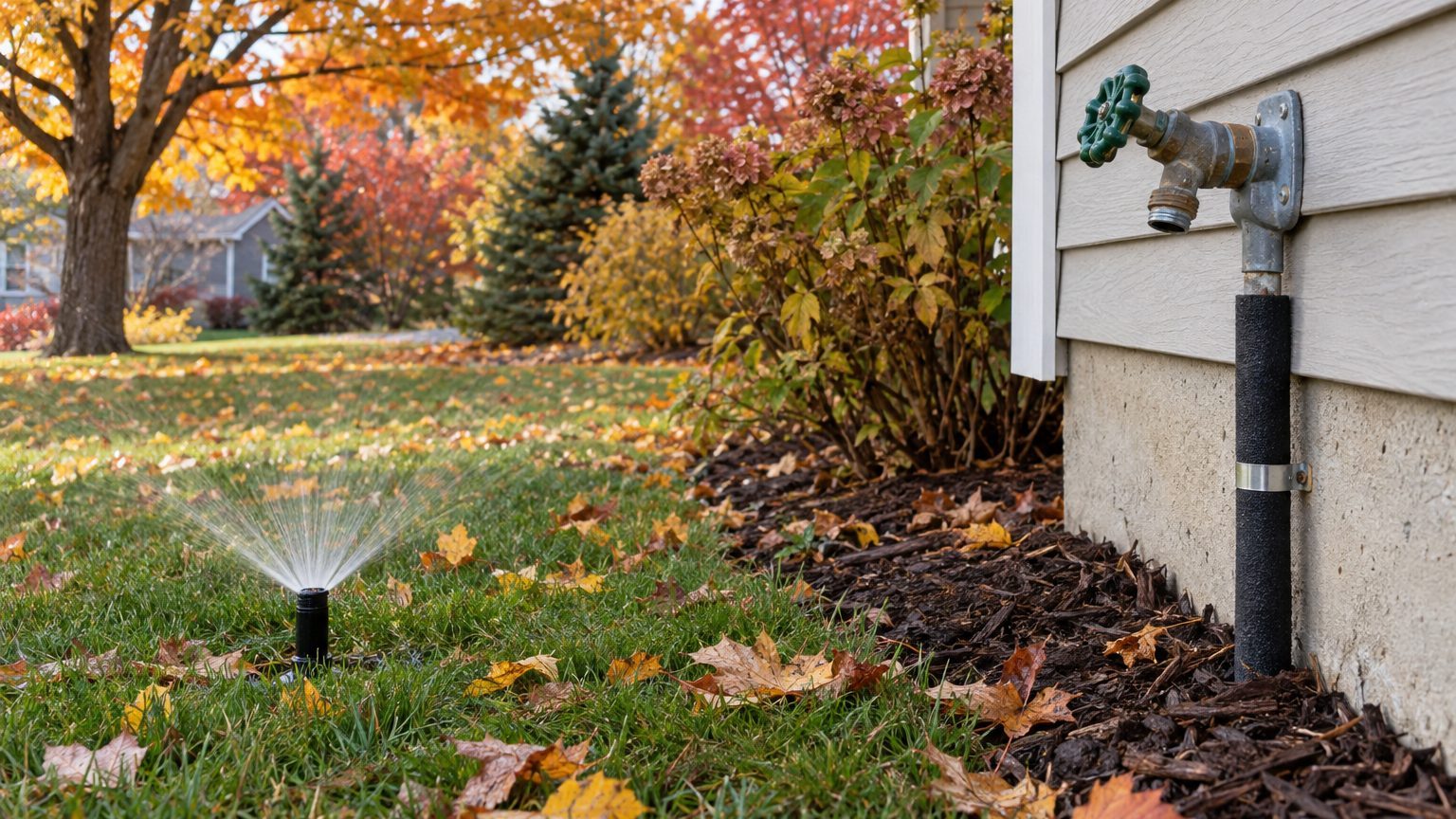

Shut down irrigation and drain outdoor faucets before the first hard freeze, not after the first light one. Colorado autumns make that timing tricky: a warm weekend can sit between two freezing nights, and water left in a sprinkler line or a hose bib ignores the seasonal average. Below are the frost dates that set the window, the three ways to clear a sprinkler system, the faucet routine, and the failures that show up as spring leaks.
When to do it in Colorado
Plan to do the work in the days leading into the first-frost window of September 30 to October 12 along the Front Range, and finish before the first hard freeze, not after the first light one. That range comes from NOAA NCEI’s 1991-2020 Climate Normals for Denver (station USW00003017), where the 30-70% probability band for a 32°F freeze falls between those two dates.
Start in the days before the September 30 to October 12 window and be finished before the first hard freeze. Since today is September 30, Denver-area homeowners are at the front edge of that window right now, and anyone who hasn’t touched the irrigation controller should put it on this week’s list.
Light frost versus hard freeze
A light frost is a dawn dip to around 32°F that burns off by mid-morning. Buried sprinkler lines usually shrug it off because the soil still holds summer heat. Exposed parts don’t: the above-ground backflow preventer, the pipe stub feeding it, hose bibs, and any hose still full of water. A hard freeze is different. The temperature stays well below 32°F for hours, and the cold works down into the soil. Waiting for that second event is the mistake, because Colorado can hand you a hard freeze with very little warning.
There’s no reason to gamble on the calendar, either. Denver’s coldest month has a mean daily minimum of 18.4°F (NOAA NCEI Climate Normals 1991-2020). That is the average low, not the record, so plenty of nights dip below it. A climate like that leaves lines no margin, and a full blowout is not an optional extra here. The USDA Plant Hardiness Zone Map (2023) places Colorado anywhere from 3b to 7b, but that system rests on the average annual extreme minimum, so it says nothing about when to drain a pipe. For dated decisions, the first-frost window is the better guide.
Elevation moves the date earlier
Denver sits at 5,280 feet on the plains, and its numbers do not carry over to the mountains. Mountain towns run far shorter growing seasons and can see frost in July, so their draining happens earlier, sometimes well ahead of the Denver window. The western slope has its own pattern again. The colder and higher your yard, the earlier you go. If you live above the plains, treat the Denver range as the latest you should be finishing, not the target.
Lawn care has its own fall calendar, laid out in Winterizing a Lawn. For other regional timing, see the Colorado guides.
Sprinkler lines: drain or blow out
Why water left behind breaks things
Water expands as it turns to ice, and pipes have nowhere to give. Rigid PVC and fittings crack, polyethylene lines split along the wall, and the small brass and plastic parts inside valves and heads shatter. The damage is invisible until spring. Nothing leaks while the ice holds, then the thaw and the first pressurized run reveal every crack at once, usually as a geyser in the lawn or a wet patch that won’t dry.
The vulnerable spots are the low points in the lines, the zone valves, and the backflow preventer, which sits above ground on most systems and gets hit first by cold air. A system can look drained and still be holding water in a dip in a flat run.
Manual drain, automatic drain, compressed-air blowout
Three methods exist, and they differ in how much water they leave behind.
| Method | How it works | Weak point |
|---|---|---|
| Manual drain | You open drain valves at the system’s low points and let gravity empty the lines | Only works if the system was installed with those valves; water pools in any low spot without one |
| Automatic drain | Valves open on their own when line pressure drops and release water at low points | Debris or a stuck valve leaves water behind, and you can’t see it happen |
| Compressed-air blowout | An air compressor pushes water out through the sprinkler heads, zone by zone | Needs the right equipment and care with pressure; too much damages heads and fittings |
Given Denver’s 18.4°F January lows, treat a compressed-air blowout as the default and use drain valves as backup, not a replacement. Gravity drainage gets most of the water out, and air gets what the low points miss. A system built with drain valves is easier to blow out, but the valves alone are a thin defense in a climate with hard, prolonged freezes.
When a professional makes sense
Blowing out a system is a job with real hazards. Pressurized air can turn a loose fitting into a projectile, and a compressor pushing beyond the system’s rating can burst lines you were trying to protect. Call a pro if you don’t own or can’t borrow a proper compressor, if the system has many zones or an unfamiliar layout, if you can’t find the shutoff and the backflow device, or if you aren’t sure how to set the pressure. Wear eye protection whenever you do it yourself, and work zone by zone instead of opening everything at once. A visit costs far less than a spring of dug-up trenches, so hiring it out is a sensible call, not an admission of defeat.
Outdoor faucets and hoses
The shutdown routine
This job takes ten minutes and needs no tools beyond your hands. Disconnect every hose, splitter, timer, and sprayer from every outdoor tap. Go inside and find the interior shutoff valve that feeds each outdoor faucet, usually in a basement, crawl space, or utility room, and turn it off. Then go back outside and open the tap so the water in the line can drain out, and leave it open through winter. Coil the hoses, drain them on a slope, and store them in a garage or shed.
Turning valves is as far as a homeowner should go. If the interior shutoff is missing, seized, or leaks when you close it, or if the faucet drips after you shut it off, stop and call a plumber. Cutting into pipe, replacing a valve, or forcing a corroded handle can turn a small problem into a flooded wall. Full step-by-step detail lives in Winterizing Outdoor Faucets Before the First Freeze.
Timing follows the sprinklers. Do the faucets during the same weekend you clear the sprinkler lines, before the September 30 to October 12 frost window is underway. Higher-elevation homeowners should do it earlier still.
Why a frost-free faucet still fails
A frost-free faucet has a long stem that puts the shutoff deep inside the heated part of the house, and the barrel is angled slightly downward so water runs out after each use. The design works only if the barrel can empty. Leave a hose attached and the hose holds water in place, so the barrel stays full behind the hose. That trapped water freezes, splits the pipe, and the crack sits inside the wall where you can’t see it. The first sign is often water running inside the house in spring, the moment the tap opens and pressure returns.
The hose alone can do it, even with the tap off. A full hose acts as a plug, and the barrel can’t drain around it. More on how these fixtures are built and when they’re worth installing is in Frost-Free Outdoor Taps.
What goes wrong here
The early cold snap
Colorado’s most common failure is timing. A cold front arrives before anyone has drained, and the first hard night lands on a system that looked fine at dinner. On the Front Range that can happen soon after the first-frost window of September 30 to October 12 opens, and in the mountains it comes sooner. In spring, the signs are a wet lawn patch that appears after the first watering, low pressure in one zone, or a head that geysers. Prevention is dull but effective: pick a weekend in the days before the window opens, and treat the forecast as a deadline, not a suggestion.
Forgotten hoses and flooded valve boxes
The forgotten hose is the classic second failure. One hose left on a back-yard tap is enough to freeze the barrel, and the damage stays hidden until spring, when a wet spot shows up on a basement or crawl space wall. A quick walk around the whole house before the first cold night catches most of these. Include the tap behind the shrub and the one on the side of the garage.
Valve boxes fail differently. If the zone valves sit in a buried box and water was left in them, the freeze cracks the valve body, and in spring the box fills with water or leaks constantly into the soil. Look inside each box before winter, and confirm the valves have been drained and the box lid is seated. A spring check should include lifting each lid to look for standing water. A cracked valve or a steady drip needs a repair before you run the system. Burst or leaking indoor pipes are covered under Frozen Pipes.
Common questions
Can I wait until November to winterize?
You can, but you’re betting against Colorado weather for no gain. Along the Front Range the first-frost window runs September 30 to October 12 (NOAA NCEI 1991-2020 Climate Normals for Denver), and a hard freeze can follow soon after. If you live in the mountains, the risk starts earlier. A mild stretch in late fall doesn’t change the odds of the next cold night.
Do I still need a blowout if my system has automatic drain valves?
Yes, in most cases. Automatic drains release water at low points, but they can stick or clog and leave water in the lines with no visible sign. Since Denver’s coldest-month mean minimum is 18.4°F (NOAA NCEI), lines have very little tolerance for leftover water. Use the valves as a first step, and follow with air.
Does my hardiness zone tell me when to winterize?
No. The USDA Plant Hardiness Zone Map (2023) is built on one variable, the average annual extreme minimum temperature, and Colorado spans 3b to 7b. It tells you which perennials survive, not when the first freeze arrives. For draining sprinklers, use the local first-fall-frost window, and move earlier if you live at higher elevation than Denver.
What is the right way to turn the system back on in spring?
Open the main valve slowly instead of all at once, since a sudden surge into empty lines is what pops fittings and heads. Walk each zone while it runs and look for geysers, soggy patches, and low pressure. Check the valve boxes and the backflow preventer for leaks too. Do it after the danger of hard freezes has passed, because a system filled in early spring and hit by one more cold night has to be drained all over again.