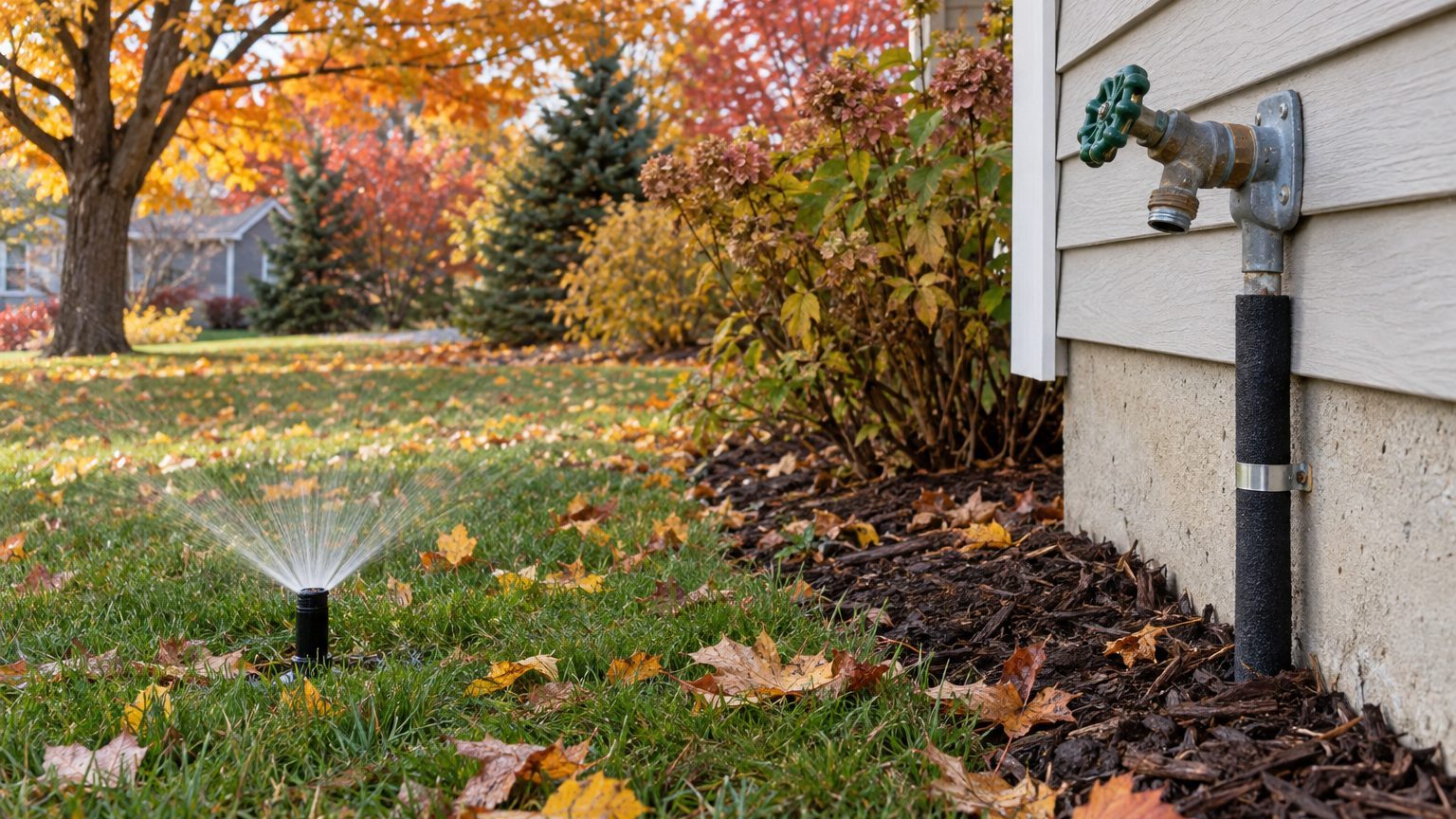

Drain the system before the first hard freeze, and treat that as a deadline rather than a suggestion. Wyoming winters are cold enough that water left in a sprinkler line, a valve or a hose-fed faucet will freeze. A frozen fitting stays quiet until the first warm weekend of spring, when it starts to spray. The window is tight, it moves earlier the higher or farther north you live, and the work itself is short compared with the repair.
When to do it in Wyoming
Finish before the first hard freeze, not after the first light one. NOAA’s 1991-2020 Climate Normals for the Cheyenne station mark September 24 to October 5 as the band in which the odds of a first 32°F freeze run from 30 to 70 percent, so the work belongs in the days and weeks ahead of that stretch. Have the sprinklers blown out and the hoses off the taps before the September 24 to October 5 band arrives.
Read the band as a slope, not a cliff. Early in it, a freeze in any given year is still the less likely outcome. By the far end it is the likely one. Anyone who plans around the back edge of the range is betting on an average year, and Wyoming does not hand those out reliably. Aim for the front of the window and you have room for a surprise.
Those dates describe one reference station, and the rule for the rest of the state is simple: colder ground gets an earlier first frost. The same NOAA data points to roughly 130 frost-free days at 6,000 feet, with frost possible in any month at higher elevations. Farther north or higher up, the deadline slides earlier. A homeowner in a mountain valley should not borrow Cheyenne’s calendar, and one in the southeast corner should not assume the first cold night will wait for October.
The light-versus-hard distinction matters because the two feel so different. A light frost whitens the grass and wilts the tomato vines, but buried lines usually sleep through it. The exposed parts do not: an above-ground backflow preventer, a hose bib, a hose with water still in it. And the warm, golden stretch that often follows a light frost is exactly what talks people into waiting. The hard freeze that follows does not send a warning.
There is no shortcut in this climate. In Cheyenne, NOAA’s normals put the mean daily minimum of the coldest month at 18.1°F, well under freezing for weeks on end. The USDA Plant Hardiness Zone Map 2023, which is built on the average annual extreme minimum temperature, places Wyoming in zones 3a to 6a, so other parts of the state run colder or milder than Cheyenne. Where winters are this cold, shutting the water off and hoping does not count as winterizing. A full blowout of the sprinkler system is part of the job. The Wyoming guides cover more of the regional differences.
Useful signals that the window is closing:
- Overnight lows in the seven-day forecast creeping toward 32°F
- Frost on rooftops or car windows, even once, even lightly
- Snow showing up in the extended outlook before you have drained anything
Sprinkler lines: drain or blow out
Water expands as it turns to ice, and a buried sprinkler system gives it nowhere to go. The ice plug forms in one section and squeezes the water still liquid between the plug and a closed valve or a dead end. That pressure finds the weakest spot, which is usually a fitting, a valve body, a pop-up head or the backflow preventer. Plastic pipe can split along its length too. The damage hides underground all winter and shows itself when you turn the system back on.
Three ways to clear the lines
Each method removes water differently, and they are not equally reliable in a cold climate.
| Method | How it works | Fit for Wyoming |
|---|---|---|
| Manual drain | You open drain valves at the low points and let gravity empty the lines | Works only if the system was built with proper drains and slope; leaves water in heads and valves |
| Automatic drain | Valves open on their own when line pressure drops | Convenient, but they can stick or clog, and low spots can hold water |
| Compressed-air blowout | Air pushed through each zone forces water out of pipes, valves and heads | The standard answer for this climate |
Gravity drains are fine as a first step and a poor last one. Even a system with working drains tends to hold small pockets of water in the heads, the valves and any sag in the pipe. In a place where the coldest month’s average low sits at 18.1°F in Cheyenne (NOAA normals), small pockets are enough to cause damage. Blow out every zone with compressed air before the first hard freeze, even if your system has drain valves.
A blowout follows a sequence. Shut off the water supply to the system and set the controller to off or rain mode rather than unplugging it. Attach the compressor at the blowout port, then work one zone at a time, in short bursts, until the heads stop spitting water and only mist comes out. Run the zones in order and repeat the pass. Leave the main shutoff handle halfway open so any trapped water has somewhere to go, and drain the backflow preventer according to its design.
Safety matters here more than most DIY jobs. Compressed air in a closed system behaves like a pressure vessel. Wear eye protection, stay clear of the heads while they are running, never exceed the pressure rating of the pipe and fittings, and do not let air run through a zone for long once the water is gone, because dry heads can overheat from friction. A small shop compressor often lacks the airflow to clear a whole zone, which is the usual reason a homeowner blowout leaves water behind.
A professional is the sensible choice in a few situations: you cannot find the blowout port or identify the valves, the system has many zones or a complicated manifold, you do not have a compressor with enough volume, or a previous winter left cracked parts that were never fully repaired. Call before the forecast turns, not after, because the pressure is highest right when the first cold night is approaching. Once the lines are clear, the grass needs its own plan, covered in Winterizing a Lawn.
Outdoor faucets and hoses
Start with the hoses, because they cause the most avoidable damage. Disconnect every hose, splitter, timer and sprayer from every outdoor tap, then drain and coil the hoses for storage. A hose left attached holds water, and that water sits against the faucet and freezes back into it. Keep one hose out until the sprinkler work is finished, then bring it in with the rest.
The faucet itself takes three turns of a valve, nothing more. Close the interior shutoff valve that feeds the outdoor tap, open the outside tap, and leave it open so the line between the two can drain all winter. If the faucet keeps dripping after the interior valve is closed, or you cannot find a shutoff at all, stop there. Anything beyond turning valves, from replacing a stem to rerouting a line, is a plumber’s job. Hose off, interior valve closed, outside tap open.
Frost-free faucets are the part that confuses people. A frost-free faucet has a long stem that puts the actual shutoff valve inside the warm wall, and the barrel is designed to drain when the handle is closed, as long as it tilts slightly downward toward the outlet. Attach a hose and that drainage stops. Water stays in the barrel, the cold reaches it, and the ice splits the pipe, usually inside the wall where you will not see it. The leak appears the following spring when someone turns the tap on and water runs into the wall cavity or the ceiling below. The design is good, but it only works when the outlet is clear. The page on Frost-Free Outdoor Taps covers how these fixtures work in more detail.
The timing here is the same as for the sprinklers, with one difference: faucets take far less effort, so there is no reason to wait for the end of the window. Do them when you do the sprinklers, or sooner. A step-by-step version lives in Winterizing Outdoor Faucets Before the First Freeze. A foam cover over the spigot is a reasonable extra layer, but it supplements draining and does not replace it.
What goes wrong here
The most likely failure in Wyoming is the early cold snap. Frost is possible in any month at higher elevations, and even in lower areas the first freeze can land before the average band opens. A homeowner who planned to drain “sometime in October” meets a hard freeze with full lines. In spring the signs are a geyser from a cracked riser, heads that spray sideways, a zone that will not hold pressure, or a soggy patch that appears in dry weather. The fix is to treat the front of the window as the deadline. If a hard freeze is forecast before you have blown out the system, shut the supply, open the drains and disconnect the hoses that night, then finish the full blowout when it warms.
The forgotten hose comes second. It is usually the one on the far side of the house, or the one attached to a timer nobody remembers. The spring sign is a slow drip inside the wall, a damp spot below the tap, or a hissing sound when you first turn the water on. A walk around the whole house before the window closes catches it. A hose on every tap means a hose to remove, so count the taps rather than trusting memory.
The flooded valve box is the quiet one. The green lid in the lawn covers the zone valves, and snowmelt and small leaks can fill the box with water that freezes around the valves. In spring a zone may refuse to shut off, a valve may weep, or one area of the yard stays soaked. Blow out the valves along with the lines, check that the box drains rather than pools, and keep the lid on. If a line does freeze somewhere you cannot reach, the page on Frozen Pipes explains what to do and when to call for help.
When you restart the system in spring, open the supply valve slowly, then check each zone for leaks before trusting the controller.
Common questions
Can I wait until it snows to winterize?
No. Snow often arrives after the first hard freeze, and the freeze is the real threat. NOAA’s Cheyenne normals put the first 32°F freeze in a 30 to 70 percent probability band between September 24 and October 5, which is typically well ahead of the heavy snow.
Is it a problem to winterize too early?
Not for the pipes. Water drained and blown out in a warm stretch stays out. The only cost is a lawn that may want water during a dry, warm fall, which is why many people keep one hose handy until the last day of the window and then drain it too.
Do automatic drain valves replace a blowout?
In most Wyoming yards they do not. They can stick, clog or sit above a low spot that holds water, and heads and valves may keep a little as well. With winters this cold, a compressed-air pass is the safer routine, either by you or by a professional.
Is there one date that works across Wyoming?
No. The September 24 to October 5 band describes the Cheyenne station, and the state has USDA zones from 3a to 6a, so conditions differ widely. Higher and more northern spots get their first frost earlier, with roughly 130 frost-free days at 6,000 feet, so finish earlier there.