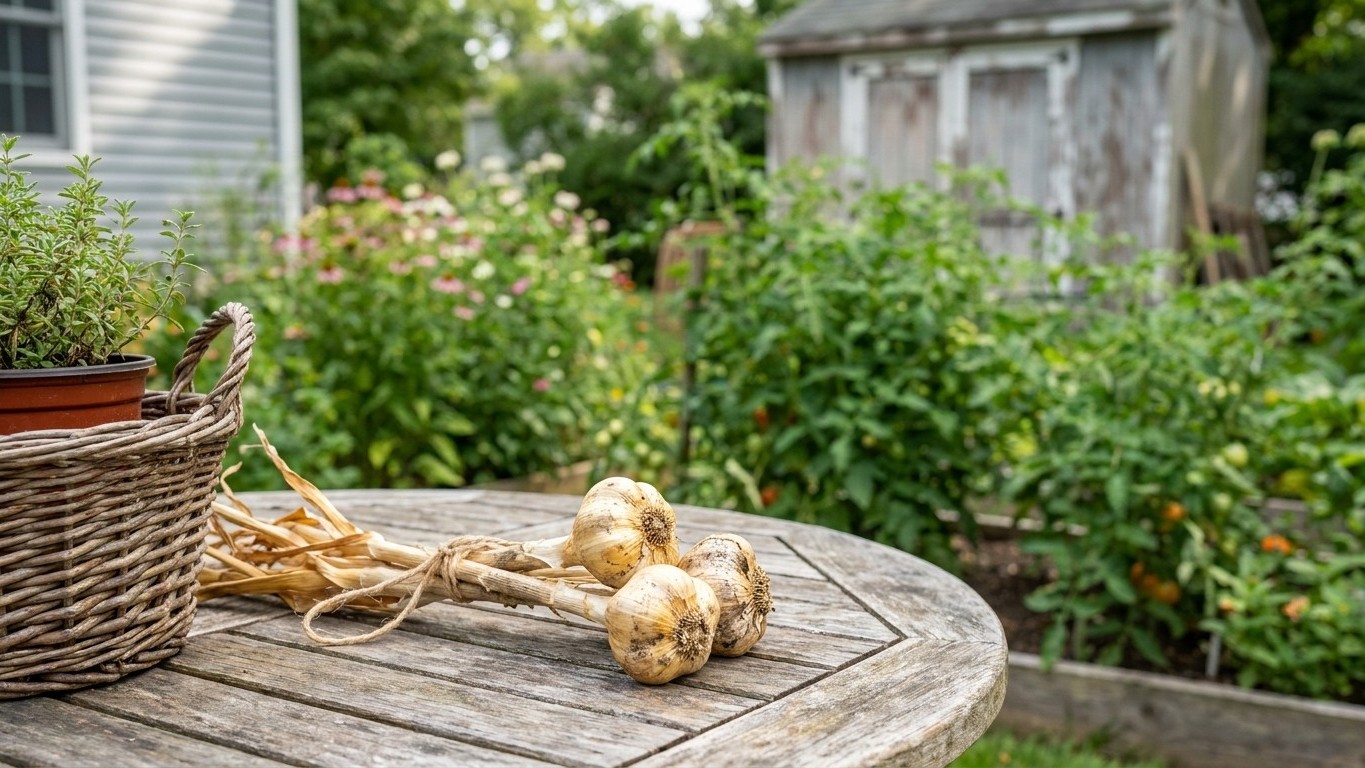

Six to eight weeks of hard chill is what turns a single round clove into a proper head of garlic, and Delaware winters hand that over without effort. Wilmington’s first freeze typically lands in late October or the first week of November, well after cloves planted that same month have settled roots into the soil. Only a sheltered raised bed or a porch container tends to fall short of the mark — worth checking before you assume your ground qualifies.
Will garlic get the cold it needs in Delaware

Garlic does not grow the way most root crops do. Each clove needs a real cold snap after planting to trigger the split into a full head of cloves. Skip that cold and the plant just grows one round, undivided bulb, essentially a giant clove with no seams inside. University of Georgia Extension’s publication C854 sets the requirement at six to eight weeks of temperatures below 40°F, and that number holds for growers everywhere hardneck or softneck garlic is planted, not just in Georgia.
Delaware clears that bar without much drama. Even in the mildest pocket, the stretch from December through February holds air temperatures below 40°F for well beyond six to eight weeks in most winters, and the freeze that opens the cold season arrives, per NOAA’s 1991-2020 climate normals for the Wilmington station, between October 26 and November 7. A garlic clove planted in early October has already rooted by the time that cold sets in, which is exactly the point behind the autumn planting window; see When to Plant Garlic in Delaware for the calendar covered in the next section.
When the cold season falls short
The one place this breaks down is a genuinely mild microclimate: a raised bed against a south-facing wall in town, a container overwintered on a porch, or a warm winter that simply underperforms. If the bed in question rarely sees a hard, sustained cold spell, refrigerating the cloves for several weeks before planting is the fix, holding them at refrigerator temperature, separate from any onions or apples that give off ethylene, to force the vernalization the ground itself did not supply.
The other option is to sidestep the requirement rather than engineer around it. Softneck varieties split their cloves on a shorter, less demanding cold requirement than hardnecks do, which is part of why growers in warm-winter states lean almost entirely on softneck stock; see how differently that plays out in Growing Garlic in Florida: Planting Dates, Varieties and Winter Cold. Delaware’s winters do not force that choice, but a grower on a marginal microclimate can still hedge with a softneck rather than gambling a whole bed of hardneck on one mild year, and checking Garlic Varieties That Suit Delaware Winters is a reasonable place to start before deciding.
When to put the cloves in
Plant too early and the cloves push soft green shoots that a hard freeze burns back before winter even sets in. Plant too late and the roots have not established before the ground goes cold, leaving the clove sitting loose and exposed to heaving all winter. The target is a clove that has grown a root system but little to no top growth by the time the ground itself gets cold.
NOAA’s 1991-2020 climate normals put the first fall freeze at the Wilmington station between October 26 and November 7. Counting back four to six weeks from that window, the ground is still workable and mild enough to root cloves through early to mid October, which is the planting window every variety in this guide’s catalogue entries is built around. That window is not a single safe date. It is a range, and it shifts with the same forces that move any frost date: elevation pushes it earlier, a large body of water like the Delaware Bay pushes it later, and a low-lying frost pocket away from that moderating water can freeze well ahead of the airport station’s average.
Adjusting for your own ground
A grower closer to the coast, where the bay keeps air a few degrees warmer into autumn, can lean toward the later half of that window. A grower inland or at any real elevation change, where cold settles faster, should lean earlier and treat the first half of the window as the safer target. Soil temperature is the more honest guide than the calendar: garlic roots well once the soil has cooled from summer’s heat, and a soil thermometer pushed a few inches into the bed tells a grower more than a date on a seed packet ever will.
Growers further north, where the ground freezes hard and early, plant on a noticeably tighter calendar than Delaware allows; the comparison is worth a look in Growing Garlic in Nova Scotia: Planting Dates, Varieties and Winter Cold. Delaware’s longer, milder autumn gives more slack, but that slack disappears fast once frost actually arrives, and a clove planted into already-cold ground roots poorly no matter how carefully the window was calculated.
Which types suit Delaware
The hardneck-versus-softneck choice is not a matter of flavor preference in a climate like Delaware’s. It is a question of whether the winter on offer is cold enough to reward a hardneck’s stronger vernalization demand, and whether the grower wants a garlic that stores through spring or one that is best used by midwinter.
Hardneck varieties for Delaware’s winters
Delaware’s winters lean toward hardneck garlic, and comfortably so given how far past the six-to-eight-week cold requirement described above the state’s winters typically run. Hardnecks also throw a scape, the curled flower stalk cut in early summer, which adds a second harvest of sorts before the bulb itself comes out of the ground. Bavarian Purple, Blue Music, Chesnok Red, Duganski, Fall Festival, Georgian Crystal, Georgian Fire, German Red, German White and Ivan are all hardneck types suited to this planting window. Catalogue figures for each are counted from planting to bulb maturity and shift by a week or two either way depending on how the season runs.
Softneck options for longer storage
Softneck garlic is not out of place here either. Early Red Italian, Inchelium Red, Italian Late and Lorz Italian all tolerate Delaware’s winter without trouble, and softneck’s real advantage is storage life, not cold tolerance: braided or bagged, a softneck head commonly holds in a pantry for months longer than a hardneck does. A grower who wants garlic on the shelf into late winter is better served planting some of both types rather than committing the whole bed to hardneck.
| Variety | Type | Planting window |
|---|---|---|
| Inchelium Red | Softneck | Early to mid October |
| Lorz Italian | Softneck | Early to mid October |
| German White | Hardneck | Early to mid October |
| Chesnok Red | Hardneck | Early to mid October |
| Duganski | Hardneck | Early to mid October |
Soil and bed preparation
Garlic sits in the same bed for eight or nine months, through a winter’s worth of rain and snowmelt, so the single most important thing to get right before planting is drainage. A clove sitting in saturated soil rots long before any fungus or cold does the damage. Standing water for even a few days over winter can kill a bed outright.
Raised beds or ridged rows solve most of Delaware’s drainage problems on the state’s heavier clay-loam soils, and even a few inches of extra height above grade keeps the root zone from sitting in a wet pan through a soggy winter. On naturally sandy, fast-draining ground closer to the coast, that step matters less, but the organic matter it takes to hold nutrients through a long season still needs adding.
Work several inches of finished compost or well-rotted manure into the bed a few weeks before planting, not the same week, so it has time to settle rather than sitting in loose pockets around the cloves. A soil test ahead of planting is the only reliable way to know whether the bed needs lime or additional phosphorus, since garlic pulls hard on both over a long season and neither corrects itself mid-winter. Clear the bed of the previous crop’s residue completely: onion and garlic family debris left in the soil is one of the more common ways white rot sclerotia get introduced to a new bed in the first place, a point worth remembering when the disease pressure section below gets into which pathogens actually favor Delaware’s climate.
What the climate here favours, and what it does not
These figures come from UC IPM’s Pest Management Guidelines for Onion and Garlic, UC ANR Publication 3453, which publish the temperature range each pathogen needs to be active. The thresholds themselves are soil temperatures, while the figures below are monthly average air temperatures, so treat this as a tendency the climate leans toward, not a threshold the garden actually crosses. A monthly average sitting inside a pathogen’s range still contains plenty of days both colder and warmer than that average, and none of this says anything about whether a given garden actually has the pathogen present. Infected seed stock introduces these diseases regardless of climate. The numbers below only describe how comfortable Delaware’s air temperatures are for a pathogen already there.
The two to watch
White rot, caused by Sclerotium cepivorum, has the most favorable run of the four: Delaware’s growing-season air temperature falls inside its published 50 to 75°F range in five separate months, September, October, April, May and June, and one of those months lands right at the pathogen’s published optimum. That is the widest window of the four diseases, and it overlaps both the planting month and the months of active spring growth, which is exactly why clearing old allium debris from the bed, as covered above, matters as much as it does.
Fusarium basal rot, from Fusarium oxysporum f. sp. cepae, falls inside its 59 to 90°F published range across four months of the season: September, May, June and July. That span pushes later into summer than white rot’s does, overlapping the curing period covered further down, when a nicked or bruised bulb is at its most vulnerable to rot organisms already in the soil.
The two Delaware’s climate mostly avoids
Pink root, caused by Setophoma terrestris, needs air temperatures in the 75 to 85°F optimum, and Delaware’s growing season hits that only in July, for one month. Southern blight, caused by Sclerotium rolfsii, needs 86 to 95°F to reach its optimum, and no month of Delaware’s growing season averages into that band at all. Neither absence means the disease cannot occur. It means the climate does not push it toward its most aggressive state, which is a real difference from a guarantee of safety.
Getting it through the winter
Mulch is what makes the difference between a bed that survives Delaware’s freeze-thaw cycles cleanly and one that heaves cloves half out of the ground by February. Lay four to six inches of straw or shredded leaves once the ground has gone cold but before the first hard freeze locks it up, which by NOAA’s 1991-2020 normals for the Wilmington station falls between October 26 and November 7; mulching a week or two ahead of that window is a reasonable target, adjusted for whichever side of the county’s own frost pattern the garden sits on.
The mulch is not there to keep the ground warm. It is there to keep the ground temperature steady, because repeated freezing and thawing is what physically pushes a shallow-planted clove up and out of the soil, snapping new roots each time it moves. A clove planted too shallow is far more exposed to this than a well-set one, which is one more reason planting depth matters as much as planting date.
Spring mulch removal
Pull the mulch back gradually in spring once new green growth is visible and the hardest freezes have passed, rather than stripping it all at once on the first mild day. Leaving a thinner layer in place through the early weeks of spring growth still suppresses weeds and holds soil moisture, and it can come off entirely once the plants are growing steadily. A bed mulched too heavily for too long into spring, on the other hand, keeps the soil cold and wet longer than the plants want, which favors exactly the white rot conditions described above rather than protecting against them.
Harvest and curing here
Garlic tells a grower when it is ready far more reliably than any date on a calendar does. Watch the leaves, not the month: once the lower third to half of the plant’s leaves have browned and died back while the upper leaves are still green, the bulb below has finished sizing and further time in the ground only risks the wrapper splitting or the cloves separating in the soil.
Lift the bulbs by loosening the soil with a fork well clear of the roots rather than pulling straight up on the stalk, which tears the wrapper leaves the bulb needs intact for curing. Brush off loose soil but leave the roots and stalk attached, and get the bulbs out of direct sun within an hour or two of lifting. Sun scald on a wet bulb right after harvest can cook the outer cloves before curing even starts.
Curing in a humid summer
Delaware’s summer humidity is the real variable in curing, more than the harvest date itself. Cure in a shaded, open-sided space with strong airflow, a barn or covered porch works better than a closed shed, for three to four weeks, until the outer wrappers are fully papery and the neck at the base of the stalk is tight and dry all the way through. In a stretch of humid, still weather, add a fan to keep air moving across the bulbs, because garlic that cures too slowly in damp air molds from the inside before the outer wrapper ever looks finished. Once cured, trim the roots and stalk, leaving an inch or so above the bulb if not braiding, and move the crop to a cool, dry, dark space for the storage stretch ahead.
Local help
County-level frost dates, soil test results and planting guidance specific to a given part of Delaware go beyond what any general guide can responsibly offer. The University of Delaware Cooperative Extension is the right first call for a soil test before bed prep, and for planting date guidance adjusted to a county’s own microclimate rather than the single Wilmington station used throughout this guide. A soil test through the extension office is worth doing the same season as bed prep, not after.
Common questions
Can I Plant Garlic in spring in Delaware instead of fall?
Not with any of the varieties covered here. Garlic planted in spring skips the cold period it needs to divide into cloves and typically produces a single small, undivided bulb rather than a full head. If a clove gets missed in fall, it is better held over for the following autumn’s planting than pushed into the ground in spring.
What happens if I plant before the window closes and we get an early warm spell?
A short warm spell after planting is not a problem. Garlic tolerates mild autumn weather fine as long as it is not pushing tall, soft top growth right as a hard freeze arrives. A little green showing above ground going into winter is normal and not a sign of a mistimed planting.
Do I need to buy seed garlic, or can I plant grocery store garlic?
Seed garlic from a supplier is the safer choice. Grocery store garlic is often treated with a sprout inhibitor, is frequently a variety not suited to this cold requirement, and carries a real risk of introducing white rot or other soil-borne disease to a bed that would otherwise stay clean for years.
How many cloves do I need for a 10-foot row?
That depends on spacing, but garlic is typically set several inches apart within the row, so a 10-foot row commonly takes somewhere around a dozen to twenty cloves depending on the variety’s typical bulb size. Check the specific variety’s catalogue spacing recommendation before ordering seed stock, since hardneck and softneck bulbs differ in mature size.
Is it too late to plant if I missed the early-to-mid October window?
A late planting into very late October can still work in a mild year, but the margin shrinks fast the closer the ground gets to the first freeze described above. A clove planted with only a week or two to root before hard cold arrives is far more vulnerable to heaving over winter, so a heavier mulch layer becomes more important, not less, the later the planting goes.