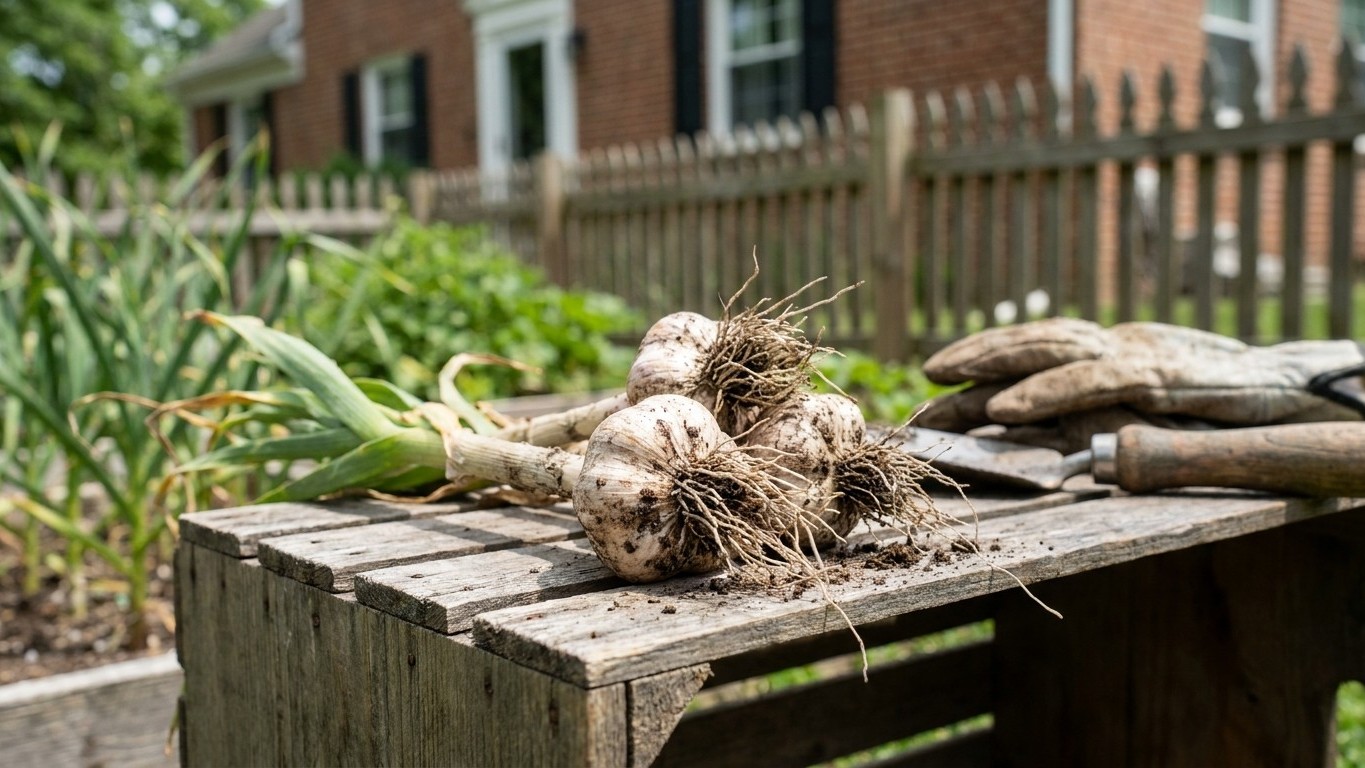

November-planted garlic in Wilmington gardens usually looks fine going into December, then comes up stunted in spring or heaves half out of the ground on the freeze-thaw cycles Delaware winters bring. The cause is almost always the same: the clove went in too late to grow the three to four weeks of root it needs before the soil locks up cold. That failure costs a whole season’s harvest, and it traces back to one overlooked distinction — root growth, not frost, is what actually sets the planting date.
The short answer for Delaware

For gardens near Wilmington, plant garlic between early October and mid October. That window applies to every cultivar sold for this territory, hardneck or softneck alike, because garlic timing has almost nothing to do with a particular variety’s cold tolerance and everything to do with giving the clove enough weeks of root growth before the ground goes cold.
The anchor point is NOAA’s 1991-2020 climate normals for the station near Wilmington, which put the first fall freeze (32°F) somewhere between October 26 and November 7. That is a 30 to 70 percent probability band, not a hard line, and it is a midpoint: in roughly half the years on record, the first freeze arrives after November 7, and in the other half it arrives before October 26. Treat the range as the middle of the distribution, never as a date you can circle on the calendar and trust.
Garlic does not need to go in after that freeze. It needs three to four weeks of root growth in soil that is still workable and reasonably cool, which is why the planting window sits ahead of the frost window rather than after it. Push planting into late October or November and the clove may not root deeply enough before winter dormancy sets in, leaving it vulnerable to heaving on the freeze-thaw cycles Delaware gets most winters.
The table below gives the same early October to mid October window for each cultivar carried for this territory. The date does not change by variety; what changes is which type suits your kitchen and your storage plans.
| Cultivar | Neck type | Set out (Wilmington reference) |
|---|---|---|
| Early Red Italian | Softneck | Early October to mid October |
| Inchelium Red | Softneck | Early October to mid October |
| Italian Late | Softneck | Early October to mid October |
| Lorz Italian | Softneck | Early October to mid October |
| Bavarian Purple | Hardneck | Early October to mid October |
| Blue Music | Hardneck | Early October to mid October |
| Chesnok Red | Hardneck | Early October to mid October |
| Duganski | Hardneck | Early October to mid October |
| Fall Festival | Hardneck | Early October to mid October |
| Georgian Crystal | Hardneck | Early October to mid October |
| Georgian Fire | Hardneck | Early October to mid October |
| German Red | Hardneck | Early October to mid October |
| German White | Hardneck | Early October to mid October |
| Ivan | Hardneck | Early October to mid October |
If you still need to pick between these, the fuller rundown of softneck and hardneck options for this state is at Garlic Varieties That Suit Delaware Winters.
Working it out for your own garden
If you haven’t finished bed prep yet, that groundwork, along with spacing and mulch depth, is covered in Growing Garlic in Delaware. The date math itself is simple enough to redo for your own soil once you know your local frost record.
The arithmetic
Start with your first fall frost. For the Wilmington-area reference station, NOAA’s 1991-2020 normals put it at October 26 to November 7. Count back three to four weeks from the early end of that range and you land in late September. Count back the same three to four weeks from the late end and you land in mid October. That spread, not a single day, is why the working window for Delaware is given as early October to mid October rather than as one date.
The reasoning behind the three to four week figure is root growth, not top growth. A garlic clove planted in cool, workable soil pushes roots for several weeks before winter dormancy shuts it down, and those roots are what carry the plant through freeze-thaw cycles and fuel the flush of leaf growth next spring. Plant too early, while soil is still warm, and the clove can push green top growth that a hard freeze then damages. Plant too late, into cold, wet soil, and the roots never get established before the ground locks up.
Adjusting for your own site
NOAA’s figure comes from one weather station near Wilmington’s airport, and that instrument sits on open, paved ground that holds heat longer than a garden bed does. Suburban and rural gardens typically see the first fall frost one to two weeks earlier than the airport figure, and gardens at higher elevation more than that. If your plot sits in a low spot where cold air pools, in a wooded clearing, or well inland from the coast, treat your true frost date as earlier than the Wilmington range and shift your planting window earlier by roughly the same margin.
None of this changes the logic, only the input. Whatever frost date you settle on for your own county, work backward the same three to four weeks and check the resulting window against what your soil is actually doing. If it’s still workable, not soggy, and cool rather than cold, you’re inside the range that matters more than any date on a chart.
What changes across Delaware
Delaware runs only about 100 miles north to south, but its geography splits into two different climates. The northern tip, New Castle County’s Piedmont hills around Wilmington and Newark, sits at higher elevation and further from open water than the rest of the state, and that combination tends to bring the first frost earlier than the coastal counties to the south.
Kent and Sussex counties sit on the flat Atlantic coastal plain, and both border large bodies of water: Delaware Bay to the east and the Atlantic itself along Sussex’s ocean side. Water holds heat longer than land, so gardens close to the bay shoreline in towns like Lewes or along the inland bays often see their first frost arrive later than the Wilmington reference figure, sometimes by a week or more, while gardens a few miles inland from that moderating effect fall closer to the NOAA range.
Soil type moves the workable window too. The coastal plain’s sandy loam warms up and dries out faster in spring, and it cools and stays workable longer into the fall than the heavier clay soils found in parts of northern New Castle County. A sandy bed in Sussex may still be diggable a week after a clay bed further north has turned cold and sticky, which matters when you’re trying to fit a three to four week root-growth window ahead of frost.
None of this replaces a local frost record. Treat the Wilmington figure as a starting point, then adjust toward earlier planting if you garden inland or at elevation, and toward the later end of the window if you’re close to the bay or ocean.
The mistakes this climate punishes
Disease risk in the planting window itself
Delaware’s fall is mild enough, and its planting window early enough, that soil temperatures during the actual planting weeks sit in a range several garlic diseases can use. UC IPM’s Pest Management Guidelines for Onion and Garlic (UC ANR Publication 3453) put white rot‘s active range at 50°F to 75°F, and the pathogen behind it, Sclerotium cepivorum, finds Delaware’s growing-season mean air temperatures inside that band in five separate months, including October, the heart of the planting window. Air temperature is not soil temperature, and a monthly average hides plenty of days on either side of it, but the overlap is real enough that planting stock matters more here than the exact date does.
Fusarium basal rot‘s published range, 59°F to 90°F for its pathogen Fusarium oxysporum f. sp. cepae, overlaps Delaware’s growing-season means in four months, September among them, right when garlic is going into ground that’s often still warm from summer. Neither disease is something the climate makes inevitable, and a count of overlapping months is not a forecast of infection. Both spread mainly through infected cloves, which is why the single biggest mistake gardeners make in this window is planting bulbs from the grocery store, or from a bag that’s been sitting in a garage, rather than certified, disease-free seed garlic from a known source.
Timing and depth mistakes
The other mistakes are less about pathogens and more about the calendar and the trowel:
- Planting in September while soil is still warm, which invites premature top growth that a hard freeze can burn back
- Setting cloves too shallow, which leaves them exposed to the freeze-thaw heaving common on Delaware’s clay soils in a variable winter
- Skipping mulch, or applying it too thin, on the theory that a mild Delaware winter doesn’t need it
- Waiting past the window into late October or November, when cold, wet soil no longer gives roots time to establish before dormancy
A mild winter punishes the last three mistakes less than a cold one does, but Delaware’s winters vary enough year to year that counting on mild is a bet, not a plan. Mulch and planting depth cost little and hedge against whichever winter shows up.
Checking this against your county
The Wilmington figures above come from one weather station, and Delaware’s coastal counties in particular can run a week or more warmer or cooler than that. Before you commit to a planting day, check county-level frost data and garlic guidance from the University of Delaware Cooperative Extension, the state’s land-grant extension service. A call to your county office beats any statewide chart, since agents there track conditions specific to New Castle, Kent, and Sussex counties rather than a single airport station. They can also point you toward local seed garlic sources, which matters more here than the exact week you plant, given how much disease risk rides on where your cloves came from.
Common questions
What if I miss the October window entirely?
You can still plant into early November in a mild year, but you’re trading away root-establishment time the crop needs before winter dormancy. Expect smaller bulbs the following summer, and mulch heavier than usual to make up for shallow rooting. If the ground has already frozen solid, wait for a thaw rather than forcing cloves into ground you can’t work.
Can I Plant Garlic in spring instead if I missed fall?
You can, as soon as the soil thaws and can be worked, but expect a smaller harvest. Garlic planted in autumn uses the whole winter to build root mass before it ever pushes a leaf, and a spring-planted clove skips that head start entirely. Treat a spring planting as a backup plan, not a substitute for the fall window.
Does frost heave mean I planted at the wrong time?
Not usually. Heaving is almost always a mulch and depth problem, not a calendar problem. Cloves set at a standard depth and covered with a few inches of straw or shredded leaf mulch rarely heave, even in a winter with heavy freeze-thaw cycling, regardless of whether they went in on the early or late end of the window.
How do I find out if my garden runs warmer or colder than the Wilmington figures?
Keep a simple frost log for a season or two, noting the first morning you see frost on grass or a covered thermometer, and compare it to the NOAA range for the Wilmington station. The University of Delaware Cooperative Extension can also help interpret local patterns if you don’t want to wait two years for your own data.
If you follow the almanac, here is when to plant garlic by the moon. It is a tradition, not a proven method.