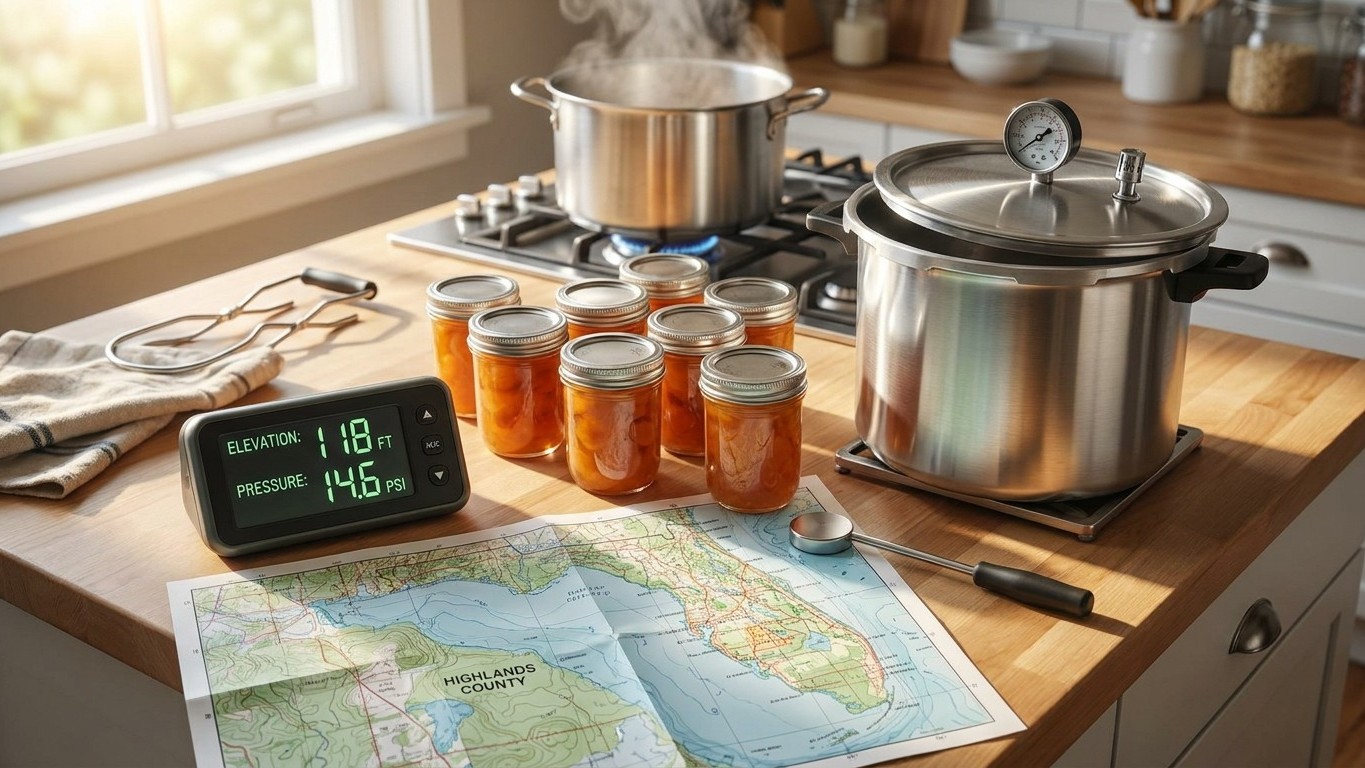

For most home canners in Florida, altitude adjustment is not something to worry about. Florida’s elevations are low enough, across nearly the entire state, that standard sea-level processing times and pressures apply as written. But “most of Florida” is not “all of Florida,” and the only way to know your own situation is to check your specific elevation against the published thresholds, not to assume based on the state’s reputation for being flat.
The short answer

Jacksonville, used here as the reference city for this figure, sits at 16 feet above sea level. Water boiling at that height falls within the range published for the 0-to-2,000-foot elevation band: between 208°F and 212°F, a range that is functionally identical to the 212°F fixed point most cooks learned in school. At 16 feet, you are close enough to true sea level that no adjustment applies. A boiling-water canner behaves exactly the way tested recipes assume it will, and a pressure canner needs no extra pounds of pressure beyond what the recipe already calls for.
That number belongs to Jacksonville, not to Florida as a whole. A state is not a single point on a map, and treating “Florida’s elevation” as one figure is the first mistake canners make when they skim past this kind of guidance. The panhandle rises gradually toward the Alabama and Georgia state lines, and a handful of inland counties sit at elevations several hundred feet above the coast. None of that comes close to the elevations where canning adjustments start to matter, but the gap between “close to zero” and “zero” is exactly why checking your own number still matters.
Where the thresholds actually kick in
Canning guidance is built around elevation bands, and the 0-to-2,000-foot band is the widest and most forgiving one. Recipes tested for sea level assume a boil at or near 212°F, and the guidance treats anything inside that first band as close enough to require no change. The next bands, starting above 2,000 feet, are where boiling-water processing times start lengthening and pressure-canner settings start climbing. Florida’s tallest points, in the low three-hundred-foot range in the panhandle’s northern reaches, never approach that first threshold.
So the practical answer for a Jacksonville canner, or for the overwhelming majority of Florida addresses, is that no altitude math is required. The exceptions are rare enough that they deserve their own quick check rather than a blanket assumption, which is exactly what the next section walks through.
Why a lower boil is a weaker process
Water boils cooler as elevation rises, and that single fact is the entire mechanism behind every altitude adjustment in home canning. At sea level, water boils at 212°F. Climb to 10,000 feet and that same pot of water boils at 194°F, a full 18 degrees cooler, simply because atmospheric pressure pushing down on the water is lower up there. Lower pressure lets water molecules escape into vapor at a lower temperature, so the boiling point drops as you gain elevation. Nothing about the water itself changes. What changes is the ceiling temperature it can reach while boiling.
A cooler boil kills less. Home canning relies on sustained heat to destroy the microorganisms and enzymes that spoil food, and in low-acid foods specifically, to destroy the spores that produce botulinum toxin. A processing time written for a 212°F boil assumes that exact temperature is doing the work for that exact number of minutes. Run the same jar at 194°F for the same number of minutes, and the food inside received measurably less lethal heat, even though it looked like it went through an identical process on the stovetop.
Cranking up the burner does not fix this. Boiling water does not get hotter no matter how hard it boils. Once water reaches its boiling point at a given elevation, additional heat just makes it boil more vigorously and boil away faster. It cannot exceed that ceiling temperature at normal atmospheric pressure. A rolling boil at 194°F is still 194°F, whether it is a gentle simmer-boil or a violent, lid-rattling boil. This is the detail that trips up a lot of canners moving from a coastal state to a mountain one: they assume a harder boil compensates for elevation, and it does not, ever.
What actually compensates is time or pressure, not heat intensity. In a boiling-water canner, the fix is more minutes in the water, giving the cooler boil longer to do the same job a hotter boil did faster. In a pressure canner, the fix is different: pressure canners work because trapped steam raises the internal temperature above what an open pot can reach, and at altitude, you dial in more pressure to push that internal temperature back up to where the tested process needs it to be. Both fixes exist for the same reason. Neither one is optional once you are far enough above sea level for the boiling point to have meaningfully dropped, and neither applies at all to a canner sitting at 16 feet in Jacksonville.
Finding your own elevation
The reference city’s elevation tells you nothing about your own address, especially in a state where inland and panhandle counties climb well above the coastline. Before you decide whether any adjustment applies to your kitchen, work through your own number.
- Start with your street address, not your city or county name, since elevation can shift by dozens of feet within the same zip code.
- Use the National Center for Home Food Preservation’s “Find Your Elevation” tool, built specifically so home canners can look up an address and get a reliable figure instead of guessing.
- Record the figure in feet, since canning guidance is published in elevation bands measured in feet, not meters.
- Match your figure to the correct elevation band in the tested recipe you plan to use, rather than assuming the 0-to-2,000-foot band applies just because you live in Florida.
- Recheck if you can your food in more than one location, such as a coastal home and an inland cabin, since the two addresses can fall into different bands even within the same state.
This is a five-minute task, and it is the only step that turns a general statement about Florida into a specific answer for your own stove.
What goes wrong
- An under-processed jar that looks completely normal. A jar that sealed, that shows no cloudiness, and that smells fine can still have received too little heat if it was processed at sea-level time in a location where the boiling point was actually lower. The remedy is checking elevation before processing, not after, since there is no way to visually detect an under-processed jar once it is sealed and cooling on the counter.
- A recipe pulled from a sea-level source without checking its assumptions. Recipe cards passed down from a relative in a coastal state, or pulled from a general cookbook, often assume 212°F without saying so anywhere on the page. The remedy is confirming the elevation band the recipe was written for and adjusting to your own band using the tested guidance for that specific food, not assuming the recipe already accounts for wherever you happen to live.
- A pressure gauge read as though elevation does not exist. A dial or weighted gauge set to the same pressure used at sea level will under-process food at higher elevations, because the pressure needed to reach the correct internal temperature rises as outside atmospheric pressure drops. The remedy is checking your canner type and elevation band together, since dial gauges and weighted gauges are adjusted differently, and neither one self-corrects for altitude on its own.
Where the exact adjustment comes from
This page does not give a processing time or a canner pressure, and it should not. The correct adjustment belongs to the tested recipe for the specific food you are canning, not to a general guide about elevation. Times and pressures are worked out food by food, jar size by jar size, through the National Center for Home Food Preservation and the USDA Complete Guide to Home Canning, and swapping in a number from a different food or a different source defeats the purpose of using a tested recipe at all.
The reason this matters more than it might seem is that botulinum toxin has no taste and no smell. An under-processed jar of low-acid food can look, smell, and taste completely normal while still being dangerous. Guessing at an adjustment, or borrowing one from a recipe for a different vegetable, removes the safety margin the testing was designed to build in.
Common questions
Does Florida ever require an altitude adjustment for canning?
Some inland and panhandle locations sit at higher elevations than the coast, so checking your own address rather than assuming the state’s low reputation applies everywhere is worth the five minutes it takes.
Is Jacksonville’s elevation the same everywhere in Florida?
No. Jacksonville’s 16 feet is a reference point for one city, not a statewide figure, and elevations across Florida vary by hundreds of feet between the coast and the northern panhandle.
Why does a harder boil not compensate for altitude?
Boiling water cannot exceed its boiling point at a given elevation no matter how vigorously it boils, so a harder boil at a lower temperature is still a lower temperature, and it does not add heat the food doesn’t already receive.
What should I do if I am unsure which elevation band I fall into?
Look up your specific address through the National Center for Home Food Preservation’s elevation tool rather than estimating from your city’s general reputation, since a few hundred feet can move you into a different band.