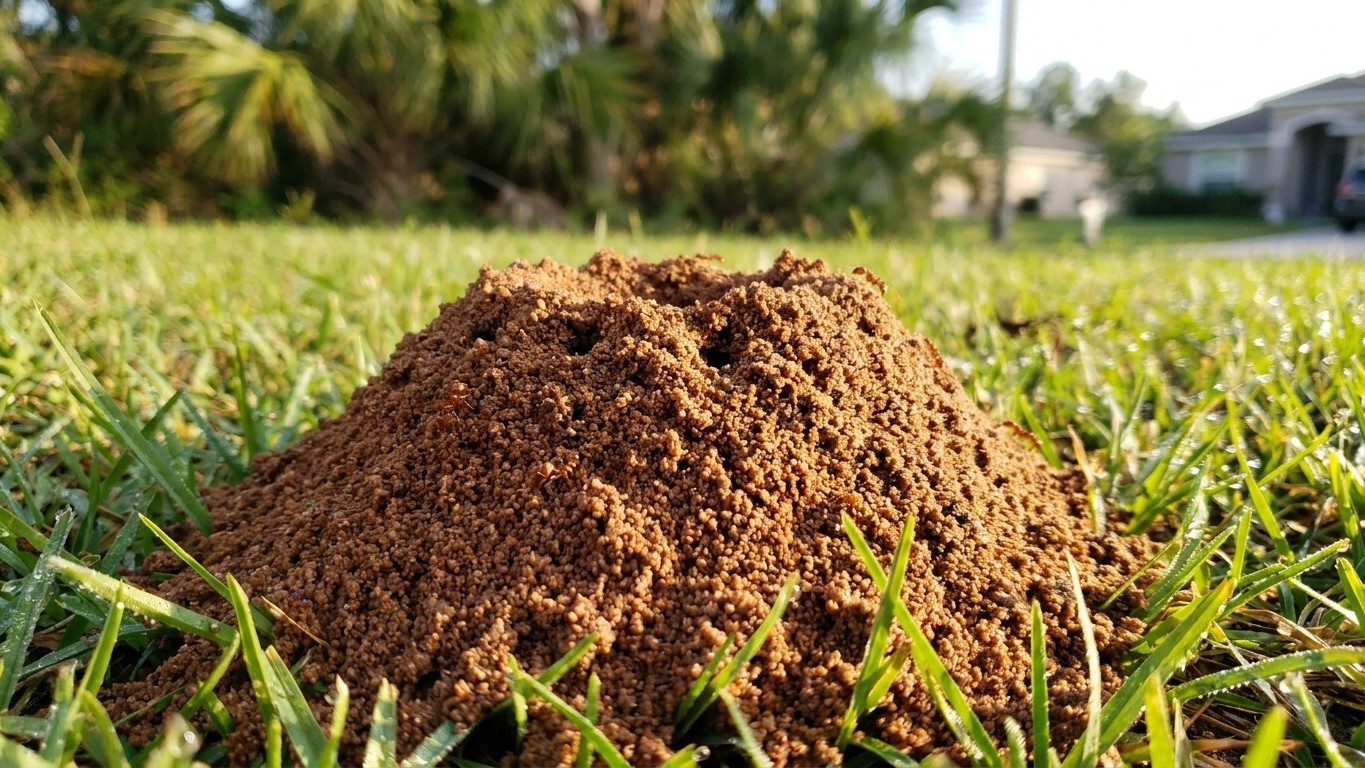

Fire ants in Florida are active nearly year-round, but they surge hardest after warm rains in spring and fall, when mounds seem to pop up overnight across lawns, pastures, and roadsides. Stopping them takes a two-part approach: broadcasting bait across the whole yard to knock out colonies you can’t see, then treating individual mounds directly for the ones causing immediate problems. Skip either step and you’re just trimming the surface of a much bigger underground network.
Florida’s Almost Year-Round Fire Ant Season

Red imported fire ants (Solenopsis invicta) arrived in the Southeast through the port of Mobile, Alabama, sometime in the late 1930s, likely riding in on soil used as ship ballast. From there they spread across the Gulf Coast and up through Florida, where the climate turned out to be close to ideal. Mild winters mean colonies rarely go fully dormant the way they might in Georgia or the Carolinas. A cold snap in January might slow foraging for a week, but it won’t wipe out a mature colony.
Activity peaks twice a year. The first surge runs from February through June, when soil temperatures climb and spring rains soften the ground. The second comes in September and October, after the worst of summer’s heat breaks but before winter cools things down. Queens can lay over 800 eggs a day during these windows, and new mounds can appear within 24 to 48 hours after a heavy rain.
Why Rain Triggers a Mound-Building Frenzy
Fire ants build their signature dome-shaped mounds partly for temperature control and partly for flood protection. When a colony’s underground tunnels flood, workers rebuild upward, pushing loose soil into the familiar mound shape you see dotting Florida yards after a storm. That’s why homeowners often notice a “fresh” mound the morning after a downpour, even in spots where the lawn looked clean the day before. The colony didn’t just arrive. It relocated a few inches and rebuilt.
There’s a stranger survival trick worth knowing about, especially during hurricane season. When floodwaters rise fast, fire ant colonies can link legs and antennae to form a floating raft, carrying the queen and brood on top, and drift until they hit dry land or something to climb. Floridians in low-lying areas sometimes find these rafts pressed against fences or floating in standing water after tropical storms. It’s an unsettling sight, but it explains how colonies bounce back so quickly after major flooding events.
How to Recognize a Fire Ant Mound (and Avoid a Sting)
Fire ant mounds don’t have a visible entrance hole the way many other ant mounds do. Instead, workers tunnel out sideways from underneath, so the dome itself looks solid until it’s disturbed. Mounds typically run 4 to 18 inches across and up to 18 inches tall in undisturbed soil, though mowed lawns often flatten them into low, loose patches of dirt that are easy to miss until you’re standing on one.
The ants themselves are reddish-brown, roughly an eighth to a quarter inch long, with workers of noticeably different sizes in the same colony. That size variation is one way to tell them apart from other common Florida ants, along with the aggressive response: disturb a mound and workers swarm up the nearest vertical surface within seconds, stinging repeatedly rather than just biting once and retreating.
Fire ant stings cause a burning sensation followed by a white pustule that typically forms within 24 hours, a symptom pattern that’s fairly distinctive compared to other insect stings. Most people deal with itching and mild swelling for a few days. But a small percentage of the population has a genuine allergic reaction, and multiple stings at once (easy to get if you step in a mound barefoot) raise the risk of a systemic reaction requiring emergency care. The CDC’s guidance on fire ant stings recommends watching for symptoms like difficulty breathing, dizziness, or swelling away from the sting site, and seeking medical attention immediately if they appear.
What Actually Stops Fire Ants: Treatment That Works
The most reliable strategy, and the one recommended by University of Florida entomologists, is called the two-step method. Step one is a broadcast bait spread across the entire yard, not just around visible mounds. Worker ants carry the bait back to the colony and feed it to the queen, which is the only way to actually eliminate a colony rather than just scattering it. Baits containing hydramethylnon, indoxacarb, or spinosad tend to act faster, while insect growth regulators like methoprene or pyriproxyfen work slower but sterilize the queen over several weeks.
Step two targets individual mounds that are causing an immediate problem, like one sitting a few feet from a swing set or a garden bed. Mound drenches (liquid insecticide poured directly into the mound), granular treatments watered in afterward, or dusts applied to the mound surface can kill a colony within a day or two. The tradeoff is that these direct treatments only reach the colony you can see. They do nothing for the dozens of smaller, less obvious mounds scattered across the rest of the property, which is why bait alone or mound treatment alone tends to disappoint.
Timing matters more than most people realize. Bait works best when ants are actively foraging, generally when soil temperatures sit between 70 and 95 degrees Fahrenheit and the ground is dry. Applying bait right before rain washes it away before workers can collect it, and applying it during the hottest part of a summer afternoon often means foragers aren’t even active on the surface. Early morning or early evening in spring and fall usually lines up best with real foraging activity.
For properties with heavy infestations, especially agricultural land, pastures, or large lots bordering wooded areas, professional pest control services often combine broadcast bait with periodic mound treatments on a seasonal schedule rather than a one-time application. That ongoing approach matters in Florida specifically because new queens can fly in from neighboring untreated land at almost any time of year.
Keeping Them From Coming Back
Treated yards don’t stay ant-free forever, particularly if neighboring properties are untreated. Mated queens fly to find new nesting sites, sometimes traveling a mile or more, and a cleared lawn can get reinfested within a season if conditions are right. A few habits make new colonies less likely to take hold:
- Mow regularly and keep grass at a moderate height, since fire ants prefer disturbed, sunny soil over shaded, root-bound turf
- Avoid overwatering, since consistently damp soil near foundations and garden beds is a common site for new mounds
- Move firewood, mulch piles, and stacked materials away from the house, since these create shaded, undisturbed spots colonies favor
- Check potted plants and nursery stock before bringing them home, since colonies sometimes hitch a ride in the soil
- Re-treat with bait on a seasonal schedule, roughly every 8 to 10 weeks during peak activity months, rather than waiting for new mounds to appear
One thing worth knowing before reaching for a shovel: physically digging up or disturbing a mound without treating it first almost always backfires. Disturbed colonies often split, with part of the colony relocating a few feet away and rebuilding, effectively turning one mound into two. Chemical treatment, not physical removal, is what actually collapses a colony for good.
Florida’s fire ant population isn’t going away. The state’s climate, soil, and rainfall patterns are close to perfect for the species, and decades of control efforts have managed containment rather than elimination. For most homeowners, that means treating fire ants less like a one-time problem to solve and more like a seasonal task, similar to fertilizing the lawn or checking gutters before hurricane season, that keeps colonies from getting a foothold big enough to matter.