
Fire ants are active in Mississippi from early spring through late fall, with the heaviest mound-building and stinging incidents happening in April, May, September, and October, when soil temperatures sit between 70 and 95 degrees Fahrenheit. They slow down in the coldest weeks of winter and the hottest stretches of August, retreating deep underground rather than dying off. What actually stops them is a combination of bait treatments that reach the queen and targeted mound drenches applied at the right soil temperature, not the quick backyard remedies most homeowners try first.
Why Mississippi Has Been Fire Ant Country for Decades

The red imported fire ant (Solenopsis invicta) isn’t native to the Southeast. It arrived through the port of Mobile, Alabama, sometime in the late 1930s, likely in soil used as ship ballast, and spread west into Mississippi within a few decades. By the 1950s it had colonized most of the state’s warmer counties, and today every county in Mississippi falls inside the federal fire ant quarantine zone that regulates the movement of soil, plants, and hay to slow further spread into ant-free regions.
The climate here is close to ideal for the species. Mississippi’s mild winters rarely produce the sustained hard freezes that knock back fire ant populations in states farther north, and the long, humid growing season gives colonies months to expand. A single mature colony can hold 100,000 to 500,000 workers, and a healthy Mississippi pasture or yard can carry 40 to 150 mounds per acre in heavily infested areas, according to entomologists who track colony density across the Gulf South.
Soil type matters too. Fire ants favor open, sunny ground with loose or sandy soil, which describes a lot of Mississippi lawns, pastures, roadside ditches, and the graded dirt around new construction. Shaded forest floors slow them down, but anywhere the sun hits bare or thin turf for most of the day is an invitation.
When Fire Ants Show Up: A Season-by-Season Pattern
Fire ant activity tracks soil temperature more closely than air temperature, which is why a warm February afternoon in the Delta can bring workers to the surface even while nights still dip into the 40s. Extension entomologists at Mississippi State University note that foraging drops off sharply once soil temperatures fall below 60°F and stops almost entirely below 50°F, but it doesn’t take much of a warm front to bring them back out.
Spring is mound-building season. As soil warms through March and April, colonies that spent winter several feet underground move closer to the surface, and new mounds seem to appear overnight after a rain, especially in lawns that were recently mowed short. This is also when queens from mature colonies take flight to start new colonies elsewhere, so a yard with a handful of mounds in March can have three times as many by June if left untreated.
Midsummer brings a strange lull. Once soil temperatures climb above 95°F, which happens routinely across central and south Mississippi in July and August, ants retreat deeper into the mound to avoid the heat near the surface. Mounds can look abandoned during the hottest part of the afternoon even though the colony is very much alive a foot or two down.
Fall is the second peak. September and October bring cooler, wetter conditions that push ants back toward the surface, and this is often when homeowners notice a fresh round of mounds after the summer dry spell breaks. Many pest control professionals in the state treat properties twice a year specifically to catch these two windows, once in early spring and again in early fall.
What a Fire Ant Mound Actually Looks Like
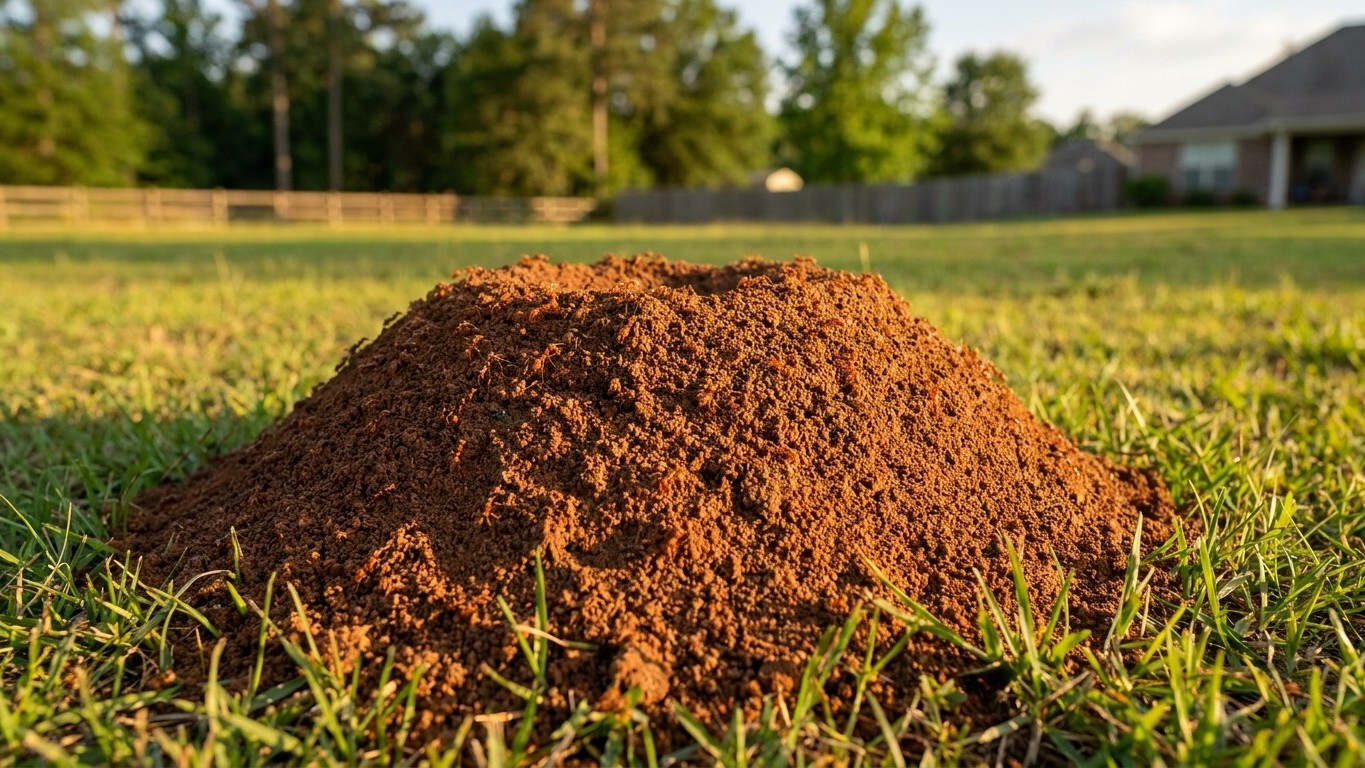
Fire ant mounds don’t have a visible entrance hole the way many other ant mounds do. Instead they look like a loose, crumbly dome of soil, usually 6 to 18 inches across and up to 18 inches tall in older colonies, with tunnels that radiate outward underground for several feet before surfacing elsewhere. Disturbing the mound with a rake or a foot brings workers boiling to the surface within seconds, which is the fastest way to tell a fire ant mound from a harmless dirt clump or a mound built by native ants that tend to be far less aggressive.
What Actually Stops Fire Ants in Mississippi Yards
The method Mississippi State University Extension recommends for most residential situations is called the two-step approach, and it works because it targets both the colonies you can see and the ones you can’t. Step one is a broadcast bait applied across the entire yard, not just around visible mounds. Worker ants carry the bait back to the colony and feed it to the queen, which is the only way to actually kill a colony rather than just scattering it. Step two is a direct mound treatment, usually a liquid drench or granular product applied to individual mounds that are causing an immediate problem, like ones near a porch, mailbox, or play area.
Timing changes how well any of this works. Baits only get carried back to the nest if ants are actively foraging, so applying bait during the heat of a July afternoon or a cold January morning is largely wasted product. The best windows are early morning or early evening when soil temperatures sit in that 70 to 95 degree range and ants are visibly moving across the mound surface. Rain within a few hours of a bait application can wash it away before ants pick it up, so a dry evening application ahead of a clear day works better than treating right before a storm front.
Homeowners sometimes try pouring boiling water on mounds, and it does kill a portion of a colony, but university trials consistently show a success rate under 60 percent, mostly because queens and much of the colony are already too deep underground by the time water reaches them. Mound treatments and baits formulated for fire ants outperform boiling water, dish soap mixtures, and gasoline (which is also illegal to use for this purpose in most states, Mississippi included, because it contaminates soil and groundwater).
For pastures, hayfields, and larger acreage, broadcast bait applied by ground equipment or aerial application twice a year is the standard approach among Mississippi row crop and cattle operations, since spot-treating hundreds of mounds individually isn’t practical at that scale. The Mississippi State University Extension Service publishes updated product recommendations each season, since active ingredients and formulations available to consumers change over time.
Why Fire Ants Matter Beyond a Painful Sting
A fire ant sting itself causes a burning welt that typically develops into a white pustule within a day, and most people recover with no more than discomfort and itching for a few days. But a small percentage of the population, generally estimated between 1 and 2 percent, develops a genuine allergic reaction that can include difficulty breathing or swelling beyond the sting site, which requires emergency care the same as a bee or wasp sting allergy would.
The bigger cost in Mississippi shows up in agriculture and infrastructure rather than backyards. Fire ants damage electrical equipment by nesting inside irrigation controllers, AC units, and utility boxes, drawn to the warmth. They also reduce yields in some row crops by feeding on seedlings and can injure newborn calves and other livestock that stumble into a disturbed mound during calving season, which is a real concern for the state’s cattle producers.
Ground-nesting wildlife takes a hit too. Studies from wildlife agencies across the Gulf South have linked heavy fire ant infestations to reduced survival rates in quail chicks and other ground-nesting bird species, since the ants attack hatchlings still in the nest.
When to Bring in a Professional
DIY bait-and-treat programs handle most residential yards just fine, especially when applied on the twice-a-year schedule extension services recommend. But a few situations call for professional treatment: properties with more than 20 to 30 active mounds, infestations near structures where colonies may be nesting inside wall voids or under slabs, and any situation involving a household member with a known insect sting allergy. Licensed pest control operators in Mississippi also have access to some broadcast and mound-injection products not sold over the counter, which can knock down large infestations faster than consumer-grade baits.
One detail worth knowing before hiring anyone: Mississippi requires pest control businesses treating for fire ants and other pests to be licensed through the Mississippi Bureau of Plant Industry, so asking to see that license before signing a contract is a reasonable and normal request, not an insult to the technician standing on your porch.