
Ignore a bowing basement wall through one more wet season and the movement won’t wait for you to catch up. It worsens quietly, season after season, until a problem an engineer could have simply monitored has turned into one that needs stabilization. The single action that matters right now: hold a straightedge or a string line against the wall today, note how far out of plane it sits, and check again in a month rather than waiting a year to look.
What is actually going on

A basement wall stands there to hold back an enormous amount of soil, not to negotiate with it. Under dry conditions, that soil pushes against the wall with a load the footing and the framing above were sized to carry. Add water and the math changes. Saturated soil is heavier, and clay soil also expands as its particles absorb moisture, which increases the lateral force against the wall well beyond what the original design accounted for. In a freezing climate, ice forming in the soil next to the wall adds a further push. The wall does not need a design flaw to bow. It just needs sustained pressure it was never built to resist.
Why the pressure builds
Most of that pressure traces back to water that isn’t getting away from the foundation the way it should, a subject the wider guide to foundations and basements covers in full. Poor grading, a downspout discharging right at the wall, or soil that stays saturated for weeks after rain all feed the same mechanism. None of it shows up overnight. It accumulates over seasons, which is why a wall that looked fine two years ago can be visibly bowed now without anything dramatic happening in between.
What the crack direction tells you
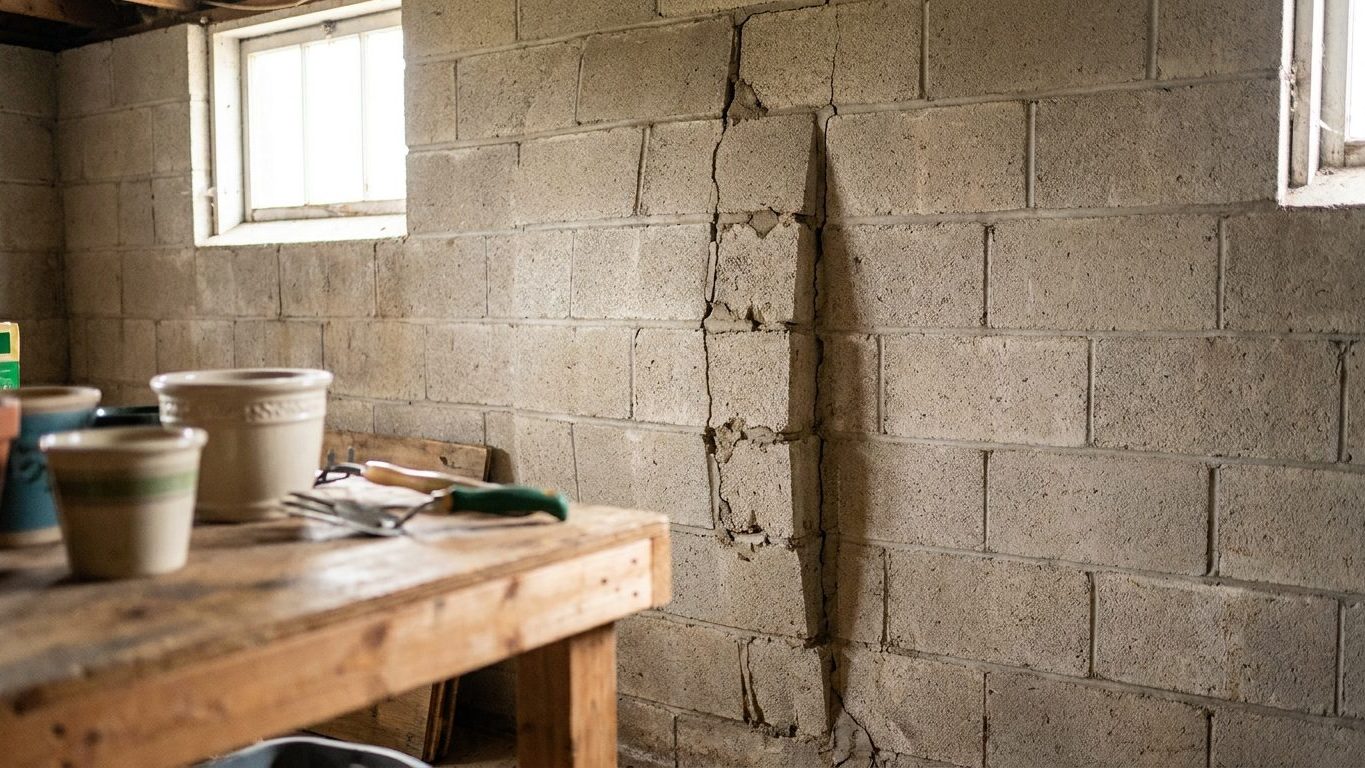
The shape of a crack points to which mechanism is at work. A wall settling unevenly under vertical load typically cracks on a diagonal, wider at one end than the other. A wall being pushed from the side develops something different: a horizontal crack near the middle of the wall’s height, sometimes with an offset you can feel with your hand, is the sign of lateral load rather than settlement. In block walls this often shows up as a stair-step crack tracking the mortar joints, or as a straight horizontal split running most of the wall’s length.
A horizontal crack paired with a visible bow is a structural symptom, and only a structural engineer can tell you how far along it is and what it will take to stop. This page doesn’t assess that crack or estimate its width, because the number that matters isn’t the width on a given day but the rate of change, and reading that rate takes training and usually a baseline measurement to compare against.
Whatever you do, don’t reach for hydraulic cement or an interior waterproof coating as the first move. Sealing the inside of a bowing wall does nothing to relieve the pressure that’s causing the bow, and it can hide the one piece of evidence, ongoing water intrusion, that would tell an engineer how urgent the problem is. Water under pressure finds another path around a coating. The wall keeps moving behind a nicely painted surface.
What to look at, and in what order
Work from least invasive to most before you call anyone. Each step either rules something in or rules something out, and by the time you reach the bottom of the list you’ll have a clearer picture to hand a professional instead of a worried description over the phone.
The checks, in order
| Check | How to do it | What it tells you |
|---|---|---|
| Straightedge or string line | Hold a long straight board or a taut string against the wall face from top to bottom | Confirms whether the wall is actually out of plane and roughly where the bow is worst, ruling out an optical illusion from framing or paint lines |
| Grading and downspouts | Walk the perimeter during or right after rain and see where water pools or where downspouts discharge | Tells you whether surface water is being held against the foundation, which rules a common driver of the pressure in or out |
| Crack orientation | Look at whether cracks run horizontal, diagonal, or stair-step through the mortar joints | Distinguishes lateral pressure, which cracks horizontally, from settlement, which cracks on a diagonal |
| Interior humidity and staining | Look for white mineral deposits, damp patches, or a change in odor near the wall | Indicates whether water is currently moving through the wall, which tells you the problem is active rather than a leftover from years ago |
| Monitoring over time | Mark a crack or the wall face and date it, then recheck monthly | Shows whether movement is ongoing or whether it stopped years ago and you’re looking at old evidence |
A wall that’s bowing and also sits above a cracked slab is worth mentioning to whoever assesses it, since the two are sometimes related and sometimes coincidental. The guide to cracks in a basement or garage floor walks through how to read those separately.
What the checks don’t tell you
If the humidity check turns up a musty smell that wasn’t there last year, track that too, even though it doesn’t speak to the structural side of the wall on its own. The guide to why a basement smells, and what it means explains what a change in odor usually signals.
What none of these checks can do is tell you whether the wall is safe to leave alone for another season. A rate of change matters far more than a single measurement, so mark it and wait rather than guessing from one look. That judgment, and the decision about what happens next, belongs to a structural engineer, not to the pattern you noticed on a Saturday afternoon. The checks above exist to make that visit more useful, not to replace it.
Watch it, or get someone in
A small, stable bow that hasn’t changed across your monthly checks is something you can reasonably keep an eye on while you deal with the water problem outside. A bow that’s increasing, a crack that’s opening further, or any inward movement you can now see with your own eyes and not just measure, is not something to keep watching. That’s a call to make this week, not this season.
What you can keep watching
- A stable, marked crack that hasn’t grown across at least one full monitoring cycle
- A slight bow with no new horizontal cracking and no fresh dampness
- Cosmetic efflorescence with no accompanying change in the wall’s shape
None of these need a phone call tonight, but none of them are a reason to stop checking either. If any of them change, they move to the other list.
Who to call, and why it matters which one
A wall that has visibly rotated since your last check, a horizontal crack that has newly appeared or widened, doors or windows in the basement that are suddenly sticking, or water actively coming through the crack rather than just staining around it, all belong on the call-now list.
Three different people will show up if you dial three different numbers, and only one of them has no financial interest in the answer. A structural engineer inspects the wall, takes measurements, and tells you whether it needs stabilization, without selling you the repair itself. That independence is worth having, because the next two calls both come with something to sell.
A drainage contractor deals with the water side of the problem: grading, downspout extensions, footing drains, the things that reduce the pressure reaching the wall in the first place. A waterproofing company will often propose an interior fix, a coating or a drain system along the inside perimeter, which manages moisture in the room but does nothing for the lateral pressure that’s actually bending the wall. Call the engineer first, and let the findings decide which of the other two, if either, you actually need.
What has to happen first
Once an engineer has told you what the wall needs, the order of the remaining work doesn’t change. Water management outside comes first, always, because no interior fix and no wall repair holds up for long against pressure that rebuilds after every storm.
Water before anything else
Start with whatever is carrying water away from the house in the first place. Gutters that overflow or discharge right at the foundation are pushing water into the same soil that’s pressing on the wall, and fixing that is a job for the roofing side of the house before it’s a basement job at all. A sump pump handling groundwater that collects inside the foundation footprint is a separate system on the plumbing side, and it needs to be sized correctly and working before you finish anything above it.
Finishes come last
Only after the water side is under control does it make sense to think about the walls themselves. Basement insulation installed against a wall still under active lateral pressure just hides the next round of movement behind a finished surface, so that step waits for after stabilization, not before it. The same logic applies underfoot. Flooring materials laid on a slab that’s still taking on moisture from an unaddressed drainage problem will fail for the same reason a paint job would have failed on the wall above it, so that waits too.
Diagnosis first, drainage second, structural repair third, finishes last. Skip a step in that order and you aren’t saving time. You’re paying for the same problem twice.
Common questions
How much bow in a basement wall is too much?
There’s no single safe number that applies to every wall, because the load, the wall material, and the soil behind it all differ from one house to the next. What matters more than the amount is whether it’s changing. A stable bow with no new cracking is a different situation than one growing month over month, and a structural engineer can measure your specific wall against an actual standard in a way a general guide can’t.
Can I fix a bowing wall myself with carbon fiber straps?
That’s a repair method some contractors install after an engineer has approved it for a specific wall, not something to put up as a first move. It’s appropriate for certain degrees of lateral movement on certain wall types. Installing it before the water problem behind the wall is under control, or before someone qualified has confirmed it fits your wall’s construction and condition, can mask a problem instead of solving it.
Does a bowing wall mean my house is about to collapse?
Almost never on any short timeline. Most bowing walls move slowly, over years rather than weeks. Slow doesn’t mean safe to ignore though, and a wall that’s actively worsening should be assessed, not because collapse is imminent but because the range of workable fixes narrows the longer the pressure keeps building.
Is a bowing wall covered by homeowners insurance?
That depends entirely on your policy and the cause, and no general guide can tell you what your specific coverage says. Check directly with your insurance company, since foundation movement from soil pressure is treated very differently from one policy to the next, and some exclude it outright while others cover resulting damage under certain conditions.