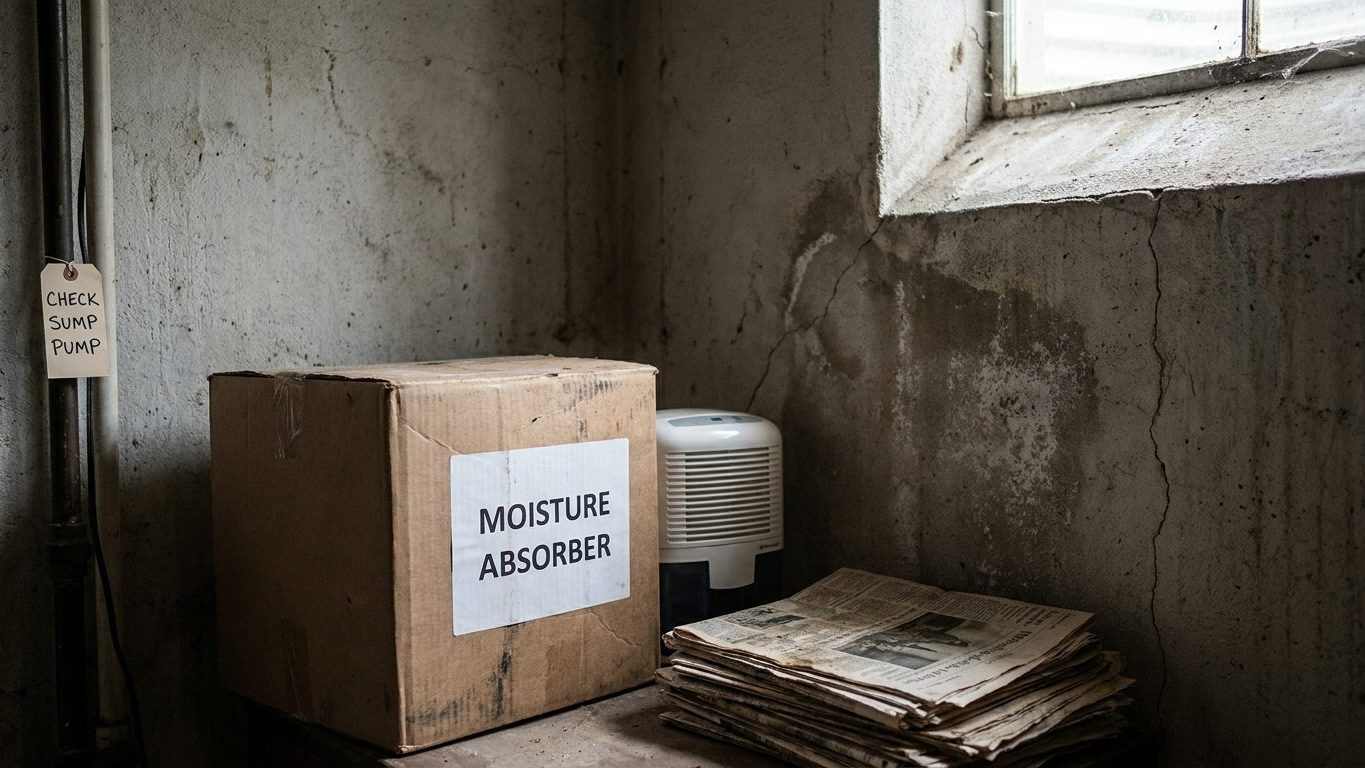

Spraying air freshener into a basement that smells like a wet towel buys you a day, then the smell comes back stronger. That smell is the earliest signal you’ll get that something down there is staying wet long enough for mold and bacteria to feed on it, well before a stain or a puddle shows up anywhere. Trace it to its source before you treat the air, not instead of treating the air.
What is actually going on

The mechanism behind the odor
That musty odor is not the smell of concrete or dirt. It is a metabolic byproduct. Mold, mildew and certain bacteria break down organic material, paper, cardboard, wood framing, dust, cotton, cellulose insulation, and the compounds they give off while feeding are what your nose is picking up. These organisms need a food source, which almost anything in a basement provides, plus oxygen and moisture held in the material long enough for a colony to get established.
That is why the smell matters more than most people give it credit for. A basement wall can hold elevated moisture for weeks without a visible drip, a visible crack, or a discolored patch, and microbial activity inside a stud bay or behind a baseboard can be well underway before any of that shows. The odor is usually the earliest instrument you have, ahead of a hygrometer reading and ahead of anything you could photograph.
Why sealing the inside isn’t the fix
Sealing the inside face of a basement wall, with a paint-on coating or a membrane, does not stop water arriving from outside under pressure. It can hide staining and slow the release of moisture into the room’s air, but water pushing through a foundation from saturated soil, a high water table, or poor grading finds another path and often resurfaces somewhere new. Anything applied on the interior is a finishing step, not a fix, and it belongs after the water’s source has been dealt with.
On mold itself: there is no federal or state standard that sets an acceptable amount of mold in a home, no home test kit that returns a pass or fail, and no square footage of visible growth below which a situation is officially fine. Nobody can hand you a number here, and any inspector or product claiming otherwise is selling a certainty that doesn’t exist. Remove the moisture, let the material dry, then decide what to do with whatever growth remains.
People react very differently to mold exposure. Some notice nothing at all. Others get a stuffy nose, a cough, or worse. Anyone with asthma, chronic respiratory disease, or a compromised immune system should not be the one opening up drywall or moving damp boxes in that space, no matter how mild the smell seems.
What to look at, and in what order
Work through these in order
A smell with no visible water is common, and it doesn’t mean you’re imagining it. It means the moisture is somewhere you can’t see, at a level below what shows as a stain, or intermittent enough to dry between events. Work through these checks cheapest and least invasive first. Each one either points you somewhere or removes a possibility.
| Check | What you do | What it suggests | What it rules out |
|---|---|---|---|
| Timing | Note whether the smell spikes after rain or snowmelt, or stays steady regardless of weather | A spike after weather points to an exterior source. A smell that never changes points to groundwater, plumbing, or trapped humidity | Rules out the other category as the dominant driver |
| Walk-through by nose | Move slowly through the basement and note where the smell is strongest | A localized strong spot usually sits near the actual wet material | Rules out a whole-room humidity problem if the smell is sharply localized |
| Hygrometer reading | Leave a hygrometer in place for several days and check it at different times of day | Readings that stay persistently high for the season point to ambient humidity rather than a single leak | Rules out a single active leak if the whole room reads uniformly damp |
| Exterior grade and downspouts | Walk the perimeter and check that soil slopes away from the foundation and downspouts discharge well clear of the wall | Grade sloping toward the house, or downspouts dumping at the foundation, points strongly to surface water | Rules out groundwater as the main cause if fixing the grade stops the smell |
| Cove joint and wall base | Look along the joint where floor meets wall, and at the base of walls, for a chalky white deposit (efflorescence) or a damp line | Efflorescence means water has moved through the concrete and evaporated, leaving dissolved minerals behind | Rules out condensation alone, since condensation leaves no mineral deposit |
| Plumbing and sump pit | Check visible supply and drain lines, the water heater, and the sump pit and its discharge line | A damp pipe run, or a sump pit that’s dry between rain events but still smells, points to a slow fixture leak | Rules out the foundation itself as the source |
What the crack or the humidity reading means
If any of these checks turns up a crack, note it and track whether it changes in width or length over the following weeks rather than guessing. The method for doing that properly is laid out in Watching a Crack to See If It Is Moving, because a stable hairline crack and a widening one call for very different responses.
If the hygrometer points to ambient humidity rather than a single source, the next move is managing that air rather than chasing a leak that may not exist. Controlling Humidity in a Basement covers bringing that down without just masking the smell with a scented plug-in.
None of the checks above require opening a wall or digging along the foundation. Digging next to a foundation to expose it is not a homeowner task. It can undermine the footing, and the excavation itself can collapse on the person doing it. Everything here works from what you can already see and reach.
Watch it, or get someone in
Who to call, and why it matters
Some of what turns up in the checks above is fine to monitor yourself for a while. A faint smell that shows up only after heavy rain and clears within a day or two, tied to a grading or downspout issue you’ve since corrected, is reasonable to watch through a season before deciding it needs anything more. A hairline crack that isn’t widening, tracked over several weeks, falls into the same category. Keep watching, don’t seal it yet.
A few situations move past watching and need a professional now, and which professional matters. A structural engineer looks at the foundation itself, cracking patterns, wall bowing, settlement, and gives an assessment with no product to sell at the end of it. An engineer’s job is to tell you what’s happening, not to sell you the fix, which is exactly why their opinion is worth paying for even when a waterproofing company’s inspection is free. A drainage contractor deals with grading, gutters, and downspout extensions, the exterior work that has to happen before anything inside gets treated. A waterproofing salesman, despite the free-sounding inspection, is there to sell an interior system, and the diagnosis tends to point toward whatever they install.
Call the engineer first if you see a crack that’s actively widening, a wall that’s bowing or stepping out of plane, a door or window frame racking out of square, or a smell that’s steadily worsened over months with no seasonal pattern. Those are structural questions, and only a structural engineer’s assessment settles them. Call a drainage contractor once the checks above confirm the water is coming from outside and you need the exterior fix designed and installed. Go to a waterproofing company only after you already know the water source has been addressed and what’s left is managing humidity or finishing the interior.
On the mold itself, nobody, professional or otherwise, can test the air and hand you a pass or fail, because that standard doesn’t exist. A professional can tell you whether the growth is tied to an active water problem or an old one, and whether the material it’s growing on needs to come out. Anyone with asthma, allergies, or a weakened immune system should stay out of that space until someone else has assessed it and removed the affected material if needed.
What has to happen first
Sequence matters more than the fix itself
This is where money gets wasted on this problem more than anywhere else, paying for interior work before the exterior water is dealt with. If you haven’t already covered the basics of how water moves through a foundation, that’s worth doing before spending on anything, and Foundations and Basements: Almost Everything Here Is Water lays out the whole sequence.
Drainage always comes before interior treatment. Water reaching the basement from outside, whether from a poor grade, gutters discharging at the foundation, or a high water table, has to be redirected or managed at the source first. Only once that’s done does it make sense to spend on anything inside. An interior coating or a finished wall applied before the exterior problem is fixed will just fail again, sometimes hiding the recurrence until it’s worse.
Gutters and downspouts are usually the cheapest and most overlooked piece of this, since a large share of the water reaching a foundation comes straight off the roof. Clogged, undersized gutters, or downspouts dumping right at the wall, are roofing and drainage territory before they’re ever a basement problem. A sump pump handling groundwater that’s already made it inside is plumbing territory, and it needs to be sized and maintained to do its job during the events that matter most.
Diagnosis comes before repair, every time. Insulating a basement wall, or laying a finished floor over a slab, only makes sense once the water problem behind the smell is solved, not managed with a fan. Insulation and interior wall finishes can trap moisture against the concrete if installed too soon, and a slab that’s still wicking moisture will ruin flooring material regardless of how good the installation is. Get the water sorted first. Everything that goes on top of it lasts only as long as that first step actually held.
Common questions
Why does the smell get worse in summer?
Warmer air holds more moisture, and that extra humidity in the air condenses on cool basement surfaces like concrete walls and floors. The same water source can produce a stronger smell in summer simply because there’s more moisture in the air feeding the same microbial growth.
Can I just run a dehumidifier and be done with it?
A dehumidifier manages ambient humidity in the room’s air, and it can genuinely reduce the smell if the source is condensation or general dampness rather than a leak. It does nothing for water actively entering through a crack, a cove joint, or a failed grade, and running one without checking the source risks masking a problem that keeps getting worse behind the scenes.
The smell only shows up in one corner. Does that matter?
Yes. A localized smell almost always means localized wet material, which is easier to find and address than a whole-room humidity problem. Start your checks in that corner specifically, looking at the nearest section of wall, the cove joint, and anything stored against that wall that might be holding moisture.
Is an old musty smell in a basement I just bought something to worry about?
It’s worth investigating before you assume it’s cosmetic. A long-standing smell in a home you didn’t build up your own history with could reflect years of a water issue nobody dealt with, or it could be residual odor in porous materials from a problem that’s already fixed. The checks in this article will tell you which, and a structural engineer’s assessment is the right call if you find any sign the foundation itself has moved.