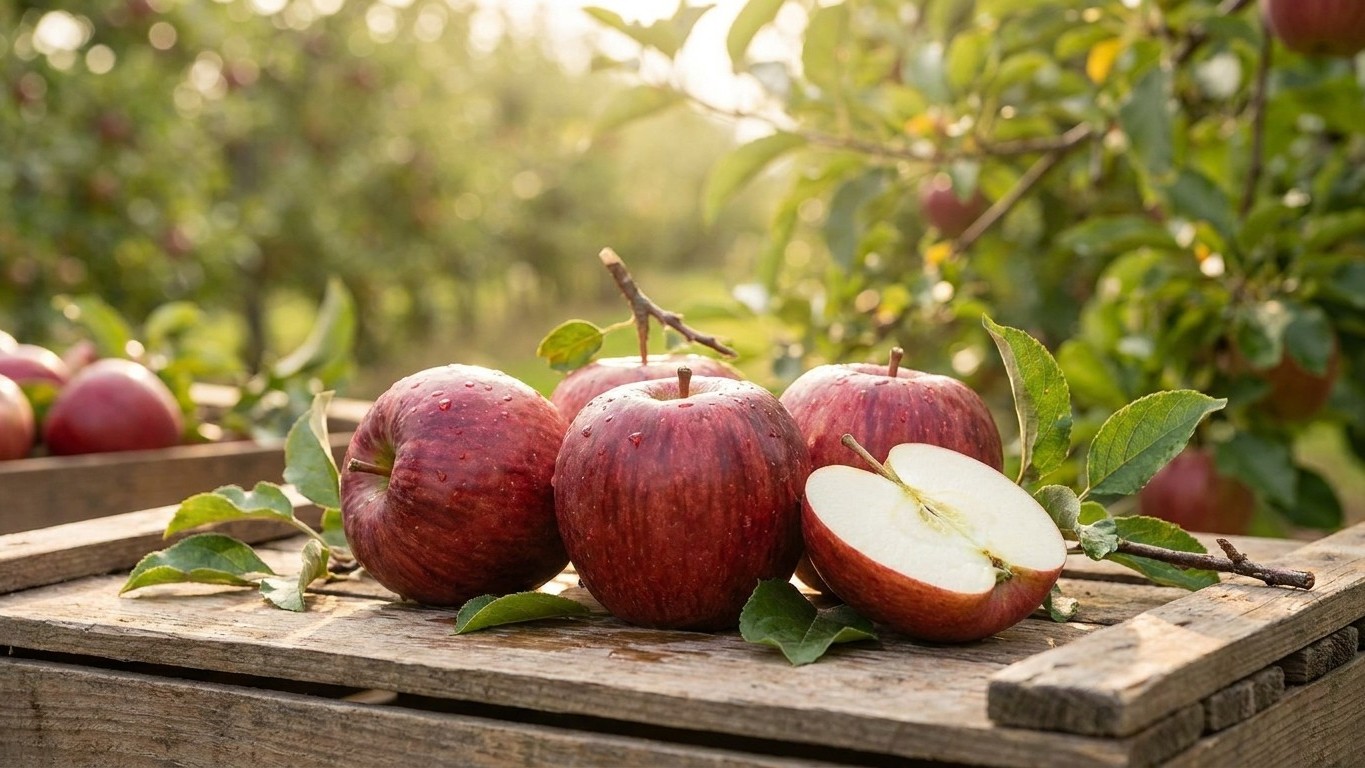

Liberty is a dessert apple bred specifically to shrug off the four diseases that force most orchardists onto a spray schedule: scab, cedar-apple rust, powdery mildew and fire blight. It ripens over roughly three weeks in September, carries a rich, sprightly flavor under solid red skin, and grows across a wide swath of the country, USDA zones 4 through 8. The catalog data behind this page names only one of those four resistances with a formal rating, and that distinction matters more than it sounds.
What Honeycrisp actually is

- When it ripens: 1 to 20 September
- What it tastes like: Crisp, with a rich and sprightly flavor
- What it is good for: Good both fresh and cooked
- How long it keeps: not published in the catalog data used on this page
The color is the first thing most growers notice: a solid red that develops fully even where summers run hot, a trait plenty of red apples can’t claim once the mercury climbs. Growers in warmer zones sometimes end up with pale, streaky red on varieties that need cool nights to color up. That’s not an issue here.
On flavor, the description is short but pointed: crisp texture, rich and sprightly taste. That combination of crispness with a lively, almost tart edge is what pulls this apple out of the “fine but forgettable” category and into one that gets requested by name at a farm stand. And because it holds up in the kitchen as well as on the counter, it’s not a one-trick variety. Good fresh and cooked covers pie, sauce and out-of-hand eating without needing to blend it with a firmer variety to keep its shape in the oven, the way some soft-fleshed apples require.
Storage life isn’t part of the figures available here, so anyone planning a winter’s worth of eating apples should ask a local extension office or a nursery that’s grown it in-region before counting on months of shelf life. Treat it, for planning purposes, as a fall apple first and a storage apple second until you’ve confirmed otherwise locally.
Will it grow where you are
Hardiness zones
This variety is listed for USDA hardiness zones 4 through 8, a span that stretches from parts of Minnesota and Vermont down through much of the mid-South. That’s one of the wider ranges among common apple varieties. For comparison, Honeycrisp is listed narrower, at zones 3 through 6, while Mutsu runs warmer, at zones 5 through 9. A wide zone listing doesn’t mean the tree performs identically at both ends: it means the tree can survive winter cold across that whole range, not that fruit quality, bloom timing or disease pressure will be the same in zone 4 as in zone 8.
| Variety | USDA zones listed |
|---|---|
| Liberty | 4-8 |
| Honeycrisp | 3-6 |
| Mutsu | 5-9 |
| Winesap | 5-8 |
Winter chill
Hardiness zone is only half the picture. The other half is chill hours, the accumulated time a tree spends below roughly 45°F each winter, which the tree needs before it will break dormancy properly in spring. This variety needs 800 hours of chill. That’s on the higher side among apples, and it points this variety toward the cooler end of its own hardiness range rather than the warm one. A grower in coastal Georgia or inland Southern California, even inside a hardiness zone this apple technically tolerates for cold survival, may struggle to accumulate 800 chill hours most winters, leading to uneven, delayed or patchy bloom. This is the filter most people skip, and it’s the reason a tree can be “hardy” for a zone on paper and still perform badly there.
What to plant beside it
Nearly all apple varieties crop better with a compatible pollen partner nearby, even ones that will set some fruit alone. The specific pollination partners for this variety aren’t part of the catalog figures held on this page, so rather than guess at names that sound plausible, the honest answer is: not published here. That’s not the same as saying it doesn’t need one.
What can be said with confidence, based on how apples pollinate generally, is that a second variety blooming at the same time, and genetically distinct from it, will improve fruit set. Two trees flowering together is not automatically enough on its own; a seedling can’t be pollinated by its own parent variety, so knowing the parentage of any variety being planted alongside it matters when the goal is guaranteed cross-pollination rather than a lucky overlap in bloom time.
Until you’ve confirmed a specific partner list with a local nursery or extension office, the practical approach is:
- Choose a second apple variety with an overlapping bloom period
- Confirm it isn’t a known parent or sibling seedling of the variety you’re planting
- Add a crabapple nearby if space is tight, since many crabapples bloom long and supply pollen to multiple varieties
For a full breakdown of which varieties bloom together and which combinations to avoid, see our apple pollination guide.
Growing it well

Fire blight rating
The fire blight rating for this variety is Resistant. In the orchard, that translates to fewer of the sudden, blackened “shepherd’s crook” shoot tips that signal an active fire blight infection, and less need for the antibiotic sprays some growers apply during bloom in high-pressure years. Resistant doesn’t mean immune. A grower in a region with an active fire blight outbreak, or one growing next to an infected pear or hawthorn, should still watch new growth each spring rather than assume the rating rules the disease out entirely.
Other disease resistances
This variety has a strong reputation among growers specifically for standing up to apple scab, cedar-apple rust and powdery mildew alongside fire blight, which is part of why it shows up so often in low-spray and backyard orchard recommendations. That said, the catalog data behind this page lists no published resistance code for those three diseases beyond the fire blight rating. Treat the broader four-disease reputation as well known in growing circles, and the fire blight figure as the one number that’s formally documented here.
Habit and biennial bearing
Specific figures on growth habit, canopy shape, and whether this variety tends toward biennial bearing (a heavy crop one year followed by a light one the next) aren’t part of the data available for this page. Any apple variety can lean biennial under stress, drought, or a year of heavy fruit set left unthinned, so growers who notice a pattern developing should thin fruit early the following spring rather than wait to see if it self-corrects.
Picking it and keeping it
The published window for this variety runs from 1 to 20 September, a span wide enough that relying on the calendar alone will get a grower picking too early or too late in a given year, depending on the season’s weather. The more reliable method is a short physical check, done in order, right at the tree:
- Lift and twist a sample apple gently upward. If it separates from the spur easily, with the stem staying attached to the fruit, it’s likely ready. If it resists and you have to tug, give it more time.
- Cut one open and check the seeds. Apples ripening on the vine move from pale or greenish seeds toward brown as they mature; consistently brown seeds are a good sign.
- Check the ground color, the background shade under any red blush. As the fruit ripens, that background typically shifts from green toward a yellow or cream tone.
Storage
No specific storage duration is published for this variety in the data used here. As a general practice with fall dessert apples, refrigeration slows ripening considerably compared with leaving fruit at room temperature, and apples stored near 32°F with high humidity hold quality longer than those left in a warm kitchen. Anyone planning to store a full harvest for months rather than weeks should confirm expected keeping time with a local extension office or an orchard that’s grown this variety before relying on it as a long-term storage apple.
Common questions
Is this variety self-pollinating?
Specific pollination data isn’t published in the figures behind this page. As with nearly all apple varieties, planting a compatible second variety nearby, one that isn’t its own parent, improves fruit set over relying on a single tree.
What zone is it hardy to?
It’s listed for USDA hardiness zones 4 through 8, one of the broader ranges among common apple varieties, though performance still depends on chill hours and local conditions within that range.
Does it need 800 chill hours every winter to fruit?
The published chill requirement is 800 hours. Falling short in a mild winter can lead to delayed, uneven or reduced bloom, even in a hardiness zone the tree otherwise tolerates for cold survival.
Is it really resistant to fire blight?
The published rating is Resistant, meaning fewer and less severe infections than a susceptible variety, not immunity. It’s a reasonable choice for a region where fire blight is already present in nearby trees, but new shoots are still worth checking each spring.
Can I eat it fresh and bake with it?
Yes. It’s rated good both fresh and cooked, so it doesn’t need to be paired with a firmer variety to hold its shape in a pie or sauce.