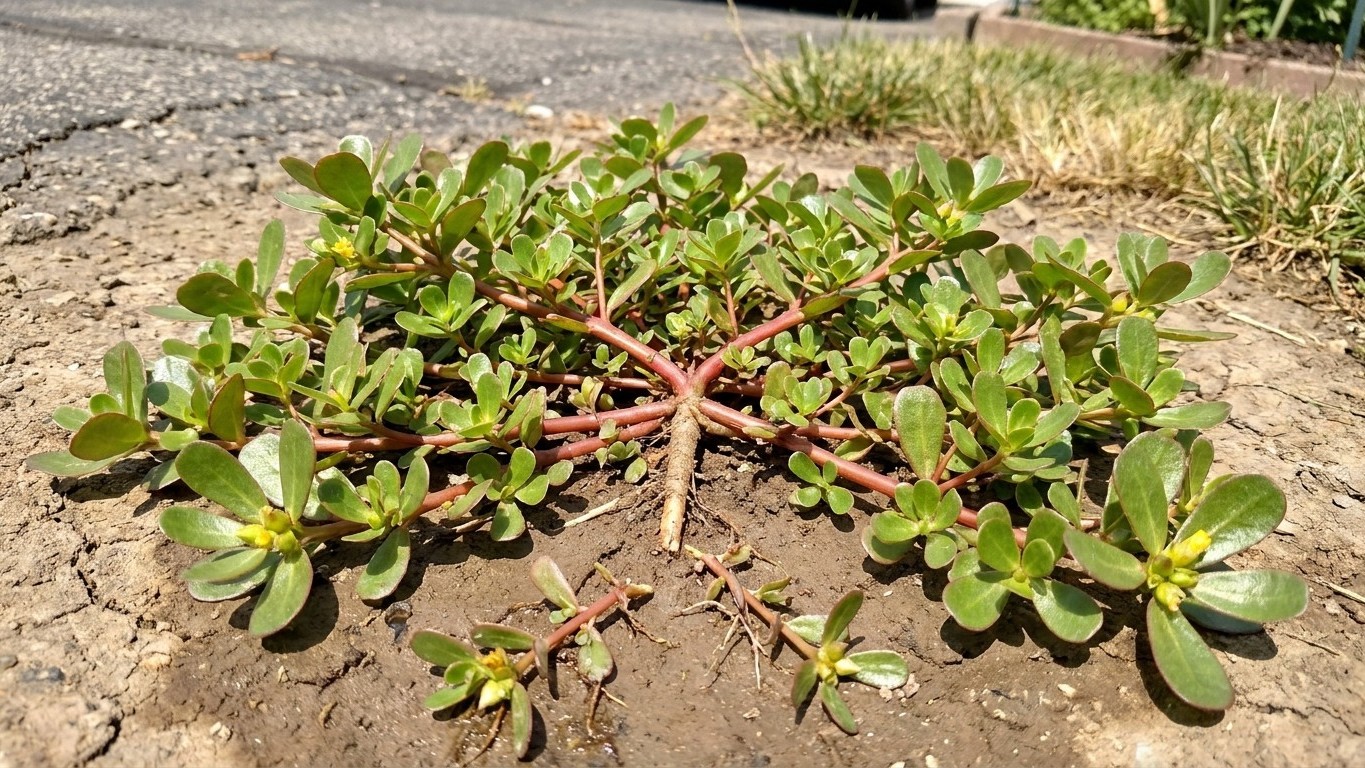

Purslane (Portulaca oleracea) is a low, fleshy summer weed that spreads fast across thin or disturbed turf, and the reason it’s so hard to shake is right in its biology: broken stems root wherever they touch soil. Confirming the plant, understanding why it picked your yard, and timing any control around its germination window matter more than which product you reach for.
How to be sure that is what you have

Purslane grows flat against the ground in a spreading mat, with reddish, rubbery stems that radiate out from a central point like spokes. The leaves are the giveaway: thick, glossy, paddle-shaped or spoon-shaped, and noticeably succulent, almost like a tiny jade plant leaf. They cluster at the stem joints and at the branch tips, catching light in a way drier-leaved weeds don’t.
It shows up where soil is bare, compacted, or freshly disturbed, driveway cracks, garden bed edges, thin patches in the lawn, anywhere full sun reaches open ground. As a summer annual, it germinates once soil warms in late spring, spreads through the hottest months, and is killed outright by the first hard frost. Through summer it also produces enormous numbers of tiny black seeds, which is a separate problem from the stem-rooting habit and one reason a small patch can become a big one within a single season.
Purslane vs. the two weeds people confuse it with
Two low-growing summer weeds get mistaken for purslane constantly, and one detail separates each of them.
- Spotted spurge also mats flat and favors the same bare, sunny ground, but its leaves are thin and dull rather than fleshy, and if you snap a stem it oozes a milky white sap. Purslane’s broken stem is watery and clear, not milky.
- Prostrate knotweed shares the wiry, ground-hugging habit and turns up in the same compacted soil, but its leaves are small, narrow, and papery rather than thick, and its stems have small membranous sheaths at each joint that purslane simply doesn’t have.
If the leaves feel rubbery between your fingers and the stem breaks clean, you’re looking at purslane.
Why it is in your lawn
Purslane doesn’t invade healthy, dense turf, it moves into the gaps healthy turf would have covered. Four conditions tend to open that door.
Compacted soil is the most common one, especially along paths, near gates, or anywhere equipment or foot traffic packs the ground down. Compaction starves grass roots of air and water, thins the stand, and leaves bare mineral soil exactly where purslane seed needs it to germinate. Mowing too short does the same thing from a different angle: scalping cool-season grass like tall fescue or Kentucky bluegrass below its recommended height, or cutting warm-season grass too close during a stressed period, exposes soil to full sun and removes the shade that would otherwise suppress weed seed germination.
Thin turf from drought stress, disease, or heavy shade creates the same opening even without mowing error. And any recently disturbed soil, a newly seeded strip, the edge of a driveway repair, a spot where a tree stump was removed, is bare by definition and purslane treats bare, sunny soil as an invitation. The plant needs full sun to establish; it rarely gains a foothold under a lawn that’s actually shading its own soil surface. Thickening the turf back up removes the opening before you ever need a herbicide.
The window that decides everything
Purslane is a summer annual, which means the entire control strategy splits into two very different timings depending on whether the seed has germinated yet.
Pre-emergent herbicide has to go down before seeds sprout, because it works by blocking germination, not by killing an established plant. Once purslane seedlings are up and growing, a pre-emergent product does nothing for them, and only a post-emergent, applied directly to actively growing foliage, will have an effect. Applying the wrong type at the wrong stage is the single most common reason home treatments fail, not a weak product.
Rather than a calendar date, Clemson University’s Home & Garden Information Center (HGIC 1219) times pre-emergent applications to a biological signal: forsythia and dogwood bloom, which reflects soil warming closely enough to be a reliable trigger for summer annual weed germination in that region. That’s a more accurate cue than “mid-April” because bloom time, and the soil warming it reflects, shifts by weeks depending on where you garden.
A forsythia that blooms in early March in the coastal Southeast may not bloom until late April farther north, and mountain or high-elevation sites lag behind both. Because that gap can run four to six weeks coast to coast, the only way to apply this timing correctly is to watch the actual bloom in your own area rather than pick a date off a national calendar, and to check your regional cooperative extension office’s guidance for the specific window that applies to your territory.
Getting rid of it
Mechanical removal is the reasonable first step for small patches, but purslane’s biggest trick is that broken stems root readily in contact with moist soil. Pulling a mat and leaving fragments behind, or tossing them onto bare ground, mulch, or a compost pile that never heats up enough to kill plant tissue, can simply start new plants in a new spot. Pull the whole plant including the taproot, bag it, and keep the soil surface from staying bare and moist afterward, since that’s exactly the condition a stray fragment needs to take hold.
For a well-established patch, or a lawn already producing seed, post-emergent broadleaf herbicides containing an active ingredient such as 2,4-D, dicamba, or MCPP (mecoprop) are the products typically available to a home grower, and label directions will specify which turf types tolerate them. These actives target broadleaf plants and generally leave established cool-season and warm-season lawn grasses unharmed when the product and rate match the grass species on the label, but that match matters: some warm-season grasses, St. Augustinegrass in particular, are more sensitive to certain broadleaf mixes and can be damaged by a product that’s perfectly safe on fescue or bluegrass.
Non-selective products containing glyphosate will kill the purslane and the surrounding turf grass together, which limits their use to driveways, gravel beds, or bare patches being renovated rather than an active lawn. Regulations on herbicide actives vary by state, and some formulations are restricted or unavailable in certain states, so checking your state’s pesticide regulatory agency or your state extension office before buying is worth the five minutes it takes, especially since label language and availability can differ from what’s sold two states over.
Keeping it out
Thick, dense turf is the only control that lasts, because it removes the bare, sunlit soil purslane needs to germinate in the first place, and it does that job without any product at all.
Mowing height matters more than most homeowners assume. Cool-season lawns, tall fescue and Kentucky bluegrass among them, hold density best mowed around 3 to 3.5 inches, tall enough to shade the soil surface and shield weed seed from the sunlight it needs to sprout. Warm-season grasses like Bermuda and zoysia are typically mowed shorter, but the same principle applies within their range: never scalp below the species’ recommended height, since every scalped patch is an opening.
Feeding timing builds the density that height alone can’t. Cool-season lawns respond best to fertilizing in fall, when they’re building root mass ahead of winter, while warm-season lawns take feeding in late spring through summer, matching their active growth cycle. Fertilizing at the wrong time for the grass type wastes the input and does little to close the turf canopy.
Overseeding thin or bare patches, ideally in fall for cool-season species, closes gaps before spring soil warming triggers the next round of purslane germination. Combined with deep, infrequent watering that encourages roots to grow down rather than stay shallow, and avoiding the foot traffic and equipment patterns that compact soil in the first place, a dense stand of turf leaves purslane with nowhere to start.
Common questions
Is purslane edible?
Common purslane is widely eaten as a leafy green in many cuisines and is known for a mild, slightly tangy, lemony flavor. If you’re removing it from a lawn treated with any herbicide, do not eat it, since residue makes it unsafe regardless of the plant’s edibility.
Does purslane die in winter?
Yes. As a summer annual, purslane is killed outright by the first hard frost each year. It doesn’t overwinter as a plant, it survives the cold season as seed in the soil, which is why prevention efforts focus on the following spring’s germination window rather than on the dead plant itself.
Can purslane take over my whole lawn?
It spreads aggressively in bare or thin turf and produces heavy seed, but it competes poorly against dense, actively growing grass. A lawn that’s thick and well-maintained rarely sees more than isolated patches, which is why turf density does more long-term work than any single herbicide application.
Will a single pulled fragment regrow?
Often, yes. Purslane stems root readily wherever they touch moist soil, so any fragment left behind after pulling, especially on bare or mulched ground, can establish as a new plant. Removing the entire plant and disposing of it away from bare soil is more effective than pulling and dropping the debris nearby.