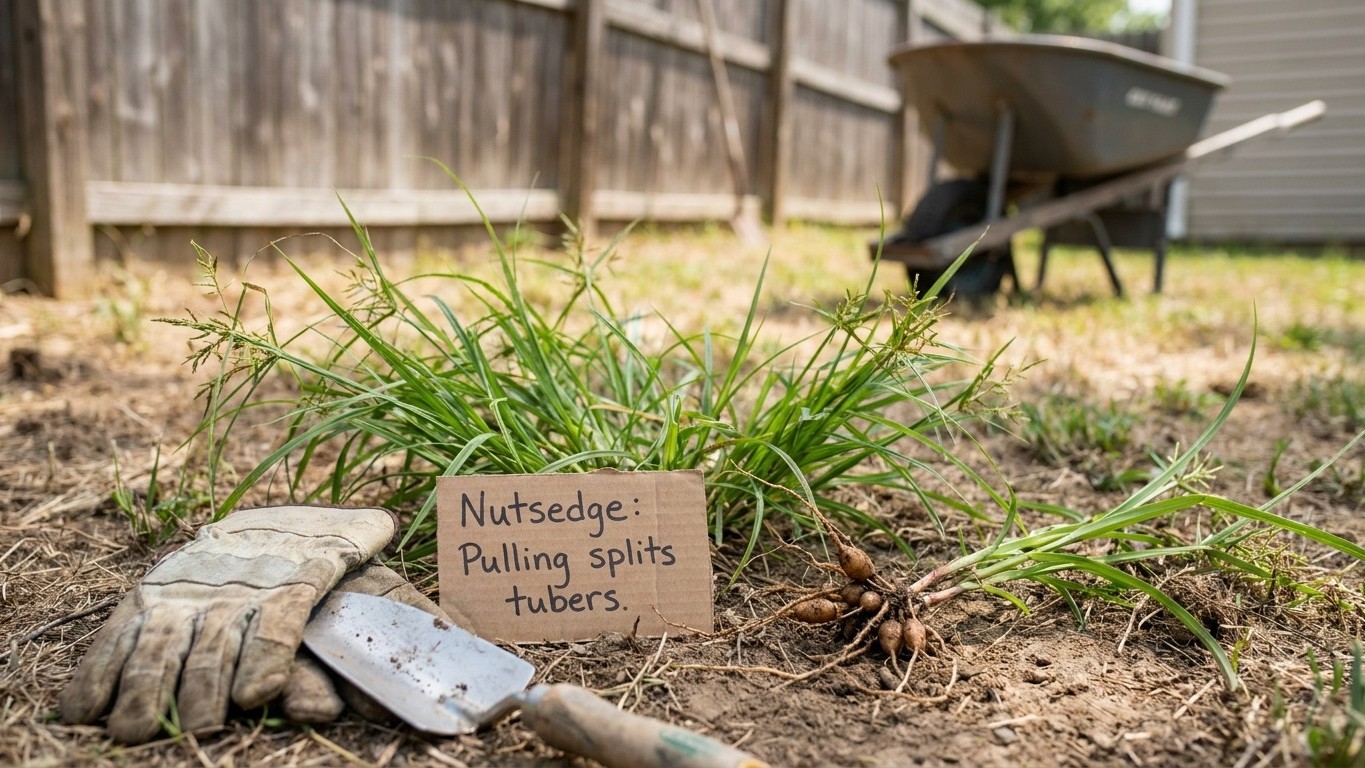

Pulling nutsedge makes it worse because the plant’s tubers, called nutlets, stay in the soil and each broken piece can sprout a new shoot within weeks. Yanking the top off does not remove the underground chain of tubers that produced it, and disturbing the soil can even signal dormant tubers to sprout. The single move that matters: before you touch a shoot, roll the stem between your fingers near the soil line. If it feels triangular, you are dealing with nutsedge, not a grass, and pulling is the wrong first step.
How to be sure that is what you have

Nutsedge looks like grass from a distance and that is exactly why it survives so many mowing seasons before anyone notices. The giveaway is in the stem, not the leaf. Grass stems are round or flat in cross section. Nutsedge stems are triangular, and if you roll one between your thumb and finger near the soil line you can feel the three distinct edges. The leaves grow in sets of three from the base, called ranks, rather than the two-sided arrangement of a true grass blade.
Two species show up in home lawns. Yellow nutsedge (Cyperus esculentus) has yellow-green, glossy leaves that taper to a sharp point, and its flower spikelets, when it is allowed to seed out in midsummer, are straw-colored. Purple nutsedge (Cyperus rotundus) is shorter, darker green, and its flower spikelets carry a reddish-purple tinge. Purple nutsedge also produces tubers in chains underground, one attached to the next, while yellow nutsedge tubers form singly at the end of wiry underground stems called rhizomes.
The two plants most often mistaken for nutsedge are crabgrass and a lawn grass blade that is simply outgrowing its neighbors. Crabgrass sprawls low and roots at each node where a stem touches soil, producing a flat, finger-like seed head. Nutsedge stands upright, does not root at the nodes, and its seed head is a cluster of narrow spikelets on a stiff, three-angled stalk. If you cannot feel a triangular stem, you are looking at grass, and the fix is a mowing or feeding adjustment, not a herbicide.
Season also gives it away. Nutsedge emerges later in spring than most lawn grasses and stays a noticeably brighter green through the hottest weeks of summer, when cool-season turf is under stress and warm-season turf has already filled in. It dies back to the tubers at the first hard frost, leaving no visible top growth in winter, while the tubers themselves survive underground indefinitely.
Why it is in your lawn
Nutsedge is a wetland plant that wandered onto dry land, and it still needs the same thing it needed in a marsh: water sitting where it should not. The single condition that invites it more than any other is poor drainage, whether that is a low spot that stays soggy after rain, a downspout that empties onto the lawn, or an irrigation system running longer than the turf actually needs. Compacted soil compounds the problem because it holds water near the surface instead of letting it move down past the root zone.
Thin turf is the second invitation. A dense stand of grass shades the soil surface and keeps it several degrees cooler, which slows nutsedge tuber sprouting. Wherever turf has thinned from foot traffic, disease, or a mower blade set too low, more light reaches bare soil and more tubers wake up. Nutsedge patches almost always trace back to one of these two conditions rather than appearing at random across an otherwise healthy lawn.
Mowing height plays a role too, though a smaller one than drainage. A lawn cut short and often stresses the turf’s root system, which in turn thins the canopy and opens the same light gaps that let nutsedge tubers sprout. This matters more for cool-season lawns already under summer heat stress than for a warm-season lawn actively growing at the same time of year.
None of this means every wet spot will grow nutsedge, and it does not mean every nutsedge patch means bad drainage everywhere on the property. It means the plant is telling you something about that specific patch of ground, and regrading, fixing a leaking irrigation head, or aerating compacted soil will do more to keep it from coming back than any spray applied after the fact.
The window that decides everything
Most lawn weed programs run on a pre-emergent and post-emergent calendar, but nutsedge does not follow the same clock as crabgrass or spotted spurge. Clemson Cooperative Extension’s HGIC 1219 Tall Fescue Maintenance Calendar times the crabgrass pre-emergent application to forsythia and dogwood bloom, a bio-indicator that tracks soil temperature better than a calendar date does. Nutsedge tubers sprout later, once soil has warmed further into the growing season, so a pre-emergent timed for crabgrass will usually have broken down before nutsedge tubers wake up.
Post-emergent is the real window
Because of that mismatch, nutsedge control in most home lawns is a post-emergent job rather than a pre-emergent one. The window that matters is a growth stage, not a date: treat while the plant has three to five leaves and before it has had time to set new tubers underground. Wait past that stage and you are only killing the visible shoot while the plant banks more tubers for next year.
The forsythia and dogwood signal that HGIC 1219 uses for crabgrass arrives weeks apart across the country, and nutsedge’s own emergence follows the same regional spread. A grower in one climate zone will see nutsedge shoots weeks before or after a grower in another, even in the same calendar month. Check your own territory’s cooperative extension calendar for the bloom or soil-temperature signal that applies to your area rather than relying on a date printed on a bag.
Repeat applications are usually necessary. A single post-emergent treatment rarely reaches every tuber in a chain, and any tuber the herbicide misses will send up a new shoot within a few weeks. Extension guidance generally calls for a second application after the label’s stated interval, watching for regrowth rather than assuming one pass has finished the job.
Getting rid of it
Pulling nutsedge by hand almost always leaves tubers behind, and every fragment left in the soil is capable of producing a new plant. The tuber chain runs deeper and wider than the visible shoot suggests, so even a careful hand-pull typically snaps the chain rather than lifting it whole. Digging with a trowel or shovel to remove the full chain works better than pulling, but expect to miss some tubers, since even one left behind restarts the patch. Repeated pulling every few days for an entire season, before any tuber has the chance to reach three to five leaves and reset, can eventually exhaust a small colony, but it takes a full growing season of diligence and will not work on an established patch.
Chemical control
Two active ingredients are the standard post-emergent options sold to home growers: halosulfuron-methyl and sulfentrazone. Halosulfuron-methyl targets sedges specifically and is labeled for use on most common lawn grasses without significant injury, though St. Augustinegrass and centipedegrass can show temporary yellowing after treatment. Sulfentrazone works faster on visible growth but has a narrower list of turf types it is safe to use on, so read the label against the specific grass species growing in the lawn before applying either product, not just the weed it is meant to kill.
Neither active ingredient kills grass weeds like crabgrass or broadleaf weeds like creeping Charlie, so a lawn with a mixed weed problem needs more than one product, applied on separate schedules rather than tank-mixed without checking label compatibility. General-purpose broadleaf herbicides sold for dandelions and clover will not touch nutsedge at all, since it is a sedge, not a broadleaf plant, and spraying one hoping it also handles the other patch in the yard wastes both the product and the season’s best treatment window.
Availability of these actives varies by state, and some formulations carry additional restrictions on lawns near water or on certain commercial sites. Check the product label and your state’s department of agriculture listing before buying, since a product sold freely in one state may require a licensed applicator in another. A local cooperative extension office can confirm what is currently registered for homeowner use in your area.
Keeping it out
Thick turf is the only control that lasts beyond one season, because a dense canopy shades the soil enough to slow tuber sprouting and gives nutsedge shoots less room to establish before mowing cuts them back. The mowing height and feeding schedule that keep turf thick depend on which species is growing, since cool-season and warm-season grasses fail under different conditions and at opposite times of year.
| Grass | Mowing height | Season type | Notes |
|---|---|---|---|
| Tall Fescue | 2.5 to 3.5 in | Cool-season | Good shade tolerance; HGIC 1219 has a full maintenance calendar |
| Kentucky Bluegrass | 2 to 3 in | Cool-season | Fair shade and drought tolerance, good wear |
| Fine Fescues | 2.5 to 3.5 in | Cool-season | Excellent shade tolerance, poor wear |
| Zoysiagrass | 0.75 to 2 in | Warm-season | Excellent shade and very good wear; HGIC 1217 calendar |
| St. Augustinegrass | 2.5 to 4 in | Warm-season | Excellent shade, good drought; HGIC 1218 calendar |
| Bermudagrass | 0.75 to 1.5 in | Warm-season | Very poor shade tolerance, excellent wear; HGIC 1216 calendar |
Mowing at the tall end of a species’ recommended range, rather than the short end, keeps more leaf surface in place to shade the soil. Clemson Cooperative Extension’s HGIC 1205 Mowing Lawns fact sheet covers the height ranges and cutting frequency for each species in more detail. Feeding on the schedule set out in HGIC 1201, Fertilizing Lawns, matters just as much: a lawn fed too early or too late in its own growing season thins out at exactly the point nutsedge needs an opening.
Overseeding cool-season lawns in their planting window, or plugging and sprigging warm-season species into bare patches, closes the same gaps that pulled or sprayed nutsedge leaves behind. A lawn that recovers quickly after any weed treatment denies the next flush of tubers the open ground they need, which does more long-term work than a second round of herbicide. For a broader look at how other weeds exploit the same thin spots, see how lawn weeds in general tend to appear where turf density has already failed, the same way Creeping Charlie takes hold in shaded, thinning turf.
Common questions
Will nutsedge kill my grass if I leave it alone?
No, nutsedge competes with turf for light and water but it does not attack the grass directly the way a fungal disease would. A thick patch can crowd out weakened turf over a season or two, but an established, dense lawn usually holds its own against a small colony while you plan a treatment.
Can I just dig out the whole patch with a shovel?
Digging works better than pulling if you go deep enough to remove the full tuber chain, which runs well below where a hand-pull reaches. Sift the removed soil, discard every tuber you find, and expect to miss some, since a single overlooked tuber restarts the patch.
Does nutsedge mean my soil is bad everywhere?
Not necessarily. Nutsedge responds to the specific patch it is growing in, so a colony in one low corner of the yard says more about drainage in that corner than about the whole property. Check the rest of the lawn on its own merits before assuming a wider problem.
Is nutsedge worse in a new lawn than an established one?
Yes, generally. Newly seeded or sodded turf has not filled in yet, so more bare soil is exposed to light and more dormant tubers get the trigger to sprout. An established, dense lawn recovers faster once you treat a patch because the surrounding turf fills the gap before new tubers can take hold.