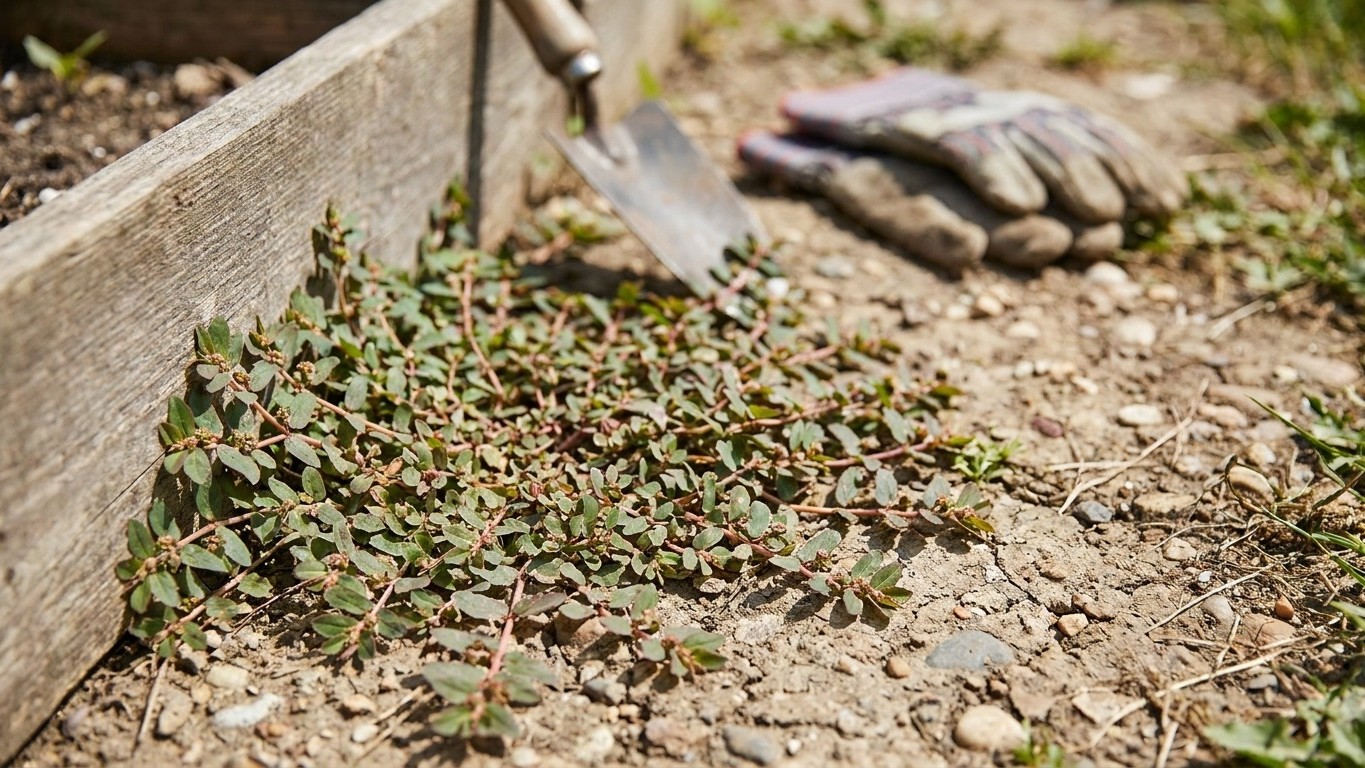

Spotted spurge is a low, ground-hugging summer annual with a small reddish-purple spot at the center of each oval leaf and a milky white sap that beads up the moment you snap a stem. It moves into the thin, open patches of lawn where turf has failed to close ranks, radiating out from a single taproot into a flat mat that can cover several square feet by late summer. Check any bare or sparse patch for that sap test first: if the broken stem weeps white, you are looking at spurge, and the next move is to identify why the turf there is thin rather than reaching straight for a spray.
How to be sure that is what you have

Spotted spurge grows flat against the soil, almost never upright, with wiry reddish stems that branch out in a low star pattern from the center. The leaves are small, oval to oblong, arranged in opposite pairs along the stem, and each one usually carries that single reddish-purple blotch at the midpoint that gives the plant its name, though the blotch can be faint on young growth. It seeds itself into cracks in a driveway, along a walkway edge, and into any lawn patch where the grass canopy has opened up, then spreads fastest once summer heat sets in.
The two look-alikes
Prostrate knotweed grows in a similarly flat mat in the same bare, compacted spots, but its stems are jointed with a thin papery sheath wrapped around each node, and it carries no milky sap when broken. Purslane also sprawls flat with reddish stems, but its leaves are thick, smooth, and paddle-shaped rather than thin and pointed, and its stems are fleshy enough to snap cleanly rather than tear, again with no sap. The milky sap is the single fastest way to separate spurge from both of them in the field: break a stem, and if nothing runs, it is not spurge.
Spurge germinates from seed once the soil has warmed well into summer conditions, so it tends to show up later in the season than most other lawn weeds, filling in bare ground just as cool-season grasses are already under heat stress and warm-season lawns are mid-growth. By the time most gardeners notice it, it has usually already flowered and dropped a fresh batch of seed into the same spot, which is why the same bare patch tends to fill in with spurge year after year until the turf itself is thickened.
Why it is in your lawn
A patch of spotted spurge is a report on the turf underneath it, not a random invasion. It needs open soil and light reaching the ground to germinate, so it shows up wherever grass has thinned enough to let both through: compacted soil along a foot path, a spot scalped by a mower, an area killed off by drought stress or disease, or turf that was simply never thick enough to close its own canopy.
Mowing height matters more than most gardeners expect. Clemson Cooperative Extension’s HGIC 1205 fact sheet on mowing lawns notes that cutting turf shorter than its recommended range opens the canopy and exposes soil to light, which is exactly what spurge seed needs to sprout. A tall fescue lawn kept below the 2.5 to 3.5 inch range that Clemson’s HGIC 1214 recommends for that species, or a bermudagrass lawn scalped well under its 0.75 to 1.5 inch range, both leave more bare ground between blades than the grass can shade out on its own.
Compaction is the other half of the picture. Soil packed down by foot traffic, a dog’s regular path, or repeated mower turns on the same line drains poorly and roots poorly, so the grass there thins first and stays thin. Wherever the lawn is thin, whatever the cause, spurge is simply the plant that is fastest to take the opening, in the same way henbit fills the same kind of gap in a cool-season lawn that went thin over winter. Fixing the compaction or the mowing habit does more long-term work than any single herbicide pass.
The window that decides everything
Pre-emergent herbicide is the more reliable route for spotted spurge because once the seedlings are up and spreading, control gets harder fast. The trick is timing it before the seed germinates rather than after, and soil temperature, not the calendar date, is what triggers germination.
Clemson Cooperative Extension’s HGIC 1219 Tall Fescue Maintenance Calendar times spring pre-emergent applications to two visual cues rather than a fixed date: forsythia bloom and dogwood bloom, both of which track soil warming closely enough to serve as a natural trigger for the whole region a gardener is standing in. That same principle carries over to spurge control on any lawn type, cool-season or warm-season: watch the shrubs, not the month on the wall.
Why a single date will not work
That bloom trigger arrives weeks apart across the country, since it follows local soil warming rather than a national calendar. A gardener in the Deep South will see forsythia and dogwood bloom, and soil temperatures rise, well before a gardener in the upper Midwest does. This is exactly why a national fact sheet gives a plant cue instead of a date, and it is why the right move is to check the maintenance calendar for your own grass species and climate, whether that is HGIC 1219 for tall fescue, HGIC 1216 for bermudagrass, HGIC 1217 for zoysiagrass, HGIC 1218 for St. Augustinegrass, or HGIC 1215 for centipedegrass, rather than borrow someone else’s date.
Once spurge seedlings are already visible as a low mat, the pre-emergent window has closed for the season, and control shifts to post-emergent herbicide or hand removal instead. A second, later germination flush is common after the first hot stretch of summer, so a lawn that looked clean in spring can still show a new patch of spurge in August.
Getting rid of it
Hand-pulling works on isolated plants if you get the whole taproot out, since spurge does not spread by rhizome the way nutsedge does when you pull it and make things worse. Small root fragments left behind generally do not regrow the way nutsedge tubers do, but a mature spurge plant has usually already dropped seed into the surrounding soil by the time it is big enough to spot, so pulling controls the plant in front of you without touching next year’s crop underneath it. Pull while the soil is damp, grip low at the base, and check that the taproot came up whole rather than snapping off at the crown.
Chemical options
For post-emergent control on an established lawn, products containing quinclorac are commonly used on spotted spurge and are labeled for use on a number of both cool-season and warm-season turf species, though quinclorac can injure centipedegrass and newly seeded lawns, so the label’s grass-species list needs to be checked against your own turf before spraying. Products containing 2,4-D combined with dicamba or MCPP are another common route for broadleaf control in cool-season lawns, but these three-way mixes are not selective for spurge alone and will also affect other broadleaf plants nearby, ornamental or otherwise, if drift reaches them.
Pre-emergent products built around dithiopyr or prodiamine stop the seed from germinating in the first place, which fits the timing window described above far better than any post-emergent spray does. Several herbicide actives carry state-specific restrictions or require a licensed applicator above certain concentrations, so check the product label and your state’s department of agriculture listing before buying rather than assuming a product sold at a local store is unrestricted everywhere.
Keeping it out
Thick, unbroken turf is the only control that lasts past one season, because spurge simply cannot germinate where light never reaches bare soil. The two levers that build that density fastest are mowing height and feeding timing, both specific to the grass species already growing in the lawn.
| Grass | Mowing height | Shade tolerance | Drought tolerance |
|---|---|---|---|
| Tall Fescue | 2.5–3.5 in | Good | Fair |
| Kentucky Bluegrass | 2–3 in | Fair | Fair |
| St. Augustinegrass | 2.5–4 in | Excellent | Good |
| Zoysiagrass | 0.75–2 in | Excellent | Good |
| Bermudagrass | 0.75–1.5 in | Very poor | Excellent |
These figures come from Clemson Cooperative Extension’s HGIC 1214 Selecting a Lawn Grass fact sheet, and from Penn State Extension’s Lawn Establishment guide for the cool-season species. Mowing above the recommended low end for whichever grass is already growing keeps more leaf canopy shading the soil surface, which is the single cheapest thing a homeowner can do to close off the light spurge seed needs.
Feeding on the schedule laid out in Clemson’s HGIC 1201 Fertilizing Lawns fact sheet, matched to the grass species’ own growing season rather than a flat calendar date, builds the density that crowds spurge out before it ever gets a foothold. Overseeding thin cool-season lawns in their proper season, or plugging and sprigging bare spots in warm-season turf, closes the specific bare patches spurge already knows how to find, which does more than any single mowing or feeding change applied to the whole lawn at once. Reviewing the broader category of lawn weeds that move into the same thin spots is worth doing once, since a lawn thin enough for spurge is usually thin enough for two or three other species as well.
Common questions
Does spotted spurge die on its own in fall?
Yes, it is killed by the first hard frost since it is a true annual with no perennial root system. That does not remove the seed it already dropped, which is why the same bare patch tends to sprout a fresh mat the following summer if the underlying thin spot is never fixed.
Will mowing over it just spread the seed around?
It can, since a mower running over a seed-bearing patch will scatter seed to nearby bare ground on the same pass. Bagging clippings when mowing over a known spurge patch, rather than letting them scatter, cuts down on how far that batch of seed travels.
Is spotted spurge poisonous to pets?
The milky sap can irritate skin or cause mild stomach upset if chewed, so it is worth keeping an eye on a pet that regularly grazes bare lawn patches. Check with a veterinarian if a pet shows symptoms after chewing on it, since sensitivity varies by animal.
Why does it keep coming back in the exact same spot every year?
Because that spot is thin for a structural reason, whether that is compacted soil, shade, or a mowing pattern that scalps the same line, and the plant already dropped seed there the year before. Treating the herbicide or pulling as the fix without addressing the bare ground underneath just resets the same cycle for the following summer.