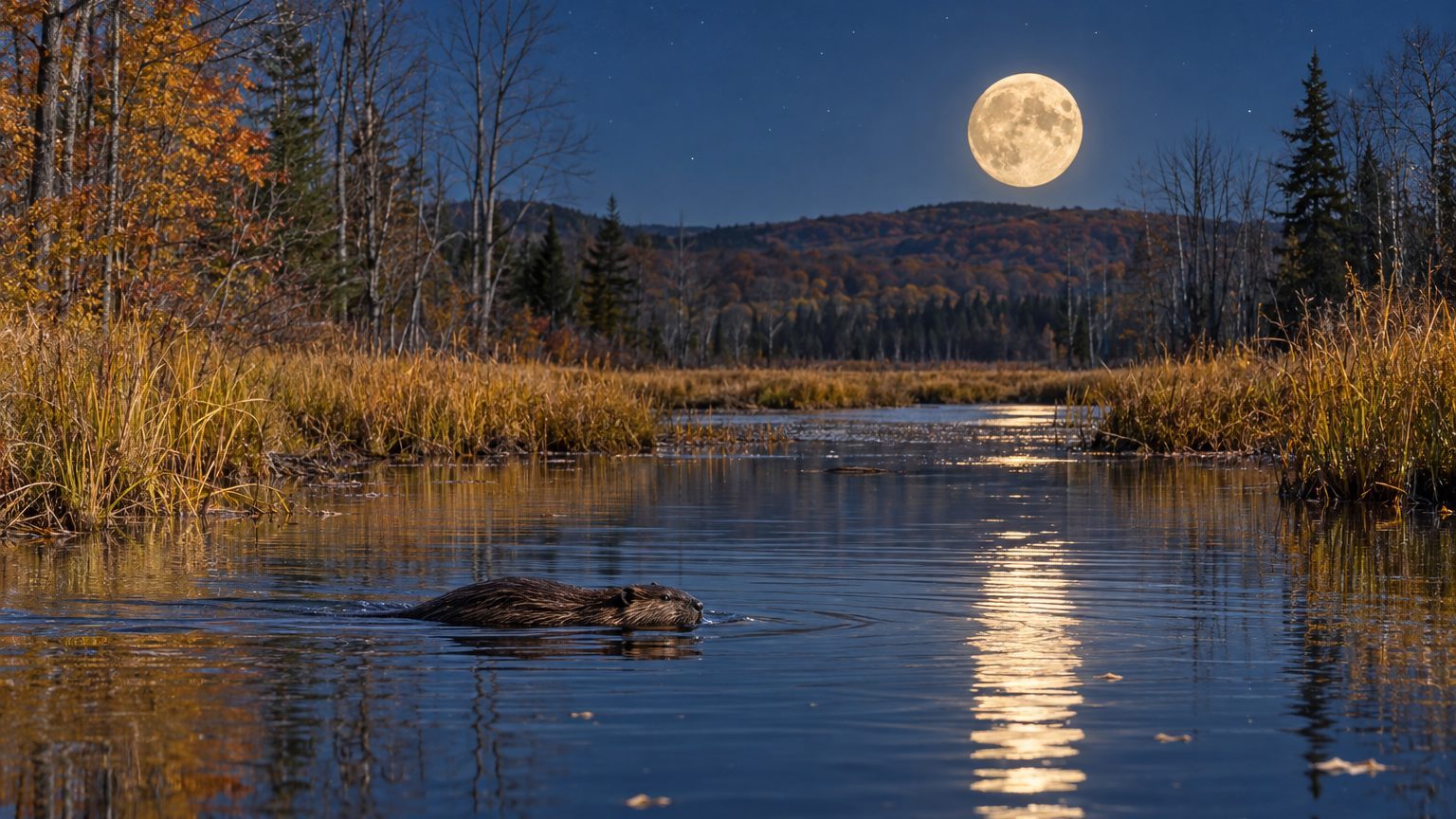

The Beaver Moon in 2026 is the full moon of November 24, 9:53 a.m. ET, in Gemini. In 2027 it falls on November 13, 10:25 p.m. ET, in Taurus. The name belongs to the November full moon, the one that follows the Hunter’s Moon. Gardeners who plant by the Moon also treat it as a marker in the almanac calendar, though the effect of the Moon on crops has never been proven.
Beaver Moon in 2026 and 2027
Both dates below are in Eastern time. If you live in another time zone, convert the clock time. Depending on where you are, the date itself can shift for a late-evening or early-morning moment.
| Year | Date | Time (ET) | Moon sign | Name that year |
|---|---|---|---|---|
| 2026 | November 24 | 9:53 a.m. ET | Gemini | Beaver Moon |
| 2027 | November 13 | 10:25 p.m. ET | Taurus | Beaver Moon |
The gap between the two years is eleven days. The Moon’s cycle runs about 29.5 days, so twelve full moons add up to a bit less than a calendar year, and each November date lands earlier than the last. That is why the full moon calendar 2026 and the full moon calendar 2027 never match day for day.
Does the name shift in either year?
No. The only name that moves between months is the Harvest Moon, which goes to the full moon nearest the September equinox. In 2026 the equinox is September 22 at 8:05 p.m. ET, and the Harvest Moon is the September 26 full moon at 12:49 p.m. ET. In 2027 the equinox is September 23 at 2:01 a.m. ET, and the Harvest Moon is the September 15 full moon at 7:03 p.m. ET. In both years the Hunter’s Moon comes next (October 26, 2026 at 12:11 a.m. ET, and October 15, 2027 at 9:47 a.m. ET), so the November full moon keeps the Beaver Moon name both times.
Where the name comes from and what it marks
The name itself
Full moon names are older than the printed almanac. The lists most Americans know draw on Native American, colonial and European sources, and the names worked as seasonal markers, not as exact labels. A name told people where they stood in the year. It said nothing about how the Moon looked, which is why a Beaver Moon looks like any other full moon.
Two explanations are given for this one, and they do not exclude each other. The first ties the name to beavers, which are busy at this point in the year gathering food and repairing lodges and dams before the water freezes. The second comes from the fur trade. Trappers set their traps in November, so the name is said to mark the weeks when beaver pelts were taken before the swamps and streams froze over. Some lists also give this moon an alternate name, the Frost Moon, but Beaver Moon is the one the Old Farmer’s Almanac uses, and the one this site follows. For the rest of the year, see our guide to full moon names.
Its place in the autumn sequence
The names around it tell the same story of a year turning toward winter. In 2026 the run looks like this:
- Harvest Moon, September 26, 12:49 p.m. ET
- Hunter’s Moon, October 26, 12:11 a.m. ET
- Beaver Moon, November 24, 9:53 a.m. ET
- Cold Moon, December 23, 8:28 p.m. ET
The Beaver Moon sits between two fixed points of the sky. In 2026 it falls after the September equinox (September 22, 8:05 p.m. ET) and before the December solstice (December 21, 3:50 p.m. ET). In 2027 the same moon lands between the September 23 equinox (2:01 a.m. ET) and the December 21 solstice (9:42 p.m. ET).
What a garden or farm looks like around that date depends heavily on the state. November in southern Florida and November in northern Minnesota are not the same season, and a full moon name cannot tell you which one you have. Your own frost dates and soil temperature do that. For anything practical, such as what can still go in the ground where you live, use your state’s planting guide, not an almanac name.
The Beaver Moon in the garden
According to almanac tradition, the Moon’s cycle is split into four quarters, and each quarter has its own kind of work. The almanac rule is that the third quarter, from the full moon to the last quarter, is the traditional window for root crops and other crops that develop below ground. The fourth quarter, from the last quarter to the new moon, is traditionally a time to rest the planting and do other work, such as clearing or tidying beds.
Applied to the Beaver Moon, those windows look like this, in Eastern time:
| Year | Third quarter (root crops, by tradition) | Fourth quarter (rest, by tradition) |
|---|---|---|
| 2026 | From the morning of November 24 to the early morning of December 1 (Last Q. December 1, 1:08 a.m. ET) | From December 1 to the evening of December 8 (New December 8, 7:51 p.m. ET) |
| 2027 | From the night of November 13 to the evening of November 20 (Last Q. November 20, 7:48 p.m. ET) | From November 20 to the night of November 27 (New November 27, 10:24 p.m. ET) |
The Moon sign matters too for gardeners who follow the full convention, since the sign is used to label days. Those labels belong to the almanac system, not to the sky itself, and the November 2026 moon calendar lays out the days one by one.
Two caveats come before any of this. The first is that nothing here is proven. Researchers have not shown that the Moon changes how seeds sprout or how much a crop yields, so treat this as a custom people enjoy, not as a method with a promised result. The second is that the Moon never overrides the calendar of the place. Frost dates and soil temperature decide whether a crop can go in the ground at all. If you follow the Moon, it only picks among days that are already open to you. The full background is in our guide to planting by the moon.
Questions
When is the Beaver Moon in 2026?
November 24, 2026, at 9:53 a.m. ET, with the Moon in Gemini. It is the only full moon in November that year. The Last Quarter before it falls on November 1 at 3:28 p.m. ET, and the First Quarter on November 17 at 6:47 a.m. ET.
When is the Beaver Moon in 2027?
November 13, 2027, at 10:25 p.m. ET, with the Moon in Taurus. It comes eleven days earlier in the month than in 2026, and for viewers in the Eastern time zone it is a late-evening full moon, not a morning one.
Should the Beaver Moon change when I plant?
Not on its own. Gardeners who plant by the Moon follow the almanac tradition described above, but that tradition is unproven. Your last and first frost dates and your soil temperature come first, and your state’s planting guide is the place to check them.