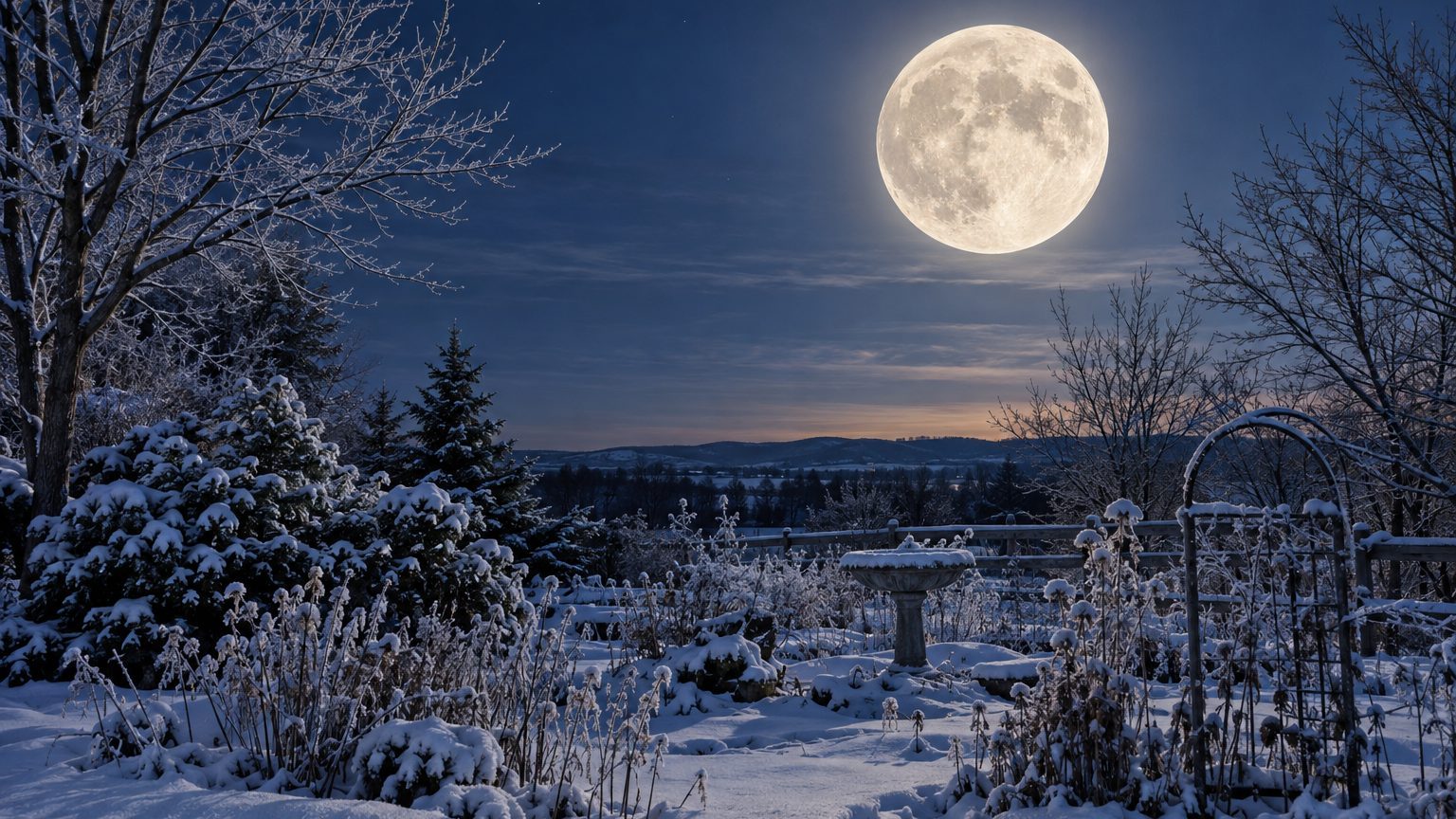

The Cold Moon of 2026 is the full moon of December 23 at 8:28 p.m. ET, with the Moon in Cancer. In 2027 it arrives earlier, on December 13 at 11:08 a.m. ET, in Gemini. Both are the Old Farmer’s Almanac name for the December full moon. Gardeners who plant by the Moon also treat the days after it as a distinct stretch of the lunar cycle, which the sections below explain.
Cold Moon in 2026 and 2027
A full moon is the instant the Moon sits directly opposite the Sun as seen from Earth. The dates below are exact moments, not whole days. All times are Eastern, so readers in other time zones should convert the clock time.
| Year | Date | Time (ET) | Moon sign | Name that year |
|---|---|---|---|---|
| 2026 | December 23 | 8:28 p.m. ET | Cancer | Cold Moon |
| 2027 | December 13 | 11:08 a.m. ET | Gemini | Cold Moon |
The sign column is a calendar convention. Almanacs record which zodiac sign the Moon occupies at each phase and use it in their planting tables. It says nothing about the weather or the sky you will see, and the planting by the moon guide explains how those tables are built.
The two years sit differently around the December solstice. In 2026 the solstice falls on December 21 at 3:50 p.m. ET, so the Cold Moon comes after it. In 2027 the solstice falls on December 21 at 9:42 p.m. ET, and the Cold Moon comes before it. Each year has only one full moon in December.
Some names do shift from year to year. The Harvest Moon is the full moon nearest the September equinox, so it can land in September or October depending on the year. In 2026 it falls on September 26 and in 2027 on September 15, both in September. May 2026 shows another kind of shift, with two full moons (May 1 and May 31) and the second one carrying the Blue Moon label. The Cold Moon has no such twist in either year. It is simply the December full moon, and the name stays the same.
For every other full moon of the year, see the full moon calendar 2026 and the full moon calendar 2027.
Where the name comes from and what it marks
The names on an almanac’s full moon list describe the season, not the Moon. Wolf Moon, Snow Moon, Worm Moon, Strawberry Moon and Beaver Moon are all labels attached to what was happening outdoors when that full moon rose. The Old Farmer’s Almanac list draws on Native American, colonial American and European naming traditions, and the Cold Moon is the last entry of the year. In 2026 it follows the Beaver Moon of November 24, and in 2027 the Beaver Moon of November 13. The full set is in the full moon names guide.
“Cold” is a weather label. The Moon itself is no colder in December than in July. The name records that the cold season has settled in across much of the northern United States by the time this full moon arrives. Other names circulate for the same full moon, and Long Night Moon is the best known. It points to the same moment on the calendar, because the December solstice brings the shortest daylight of the year in the Northern Hemisphere. The solstice falls on December 21 in both 2026 and 2027, at 3:50 p.m. ET and 9:42 p.m. ET respectively.
There is also an astronomy detail behind winter full moons. The full Moon sits opposite the Sun, and in winter the Sun is low in the Northern Hemisphere’s sky. The December full moon therefore travels a high path overhead, which is why it can seem to hang in the sky for most of a long night. The effect comes from geometry and has nothing to do with planting.
The name is also tied to the hemisphere. In the Southern Hemisphere December is a summer month, so “Cold Moon” is a Northern Hemisphere label that does not describe the weather there.
As for what a garden or farm looks like in December, that depends entirely on where you live. A December in Minnesota and a December in southern Florida are not the same season, and almanac tables written for a whole country cannot capture that. The almanac tradition treats the cold months as a pause in its planting tables, but whether anything can go into the ground at your address is a local question. Your state’s planting guide answers it with local frost dates and soil conditions. This page covers the date and the name, and it makes no claims about what to sow where.
The Cold Moon in the garden
According to almanac tradition, the lunar cycle splits into four quarters, and each quarter has its own kind of work. The days from full moon to last quarter are the third quarter, which the almanac rule assigns to root crops. The fourth quarter, from last quarter to the new moon, is the traditional period of rest.
For the Cold Moon, the third-quarter window runs from the evening of December 23 (8:28 p.m. ET) to the afternoon of December 30 (1:59 p.m. ET) in 2026. In 2027 it runs from the morning of December 13 (11:08 a.m. ET) to the early morning of December 20 (4:10 a.m. ET). Gardeners who plant by the Moon use windows like these to pick days within a month.
The effect of the Moon on crops is not proven. The custom is an old almanac practice, and this page presents it as tradition and makes no promise about germination, growth or yield. Anyone who follows it should also keep the order straight. Frost dates and soil temperature decide whether a crop can go into the ground at all. The Moon, for gardeners who follow it, only chooses among the days the local calendar already allows. In many states in December that may leave very little to choose from, and the state planting guides are the place to check.
For a day-by-day view of the month, including the other phases and signs, see the December 2026 moon calendar. The planting by the moon pillar covers the four quarters, the sign conventions and the reasons the tradition is kept.
Questions
When is the Cold Moon in 2026?
The full moon falls on December 23, 2026, at 8:28 p.m. ET, with the Moon in Cancer. It is the only full moon of December that year and comes after the December solstice on December 21.
When is the Cold Moon in 2027?
The 2027 Cold Moon is on December 13 at 11:08 a.m. ET, in Gemini. This time it comes before the December solstice, which falls on December 21 at 9:42 p.m. ET.
Should the Cold Moon decide when I plant?
No. The Moon’s effect on crops is not proven, and the almanac rule is a tradition that some gardeners keep. Local frost dates and soil temperature come first, and your state’s planting guide gives those. If you do follow the tradition, the Moon only picks among days the local calendar already allows.