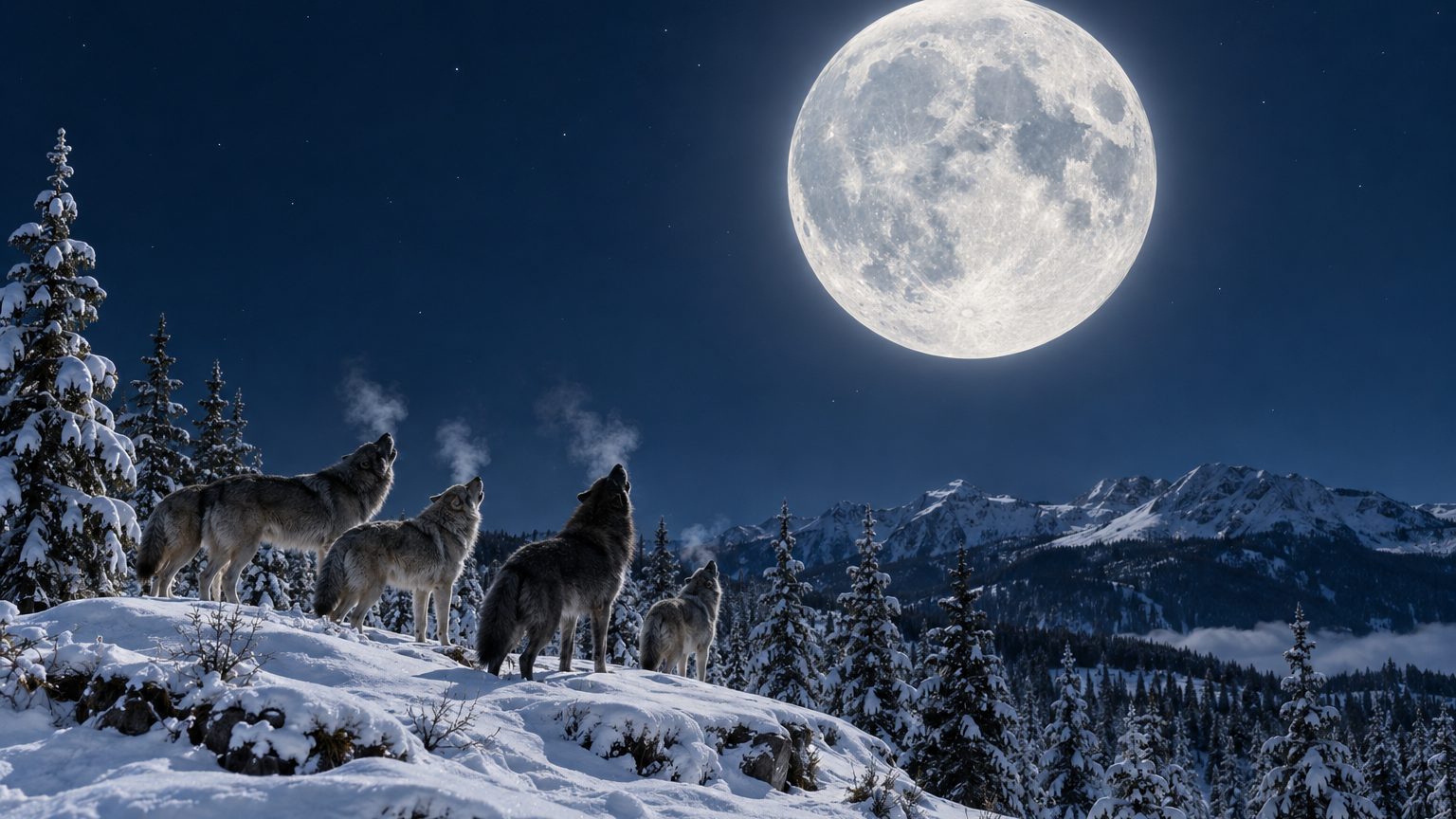

The Wolf Moon is the traditional name for the January full moon. In 2026 it falls on January 3, 5:02 a.m. ET, with the Moon in Cancer. In 2027 it arrives later, on January 22, 7:17 a.m. ET, with the Moon in Leo. Both dates follow Old Farmer’s Almanac usage. Gardeners who plant by the Moon treat this full moon as the start of a waning stretch.
Wolf Moon in 2026 and 2027
| Year | Full moon date | Time (ET) | Moon sign | Name that year |
|---|---|---|---|---|
| 2026 | January 3 | 5:02 a.m. ET | Cancer | Wolf Moon |
| 2027 | January 22 | 7:17 a.m. ET | Leo | Wolf Moon |
All times are Eastern. Readers in other time zones should convert the clock time before planning around it.
The gap between the two dates comes from the lunar cycle, which runs about 29.5 days. Twelve cycles fall a little short of a calendar year, so full moons creep earlier in the calendar from year to year. Every so often the pattern adds a thirteenth full moon. 2026 is one of those years. It holds 13 full moons, including a second full moon in May on May 31 at 4:45 a.m. ET, labeled a Blue Moon. 2027 holds 12. Thirteen cycles run longer than one calendar year, which is why the January full moon lands nearly three weeks later in 2027.
The name itself does not move. In both years the Wolf Moon is the January full moon, and January 2026 has only one full moon, so there is no doubt about which one carries the name. The name that does shift with the calendar is the Harvest Moon, which goes to the full moon nearest the September equinox. That is a September question, not a January one.
The Moon sign in the table is where the Moon sits at the moment of fullness. It is a date-keeping detail that almanacs print beside each phase. Nothing in the table is a planting instruction.
Where the name comes from and what it marks
The explanation passed down for the name is about hunger and howling. In midwinter, the story goes, wolves were heard close to settlements, and the January full moon took its name from that sound. It is a traditional account, not a documented record of any one place. The almanac lists it among twelve seasonal names that run from Wolf Moon in January to Cold Moon in December. For the full sequence and where each name is said to come from, see the full moon names page.
The name describes the time of year, not the Moon’s appearance. A January full moon looks like any other full moon. What changes is the calendar around it. In astronomical terms, winter runs from the December solstice to the March equinox. For the 2027 Wolf Moon, that stretch begins with the solstice on December 21, 2026, at 3:50 p.m. ET. The Cold Moon on December 23, 2026, at 8:28 p.m. ET comes two days after it, and the Wolf Moon follows about a month later. The March equinox in 2027 is on March 20 at 4:24 p.m. ET. In 2026 the equivalent date is March 20 at 10:45 a.m. ET, and the Snow Moon on February 1, 5:09 p.m. ET follows the Wolf Moon by under a month.
Each year’s Wolf Moon is followed by the Snow Moon, the February full moon. In 2026 that is February 1 at 5:09 p.m. ET. In 2027 it is February 20 at 6:23 p.m. ET. The Wolf Moon is the opening name in the sequence, and many almanac calendars start their year with it for that reason.
What January looks like in a garden depends on where the garden is. A yard in Minnesota and a yard on the Gulf Coast or in southern Florida are in different seasons on the same date, and no single description covers the whole country. That spread is the reason this page gives no planting dates. What can go into the ground in January, and when, is a question for your state’s planting guide, which is built around local frost dates.
On a farm, the name belongs to the calendar rather than to any particular task. Almanacs have long used these names as a way to keep track of the months, and the Wolf Moon is simply the label for the first full moon of the year. Treat it as a date marker with a story attached.
The Wolf Moon in the garden
The planting-by-the-Moon tradition splits the lunar month into four quarters. According to almanac tradition, the stretch from full moon to last quarter, the third quarter, is the traditional window for crops grown below ground, such as root crops. The fourth quarter, from last quarter to the next new moon, is traditionally a rest period, set aside for tasks other than sowing. For the Wolf Moon, the third-quarter windows are:
- 2026: from January 3, 5:02 a.m. ET (full moon) to January 10, 10:48 a.m. ET (last quarter)
- 2027: from January 22, 7:17 a.m. ET (full moon) to January 29, 5:55 a.m. ET (last quarter)
The rest period that follows runs, in 2026, from the last quarter on January 10 at 10:48 a.m. ET to the new moon on January 18 at 2:51 p.m. ET. In 2027 it runs from the last quarter on January 29 at 5:55 a.m. ET to the new moon on February 6 at 10:56 a.m. ET.
The effect of the Moon on crops is not proven. These rules are almanac custom, and some gardeners follow them while others ignore them. Nothing here promises a result, and this page does not claim that the Moon changes how seeds sprout or how roots develop.
The Moon never overrides the calendar of the place. Frost dates and soil temperature decide whether a crop can go into the ground in your area. For those who follow the custom, the Moon only chooses among the days the local calendar already allows. In much of the country, a January window has no bearing on what can be sown, and your state planting guide is the place to check.
To see how the Wolf Moon sits among the other months, open the full moon calendar 2026 or the full moon calendar 2027. For the full explanation of the quarters and how the tradition is laid out, start with planting by the moon.
Questions
When is the Wolf Moon in 2026 and 2027?
In 2026 it is January 3 at 5:02 a.m. ET, in Cancer. In 2027 it is January 22 at 7:17 a.m. ET, in Leo. Both are Eastern time.
Why is the 2027 Wolf Moon so much later?
Lunar cycles last about 29.5 days, which does not divide evenly into a calendar year. 2026 has 13 full moons, including the Blue Moon on May 31, and 2027 has 12. That extra cycle pushes the January full moon from January 3 to January 22.
Does planting around the Wolf Moon improve a garden?
That has not been shown. The almanac rule is a tradition, and it points to the third quarter as the traditional window for root crops. Local frost dates and soil temperature come first. The Moon, for those who follow it, only picks among the days that are already open.