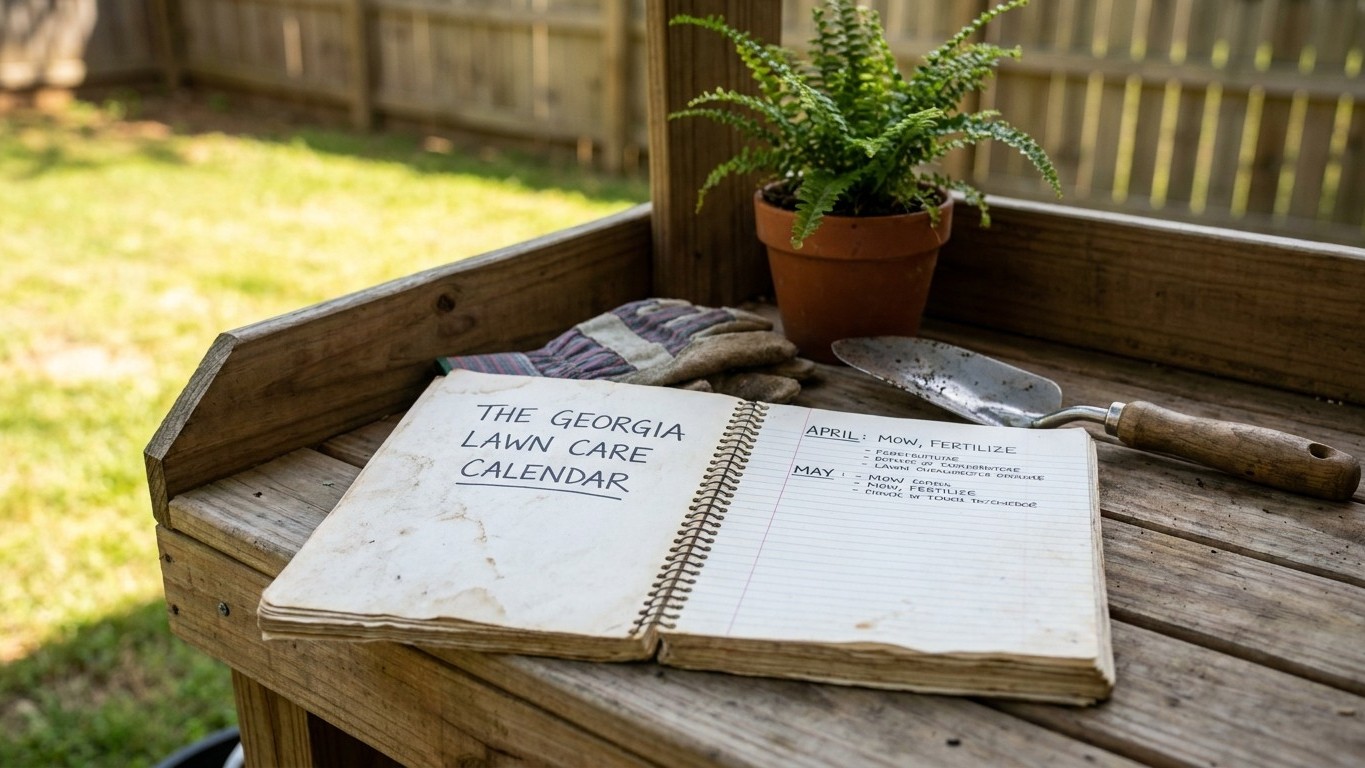

Georgia’s lawn calendar splits in two, because the state sits in the turf transition zone, where neither cool-season nor warm-season grass performs perfectly year-round. NOAA’s 1991-2020 climate normals put the first fall freeze at the Atlanta station between November 13 and December 1, a window that anchors the last feeding and last mowing for warm-season lawns. Before you follow any date on this page, check which grass is already growing in your yard. Cool-season and warm-season species are worked on opposite ends of the year, and a task that helps one can damage the other.
The short answer for Georgia
Fescue or bermuda decides everything else in the calendar. One greens up in fall and rests through summer heat; the other sleeps through winter and grows hardest in July. Georgia sits in the strange position of supporting both, which is why a calendar that works for a north Georgia lawn can wreck one forty miles south. Every date that follows is anchored near Atlanta and split by grass type, because lumping them together is how good intentions kill lawns.
That choice is the thing this whole calendar depends on. If you haven’t made it yet, The Best Grass Seed for Georgia Lawns lays out the trade-offs in more depth before you commit to a maintenance schedule. If you already know your grass, and you’ve handled the groundwork of soil testing, mowing height, and irrigation setup covered in Georgia Lawn Care, the rest of the calendar tells you what to do and when.
The dates below are measured at or near Atlanta. A lawn in the north Georgia mountains or on the coastal plain runs on a different clock, which the next section covers in detail.
Working through the year

Georgia effectively runs two lawn calendars at once, one for cool-season fescue and one for warm-season bermudagrass or zoysiagrass, and they point in opposite directions through the year.
Cool-season lawns: fall and spring do the work
For tall fescue, and the less common Kentucky bluegrass and perennial ryegrass, Clemson’s HGIC 1219 Tall Fescue Maintenance Calendar puts the working season in fall and spring. Overseeding and the heaviest feeding happen as summer heat breaks, in the weeks around the first fall frost window that NOAA’s 1991-2020 normals set at November 13 to December 1 for the Atlanta area. A second, lighter feeding and any pre-emergent herbicide application come in spring, before summer weeds germinate. Through July and August, HGIC 1219 shifts the goal from growth to survival: mow high, water only to prevent wilt, and skip nitrogen, because feeding a heat-stressed fescue lawn in midsummer pushes leaf growth the roots can’t support.
Warm-season lawns: summer is the growing season
For bermudagrass or zoysiagrass, Clemson’s HGIC 1216 and HGIC 1217 maintenance calendars center the active season on late spring through summer, once the turf has fully greened up. Aeration and any dethatching belong in this window too, while the grass is growing fast enough to heal the wounds quickly. Feeding tapers off well before the first frost, and stops once the turf begins to lose color, because a late nitrogen application delays the hardening-off the grass needs to survive winter dormancy.
| Task | Cool-season (tall fescue) — HGIC 1219 | Warm-season (bermudagrass/zoysiagrass) — HGIC 1216 / 1217 |
|---|---|---|
| Active growth | Fall and spring | Late spring through summer |
| Seeding or overseeding | Fall, around the first frost window | Late spring, once soil has warmed |
| Heaviest feeding | Fall, with a lighter spring round | Summer |
| Aeration | Fall | Late spring to summer |
| Dormant or stressed period | Summer heat | Winter, after first frost |
Both calendars give exact nitrogen rates and mowing heights by month for their species. Since those numbers vary with soil test results and mower type, check the HGIC calendar for your actual grass before you buy fertilizer, rather than borrowing a rate from a neighbor’s lawn of a different species.
What changes across Georgia
Every date here is measured at the Atlanta airport station, and Atlanta itself runs warmer than most of the state because it’s an urban heat island. Move outside the city and the numbers shift in both directions.
North Georgia and the mountains freeze several weeks earlier in fall than the NOAA normals cited above. A warm-season lawn in Dahlonega or Blairsville typically stops growing, and needs its last feeding, well before a lawn in downtown Atlanta does. Anyone gardening at elevation should treat the November 13 to December 1 window as a late estimate, not an early one.
The coastal plain in south Georgia runs the opposite way: milder winters, a shorter frost season, and warm-season grass that holds its color later into fall and greens up earlier in spring than the Atlanta figures suggest. Bermudagrass in Valdosta or Savannah is realistically on a different clock than bermudagrass in Atlanta, even though both follow the same HGIC 1216 calendar in terms of what to do, just not exactly when.
None of this changes which grass is realistic for a given yard, since the whole state falls in the same transition zone by the climate measures used to define it. It changes only the timing within each season, by a matter of weeks rather than months. A homeowner near the coast or in the mountains should treat every date in this article as a starting point to adjust, not a fixed calendar day.
The mistakes this climate punishes
Feeding the wrong grass at the wrong time
The single most common error in a transition-zone state is applying a fall fertilizer program to a warm-season lawn, or a summer program to a cool-season one. Nitrogen on bermudagrass or zoysiagrass in October delays the dormancy the grass needs to survive winter, and the damage shows up as winterkill in February and March, patches that never green back up the following spring. Nitrogen on fescue in July does the opposite kind of harm: it forces leaf growth the heat-stressed roots can’t sustain, and the lawn thins by late August.
Seeding on the wrong side of summer
Cool-season seed sown in May germinates fine and then dies in June, because the seedling has no root system deep enough to survive its first hot month. The mistake looks like a lawn failure in July, but the actual error happened at planting. Warm-season grass has the same problem in reverse: seed or sod put down too late in fall never establishes enough root before frost, and the thin spots show up as bare patches the following spring instead of a solid green-up.
Mowing too short in a hot summer
A fescue lawn scalped to a low height in July loses the shade its own canopy would have provided the soil, and the crown dries out fast. The damage doesn’t always show the same week you mow. It shows ten days to two weeks later, as a general yellow cast that looks like disease but is really drought stress compounding a bad haircut. Raising the mower deck before the heat arrives, not after the lawn already looks stressed, is the only fix that works.
Checking this against your county
The figures come from a single Atlanta-area weather station and from Clemson calendars written for the same regional climate rather than for Georgia specifically. Your county’s soil, rainfall, and frost timing can differ enough to matter, especially in the mountains, the coastal plain, or anywhere well outside the Atlanta metro.
The University of Georgia’s Cooperative Extension network keeps county-level agents who can confirm local frost dates, soil test results, and grass recommendations for your specific address. Find your county office through UGA Extension before you commit to a planting date that can only be estimated.
Common questions
Can I just follow a South Carolina calendar if I garden in Georgia?
Yes, for the species-specific tasks. The Clemson HGIC calendars cited above are written for the same transition-zone climate that covers most of Georgia, so the sequence of tasks applies. The exact calendar dates should still be checked against your local UGA Extension office, since county frost dates shift the timing by a week or two in either direction.
My bermudagrass is still brown in April, is it dead?
Probably not. Warm-season turf stays dormant and brown until soil temperatures climb enough to trigger green-up, and a slow spring can push that later than expected. Scratch a small patch of the crown near the soil line. If you find any green or white tissue underneath the brown blades, the plant is alive and just hasn’t broken dormancy yet.
Can bermudagrass take over my fescue lawn?
Yes, and it’s a common complaint in Georgia specifically because both grasses are grown side by side here. Bermudagrass spreads by stolons during summer, right when fescue is at its weakest, and can invade a thin fescue lawn within a season or two. A solid, well-fed fescue stand resists invasion better than a thin one, which is one more reason the fall feeding schedule matters.
What about centipede grass or St. Augustine grass?
Those warm-season species are common further south along the coastal plain but aren’t among the grasses covered for the Atlanta-area transition zone. If you’re in south Georgia and considering either one, check with your county UGA Extension office for local performance data before planting.