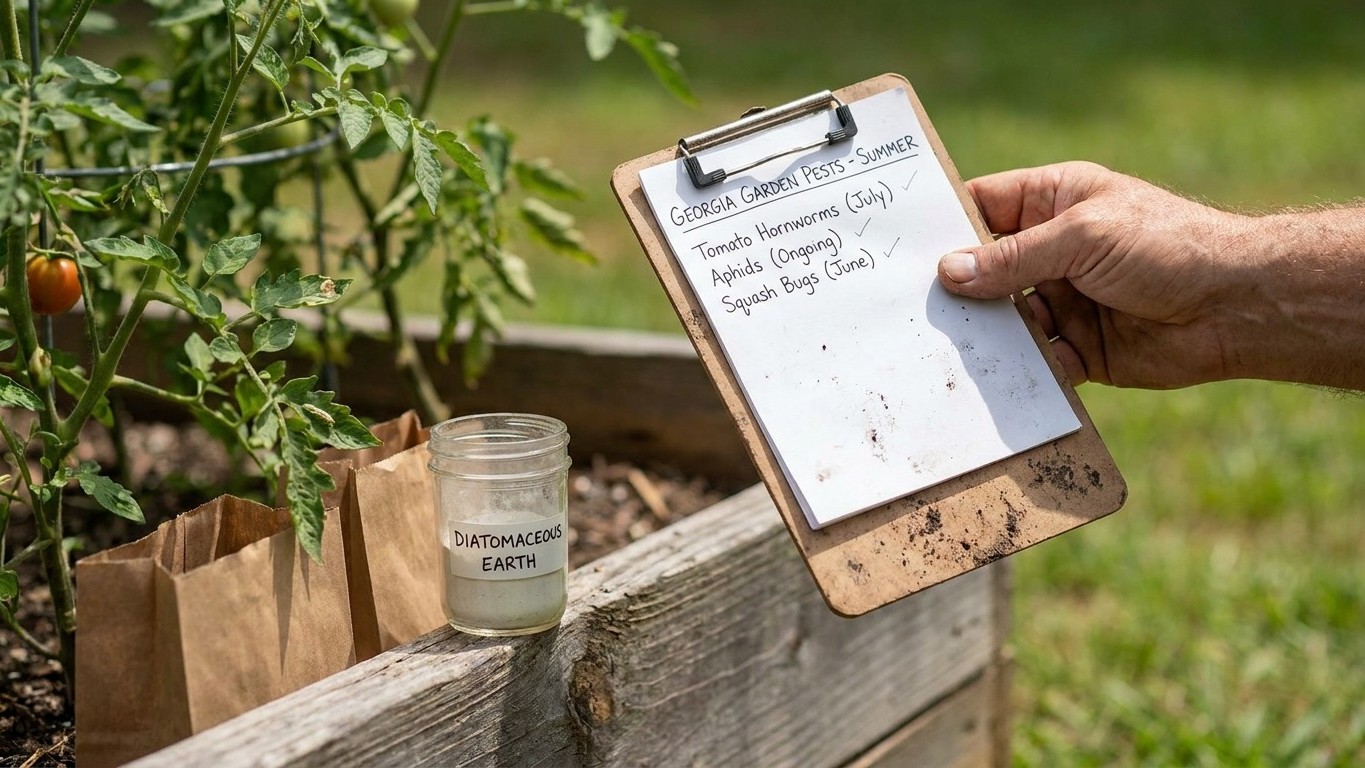

Georgia’s ten most-reported garden pests, according to UGA Cooperative Extension’s Bulletin 577 Home Gardening and the Georgia Pest Management Handbook Home and Garden Edition, are aphids, cutworms, tomato fruitworm and corn earworm, pickleworm, melonworm, squash vine borer, cowpea curculio, spider mites, Mexican bean beetle populations, and Colorado potato beetle in Georgia. That list isn’t exhaustive and pressure shifts by region, so a county extension office is the right call for anything that doesn’t match. Check the undersides of leaves and the base of stems on every transplant before it goes in the ground. That’s where the season’s first infestation usually starts, and catching it there costs a lot less than catching it three weeks later.
What Georgia gardens actually deal with

Georgia’s long, humid growing season and mild winters let several generations of the same insect complete their life cycle before frost finally shuts things down. That’s the mechanism behind most of what shows up on the UGA list below: warmth speeds up reproduction, and a wet spring keeps soft new growth on tap for chewing and sucking insects all season long.
Aphids

Aphids build colonies fast in cool, humid spring weather, sucking sap from new growth and leaving leaves curled, yellowed, and coated in a sticky residue called honeydew. A strong jet of water knocks most colonies off. Insecticidal soap handles the rest, and heavy infestations usually mean ants are farming them for the honeydew, so check for ant trails on the stem too.
Cutworms

Cutworms in Georgia feed at night and sever young seedlings right at the soil line, leaving a healthy-looking transplant lying flat by morning. A cardboard collar pushed an inch into the soil around each transplant stops them cold, and it costs nothing but a few minutes.
Colorado potato beetle

Both the adult beetle and its spiny larva strip potato and eggplant foliage down to the veins. Hand-picking works if you check plants every few days, since a female can lay hundreds of eggs before you notice the first adult.
Mexican bean beetle

This pest skeletonizes bean leaves from the underside out, leaving a lacy, papery pattern that’s easy to mistake for disease. The larvae do most of the damage, so flip leaves over early in the season to catch the first egg clusters.
Spider mites

Hot, dry stretches favor spider mites, which cause a fine stippled, dusty look on leaves before webbing appears at leaf joints. They’re arachnids, not insects, so many standard insecticides do nothing against them.
Squash vine borer

The larva bores into the base of the stem and feeds inside it, causing sudden wilting of an otherwise healthy squash plant. Sawdust-like frass at the stem base is the giveaway. Once inside, spray is useless. Prevention timing matters more here than for almost any other pest on this list.
Tomato fruitworm / corn earworm
The same caterpillar species attacks corn ear tips and tomato fruit, boring a single clean entry hole and hollowing out the inside. On corn, it arrives with silking. On tomato, it targets fruit just as it starts to ripen.
Cowpea curculio
This weevil punctures developing pea pods to lay eggs, and the larvae feed inside, ruining pods that looked fine from the outside. UGA Extension recommends starting treatment once pods reach half an inch long, before the weevil has a chance to get inside.
Pickleworm
Pickleworm larvae tunnel into squash and cucumber fruit and blossoms, and by the time you see the hole, the inside is often already ruined. UGA Extension notes that crops planted after mid-June are at the highest risk.
Melonworm
Melonworm feeds on leaves first, skeletonizing them, before moving into the fruit itself on melons and squash. It follows the same late-planting risk pattern as pickleworm, and both are best caught at first bloom.
Telling damage apart

The shape of the damage tells you more than the bug itself, and reading it correctly is what keeps you from spraying for the wrong problem.
Reading the pattern
Chewed edges and ragged holes point to a chewing insect with mouthparts built for biting, like a beetle or a caterpillar. Look for the culprit on the leaf itself or just under the soil surface nearby, since many chewers feed at night and hide by day.
Stippling, a fine dusty speckled look across the leaf surface, is the signature of sucking pests like spider mites and aphids that drain individual cells rather than biting through tissue. Hold the leaf up to light. Aphids cluster visibly on the underside, while spider mite damage often shows up before you can see the mite itself.
Sticky residue on leaves or on the ground beneath the plant is honeydew, a byproduct of aphids or other sap-feeders, not a sign of disease. Sooty mold sometimes grows on top of honeydew afterward, which can make the problem look worse than it is.
A wilting plant is the trickiest call. Wilting from squash vine borer damage stays localized to one stem even though the rest of the plant looks fine, while wilting from underwatering or root rot droops the whole plant evenly. Check the stem base for a hole and frass before assuming it’s a watering problem.
Holes bored straight into fruit, as opposed to surface scarring, almost always mean a caterpillar is already inside, whether that’s tomato fruitworm, pickleworm, or melonworm. At that point the fruit is usually not worth saving, and the lesson is to have caught it at the bloom stage instead.
Disease tends to spread in blotches or rings with a defined edge, often starting on lower leaves and moving up, while insect damage is scattered and irregular across the plant. A magnifying glass or phone camera zoomed in on the leaf edge settles most disputes between the two.
- Ragged holes or missing leaf tissue: a chewing insect, active recently, likely still nearby
- Fine stippling with no visible holes: a sucking pest, check leaf undersides
- Sticky film with sooty black coating: honeydew from aphids or similar, treat the insect not the mold
- One stem wilting while the rest of the plant looks healthy: check for a borer at the base
- Clean round holes into fruit: a caterpillar is inside or has already moved on
When each one shows up
Pest timing in Georgia tracks plant growth stage and temperature more reliably than the calendar. Aphids and cutworms tend to show up earliest, hitting tender transplants and new seedlings while spring growth is still soft and the weather is cool and humid. Colorado potato beetle and Mexican bean beetle follow shortly after, arriving as potato, eggplant and bean plants put out the flush of leaf growth that both insects depend on.
The summer shift
UGA Cooperative Extension identifies summer as the peak pressure window statewide, and the mechanism is straightforward: consistent heat shortens the time it takes each pest to complete a generation, so populations that started small in May can be large by July. Spider mites follow this pattern closely, building fastest during hot, dry stretches when plants are already somewhat stressed.
Squash vine borer activity lines up with squash and cucumber vines putting on their main runners, and the earlier you catch the adult moth around the base of the plant, the better your odds of preventing the larva from ever getting inside the stem. Tomato fruitworm and corn earworm arrive as corn begins silking and as the first tomato fruit starts to size up and ripen, since both crop stages offer exactly the tissue the caterpillar wants to bore into.
Cowpea curculio timing is one of the few fixed thresholds on this list. UGA Extension recommends starting treatment once pods reach half an inch long, which gives the weevil no window to get inside before the pod hardens. Pickleworm and melonworm are the latest arrivals of the season, and UGA Extension warns that squash and cucumber crops planted after mid-June face the heaviest pressure from both, with damage often starting right at first bloom and continuing through harvest unless treatment starts on schedule and repeats weekly.
These windows are set around conditions near Atlanta, where UGA Cooperative Extension is based, and they run earlier in south Georgia and later at higher elevation in the north Georgia mountains. Gardeners in cooler regions further outside the Southeast see a different rhythm entirely. The pest calendar for gardens in Kentucky shifts later across the board because of a shorter, cooler season, and the same is true further north still in Iowa gardens, where summer heat arrives later and drops off sooner.
What actually works
Prevention beats intervention on every pest on this list, mostly because by the time damage is visible, a chewing or boring insect has usually already done the worst of it. Crop rotation breaks the cycle for pests like Colorado potato beetle and cutworms that overwinter in soil near where their host crop grew the year before. Moving nightshades and beans to a different bed each year denies the next generation an easy start.
Timing and barriers
Floating row cover put on at transplant time keeps squash vine borer moths, cutworm moths, and bean beetle adults from ever reaching the plant, but it has to come off once flowers open on any crop that needs pollination. A cardboard or foil collar around a transplant stem stops cutworms specifically, and it’s one of the cheapest, most reliable fixes on this entire list.
Encouraging natural predators does real work against aphids and spider mites in particular. Lady beetles and lacewings eat aphids in large numbers, and letting a strip of flowering plants go unsprayed nearby gives them somewhere to live between meals. Broad-spectrum insecticide sprays kill these predators along with the pest, which is one reason spider mite outbreaks often follow right after a garden gets sprayed for something else.
Hand-picking is slow but effective against Colorado potato beetle and Mexican bean beetle, since both are large enough to spot and slow enough to catch. Checking the undersides of leaves for egg clusters and crushing them before they hatch is faster than picking adults later.
For pests with hard treatment windows, timing the spray matters more than the product. UGA Extension’s threshold for cowpea curculio, half an inch pod length, exists because spraying earlier wastes product on pods the weevil can’t yet reach, and spraying later means the damage is already inside. Pickleworm and melonworm both call for treatment starting at first bloom and repeating weekly through harvest, since new generations keep arriving as long as the plant keeps flowering.
A few popular home remedies do essentially nothing against these pests. Garlic or pepper sprays repel by scent for a day or two at best and wash off in the next rain. Marigolds planted nearby have no measurable effect on squash vine borer or fruitworm populations, whatever the folklore says. Beer traps work against slugs, not against any insect on this list, and get pinned to the wrong pest constantly.
What control costs
Cost on a home garden pest problem is mostly a question of time rather than money, and the cheapest options require the most of it.
| Method | Money cost | Time cost | Best against |
|---|---|---|---|
| Hand-picking | None | High, needs checking every few days all season | Colorado potato beetle, Mexican bean beetle |
| Barriers and row cover | Low, reusable for several seasons | Low once installed, but must be removed for pollination | Cutworms, squash vine borer, bean beetle |
| Biological controls (predators, Bt) | Low to moderate | Moderate, needs repeat applications for Bt | Aphids, caterpillar pests |
| Targeted sprays | Moderate, repeats add up over a season | Moderate, weekly reapplication during peak pressure | Pickleworm, melonworm, fruitworm |
Hand-picking is the cheapest option in dollars and the most expensive in attention, since missing even a few days lets eggs hatch into a full generation of larvae. Barriers and row cover cost more upfront but pay that back over several seasons of reuse, and they need almost no ongoing labor once they’re in place.
Biological controls, whether that’s encouraging existing predator populations or applying a targeted product like Bt against caterpillar pests, sit in the middle. They take longer to show results than a spray does, but they don’t wipe out the predator insects doing free work in the same bed. Sprays are the most repeat-dependent option on this list, since UGA Extension’s own guidance calls for weekly reapplication against pickleworm and melonworm through the entire bloom and harvest period, and skipping a week during peak pressure often means starting over.
For a typical home vegetable garden, a combination of barriers early in the season and hand-picking or spot treatment later usually ends up cheapest overall, since it avoids the recurring cost of a full spray program while still catching the pests that barriers can’t stop, like cowpea curculio once pods are already forming.
Local help
UGA Cooperative Extension identifies pest specimens, tracks regional outbreaks, and publishes the county-by-county guidance behind Bulletin 577. A local county office can confirm which of these ten pests is actually in your garden before you spend money treating the wrong one. Find your county’s contact through UGA Extension, and browse the rest of our Georgia guides for other seasonal garden tasks specific to the state.
One Pest Worth Watching Closer
Most of what lands in a Georgia garden follows a predictable calendar, but not every pest waits for spring to start trouble. Take a look at melonworm, which UGA Cooperative Extension treats as a summer-only concern rather than something that shows up early in the season. If you’ve got squash, cucumbers, or other cucurbits going into the ground after mid-June, that’s the planting window Extension flags as the one most likely to take a real hit. It’s a good reminder that timing your planting isn’t just about frost dates and soil temperature — it’s also about knowing which pests are keyed to specific stretches of the calendar and staying ahead of them rather than reacting once the damage is visible. The page walks through when melonworm actually shows up in Georgia, why later plantings draw the worst of it, and when treatment needs to start to keep it from getting ahead of you. If cucurbits are part of your summer garden plan, it’s worth reading before you decide when to put seed in the ground.
Common questions
Why do my squash plants keep dying even though I don’t see any bugs?
Check the base of the main stem for a small hole and sawdust-like debris before assuming it’s a watering or disease problem. That’s the signature of squash vine borer, and the larva feeds inside the stem where you can’t see it until the plant has already started wilting.
Is it too late to plant squash or cucumbers in July in Georgia?
You can still plant, but UGA Extension flags crops planted after mid-June as facing the heaviest pickleworm and melonworm pressure of the season. If you plant late, start checking blossoms and fruit at first bloom rather than waiting for visible damage.
Do ladybugs actually help with garden pests or is that a myth?
They genuinely help, particularly against aphids, which both the adult beetle and its larva eat in large numbers. Spraying a broad-spectrum insecticide nearby kills off these predators along with the target pest, which is why aphid or spider mite problems sometimes get worse right after an unrelated spray.
My bean leaves look lacy and skeletonized, is that a disease?
It’s almost certainly Mexican bean beetle, not a disease. Flip a few leaves over and look for the yellow, spiny larvae doing the feeding, since they cause most of the damage and are easier to catch early than the adult beetle.