
If you’re standing over your tomato plants wondering what’s going to come after them this year, the honest answer is: it depends on the week. Right after you transplant, it’s cutworms cutting stems at the soil line and flea beetles peppering the leaves. Later it’s beetles and aphids, then hornworms and fruitworms once fruit sets, then stink bugs as it ripens. Go check the base of each seedling right now for a severed stem — that’s the one worth ruling out first, before anything else on this list has a chance to matter.
What this comes down to in Illinois

The pests that matter in an Illinois tomato patch track the season in a fairly predictable order, starting at transplant and ending as fruit ripens in late summer. Timing tells you almost as much as appearance does: a chewed stem in early May is a different animal than the same-looking damage in July. This section covers only which pests show up and how to identify each one. If you have not settled on when to set plants out, Tomato Planting Dates in Illinois: Counting Back From Your Frost Window covers that groundwork first.
Cutworms

Cutworms are the first pest most Illinois gardeners meet, usually within days of setting out transplants. The caterpillar hides in the top inch of soil during the day and comes out at night to chew through a stem right at ground level, dropping the whole seedling overnight with no warning the day before. A cardboard collar pushed an inch into the soil around each stem stops them cold, and it costs nothing.
Flea Beetles

Flea beetles arrive around the same time as cutworms but attack from above instead of below. The adults are barely visible and jump the instant you get close, leaving leaves peppered with small round holes that make young foliage look like it has been shot with fine buckshot. Established plants shrug this off, but a bad flea beetle year on seedlings can stall growth for weeks.
Colorado Potato Beetle

This one shows up as plants are putting on real size, usually a few weeks after transplant. The striped adult and its orange, humpbacked larva both feed on foliage, and a heavy infestation can strip a plant of leaves in a matter of days. Hand-picking works on a small planting if you check the undersides of leaves for the yellow egg clusters and crush them before they hatch.
Aphids

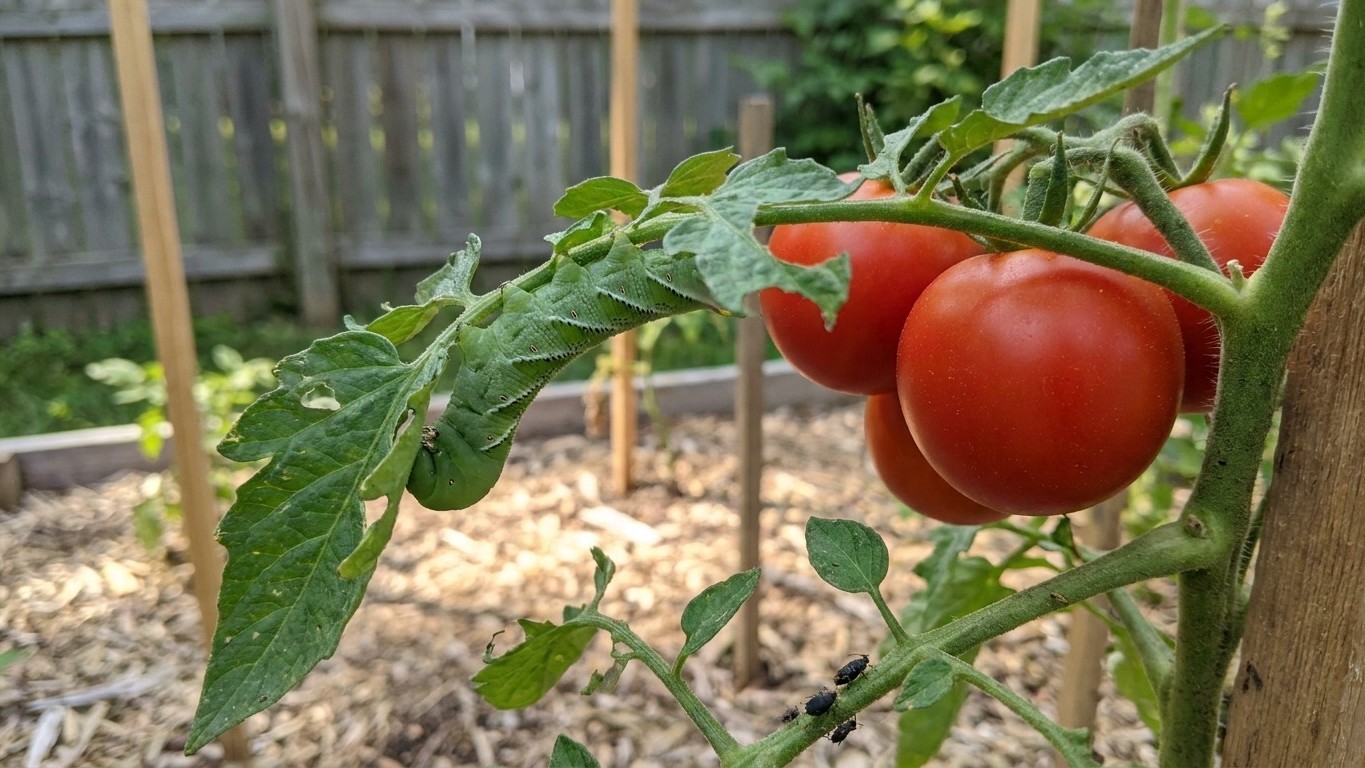
Aphids can turn up any time conditions stay mild and plants are growing fast, often clustering on the undersides of leaves and around new growth at the stem tips. A light infestation does little harm, but a heavy one leaves leaves curled, sticky with honeydew, and sometimes coated in sooty mold. A strong jet of water knocks most colonies down enough for natural predators to catch up.
Tomato Hornworm

Hornworms show up from mid to late summer and are hard to miss once you know what you are looking for, though the caterpillar’s green coloring and white stripes blend into foliage surprisingly well. They eat voraciously, and a single worm can strip a branch of leaves in a night, leaving dark pellet droppings on the leaves below as the giveaway. Hand-picking is the most reliable control once you spot one.
Tomato Fruitworm

Fruitworm shows up as the first fruit is setting and goes straight for the tomato itself rather than the leaves, boring in near the stem end and leaving a small entry hole ringed with frass. Damage is usually confined to one or two fruits per plant rather than a wipeout, but any fruit it enters is a loss since the tunnel invites rot.
Stink Bugs
Stink bugs feed as fruit ripens, piercing the skin to reach the flesh underneath and leaving cloudy, hard white blotches just under the surface that only show up when you cut the tomato open. The fruit is still usable if you trim around the damage, but a bad year can mark a large share of the crop cosmetically.
Working it out for your own garden
The fastest way to identify a pest correctly is to work through three questions in order: what point in the season it is, which part of the plant is damaged, and what the insect or larva actually looks like up close. Guessing from damage alone leads people to blame the wrong pest more often than not, especially early in the season when cutworm and flea beetle damage can look similar to a beginner.
A quick reference by season and location
| Pest | When it shows up | Where to look | Telltale sign |
|---|---|---|---|
| Cutworms | Within days of transplanting | Soil line at base of stem | Stem severed or chewed through overnight |
| Flea beetles | Right after transplant | Leaves of young plants | Many small round shot-holes |
| Colorado potato beetle | Early summer, as plants fill out | Leaves and stem tips | Striped adults, orange humpbacked larvae, stripped foliage |
| Aphids | Anytime growth is fast and mild | Undersides of leaves, new growth | Sticky honeydew, curled leaves |
| Tomato hornworm | Mid to late summer | Stems and leaves | Large striped caterpillar, dark droppings below |
| Tomato fruitworm | As first fruit sets | The fruit itself | Entry hole with frass near stem end |
| Stink bugs | As fruit ripens | Fruit surface | Cloudy or hard white blotches under skin |
Once you know roughly which pest fits the timing and location, confirm it with a close look rather than acting on a guess. A hand lens or even a phone camera zoomed in is usually enough to tell a Colorado potato beetle larva from an aphid colony, and that ten seconds of checking saves you from spraying for the wrong insect entirely. Treating the wrong pest wastes the spray and does nothing for the plant. If you are still choosing which varieties to grow, some carry useful resistance to diseases these pests can spread, and Tomato Varieties That Ripen in Time in Illinois lists which ones and what they resist.
What changes across the state
The frost figures above come from the Chicago area, and pest timing shifts with them across a state that spans USDA hardiness zones 5a to 7b according to the USDA Plant Hardiness Zone Map. Southern Illinois warms up earlier in spring and holds heat later into fall than the Chicago region, which means cutworm and flea beetle activity can start earlier there, and pests with multiple generations per year, like aphids and Colorado potato beetle, have more time to build a second or third wave before frost ends the season.
Proximity to Lake Michigan complicates the picture further for gardens right along the shoreline, where the lake moderates spring and fall temperatures and can push pest activity a little later than it runs even a short distance inland. None of these shifts change which pests show up, only when. A gardener in far southern Illinois should expect the same cutworm-to-stink-bug sequence described above, just compressed earlier and stretched longer on both ends compared to what a Chicago-area garden sees.
Local microclimate matters too. A garden tucked against a south-facing wall or in a low spot that holds cold air behaves differently than an open plot a quarter mile away, and that can shift when the first flea beetles or the first hornworm moths appear by a week or more in either direction. Treat the sequence above as the order pests arrive, not a calendar of exact dates for your specific yard.
The mistakes this state punishes

The most common mistake is skipping the cutworm check because the seedlings looked fine the day they went in the ground. Cutworm damage happens overnight and looks like nothing until a stem is severed, so the plant that was healthy at dusk can be lying flat by morning. Check the base of every transplant for the first week or two, not just once.
The second is reaching for a broad-spectrum insecticide the moment aphids or a few flea beetles show up. Broad-spectrum sprays kill the ladybugs, lacewings, and parasitic wasps that would otherwise keep aphid and hornworm numbers in check on their own, which often makes the following generation of pests worse rather than better. A targeted approach, hand-picking hornworms and Colorado potato beetle larvae, and a strong water spray for aphids, does less collateral damage.
The third is waiting too long to look for hornworms because the damage seems minor at first glance. A hornworm caterpillar goes from small to plant-defoliating in roughly a week as it moves through its final growth stages, and by the time whole branches are stripped, the worm responsible is usually already close to full size and about to drop off the plant to pupate. Checking foliage every few days during mid to late summer catches them while they are still small and easy to remove by hand.
- Skipping the cutworm check in the first week or two after transplant
- Spraying broad-spectrum insecticide for a light aphid or flea beetle presence
- Waiting until foliage is already stripped to start checking for hornworms
- Assuming fruit damage from stink bugs is a disease rather than an insect
Checking this against your county
The pest sequence above holds across Illinois, but the exact timing shifts by region and even by microclimate within a county. Illinois Extension, the state’s land-grant university extension service, publishes county-level guidance and can confirm what is actually active in your area in a given year, especially for pests that come and go depending on the previous winter’s severity. Start at extension.illinois.edu and look for your county office, since staff there track local outbreaks that a state-wide page like this one cannot.
If you are still working out the basics of the crop itself, growing tomatoes in Illinois covers soil, spacing, and watering, and is worth a look before pest pressure becomes the main thing standing between you and a harvest. See growing tomatoes in Illinois for that groundwork.
Common questions
Why are my tomato leaves full of tiny holes but I never see anything on them?
That pattern points to flea beetles, which are small enough to be easy to miss and jump away the moment you get close to inspect a leaf. Established plants usually outgrow the damage on their own, so treatment is mainly worth it on young seedlings that are still small enough to be set back.
My tomato plant just fell over overnight with no warning, what did that?
That is almost always a cutworm, which severs the stem right at the soil line while feeding at night. Check nearby soil for a curled gray-brown caterpillar and protect remaining seedlings with a simple collar pushed into the soil around each stem.
Is it worth spraying for aphids the first time I see a few?
Not usually. A small aphid colony is often kept in check by ladybugs and other predators within a week or two on its own, and spraying too early can kill off those predators before they get a chance to work.
How do I tell hornworm damage from something else eating my plant?
Hornworm damage is fast and concentrated: whole sections of a branch stripped of leaves within a day or two, with dark caterpillar droppings visible on the leaves or ground below. Once you spot that pattern, look carefully along the stem near the damage, since the caterpillar’s green color blends in well.