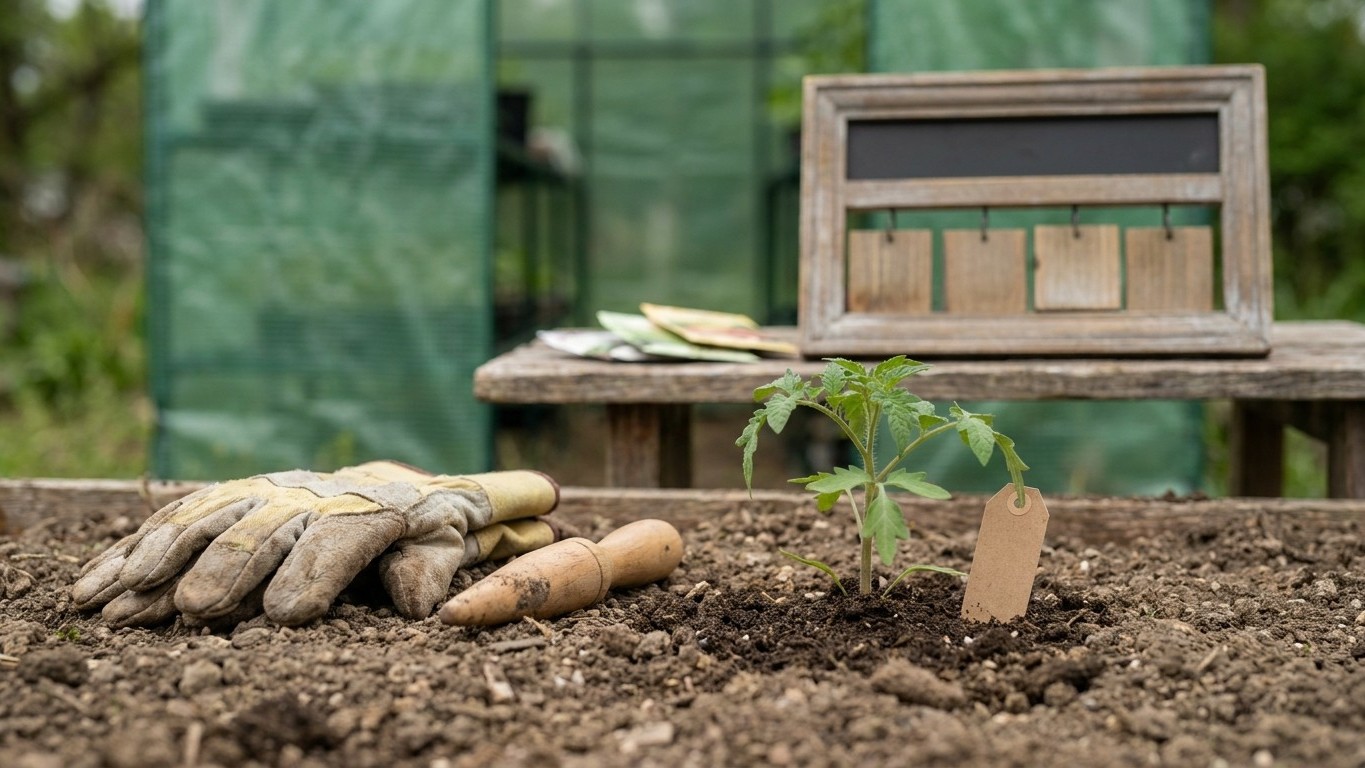

April 9 to April 21 is when Indianapolis’s last spring freeze typically lets go, and October 21 to October 30 is when the first fall freeze arrives — that six-and-a-half-month window is what every tomato planting decision in Indiana actually works from. But don’t transplant at the start of that range. Soil needs to warm, not just the calendar to turn, so late April through early May is the real target, which puts indoor seed-starting at early to mid March.
What this comes down to in Indiana

For Indianapolis, NOAA’s 1991-2020 Climate Normals put the last spring freeze at April 9 to April 21, and the first fall freeze at October 21 to October 30. Nearly every tomato planting decision in the state works forward or backward from that six-and-a-half-month window. If you haven’t settled the basics of growing tomatoes in Indiana yet, that’s the place to start before locking in a date, since spacing, soil prep and hardening off all assume you already know roughly when you’re transplanting.
The transplant date itself sits at the tail end of the spring range rather than the start of it. Tomato seedlings need soil that has actually warmed, not just a calendar date that has passed, which is why late April through early May is the realistic window even though the frost data technically opens on April 9. Seed-starting indoors runs on its own clock: because seedlings need roughly six to eight weeks under lights before they’re ready to go outside, counting back from a late April to early May transplant target lands you on early to mid March for sowing indoors, itself a range rather than a fixed day.
Purdue Extension’s caution matters here. Even after the published spring date, there remains roughly a 10% chance of a 32-degree freeze event, so anyone setting transplants out on the early edge of the window should have frost cloth or row cover ready to throw over the plants on a cold night rather than trusting the calendar alone. The USDA’s Plant Hardiness Zone Map puts Indiana across zones 5b to 7a, a two-zone spread wide enough that the Indianapolis figures above are a starting point for the rest of the state, not a fixed rule.
Working it out for your own garden
Every days-to-maturity figure on a seed packet is counted from transplant, not from seed, and it assumes an average season. Treat it as a starting point, then check it against the local frost window instead of trusting it blind. The method is the same for any variety: take the safe transplant range for your area, add the catalog’s days-to-maturity figure, and see how much room is left before the first fall frost.
Two cultivars, two outcomes
Run that arithmetic on a genuinely short-season cherry tomato and a slower paste tomato and the difference shows up fast.
| Cultivar | Days to Maturity | Transplant Window | First Ripe | Margin Before Fall Frost |
|---|---|---|---|---|
| Sun Gold | 57 | Late April to early May | Early July | 112 days |
| Juliet | 60 | Late April to early May | Early July | 109 days |
| Cherokee Purple | 72 | Late April to early May | Mid July | 97 days |
| Amish Paste | 85 | Late April to early May | Late July | 84 days |
Sun Gold, set out in the late April to early May window and ripening in early July, leaves 112 days of margin before the earliest edge of Indianapolis’s fall frost range. That’s the loosest case in this set. Even a cool, slow-starting season has room to recover before frost shuts things down.
Amish Paste tells a different story. At 85 days to maturity it’s the longest-season variety here, and even set out in that same late April to early May window it clears the season with only 84 days of margin, the tightest cushion of any variety in this comparison. Push that transplant date back into late May or early June, whether from cold soil, a wet spring, or simple procrastination, and a three-week delay eats most of the slack a paste tomato like this one has to give. Run this same math on any variety from Tomato Varieties That Ripen in Time in Indiana before committing garden space to it this season.
What changes across the state
Indianapolis sits close to the middle of the state, and its frost dates are a reasonable stand-in for the counties immediately around it. Move south toward the Ohio River and the growing season stretches in both directions: NOAA’s data notes that southern Indiana runs earlier in spring and later in autumn than the northern part of the state, by a fortnight or more at each end. A gardener near the river can often set transplants out before the Indianapolis window opens and keep harvesting well after a northern garden has been frosted off.
Head north instead, toward the Michigan line, and the pattern reverses. Lake Michigan’s mass moderates the immediate shoreline counties in ways the Indianapolis figures don’t capture at all, sometimes delaying both the last spring freeze and the first fall one right along the lake, while towns a short drive inland lose that effect and run colder and shorter on both ends than Indianapolis does.
None of this is precise enough to hang a planting date on. It shows up instead in the width of the USDA’s hardiness zone map for the state, which runs from 5b in the coldest pockets to 7a in the mildest, a spread that reflects real differences in how long the frost-free season actually runs from one county to the next.
The mistakes this state punishes

A few habits cost Indiana gardeners a harvest more often than any single pest or disease does.
- Trusting a warm week in April. A run of 70-degree days doesn’t move the frost calendar. Purdue Extension’s residual freeze risk applies right through the end of the published window, so a warm spell is not permission to skip hardening off or covering plants.
- Planting into cold, wet soil. Tomato roots stall in soil that hasn’t caught up with the air temperature, even after the freeze date has technically passed, and a stalled transplant rarely outgrows that setback for the rest of the season.
- Choosing a long-season variety without checking the margin. An 85-day paste tomato and a 57-day cherry tomato don’t carry the same risk in the same garden. Run the arithmetic from the section above before giving a slow variety your best bed space.
- Missing the pest calendar. Several of the state’s tomato pests show up at predictable points in the season, and a transplant date chosen without checking Tomato Pests in Indiana: Which Ones Actually Show Up Here can put young, vulnerable plants right in the path of the first generation.
Checking this against your county
The Indianapolis figures in this guide are a starting point, not an instruction for your specific address. Purdue Extension keeps county-level guidance and can direct you to a local office for a more exact read on your soil and frost history, available at extension.purdue.edu. A county office can also tell you how quickly your local soil warms in spring, something a statewide frost window can’t capture, and confirm whether your area tracks closer to the early or late edge of the Indianapolis range.
Common questions
Can I plant tomatoes earlier if I use a greenhouse or high tunnel?
An unheated tunnel buys you a few extra weeks on the front end but doesn’t eliminate frost risk entirely, since a hard freeze can still reach plants inside an unheated structure on a clear, calm night. Treat the tunnel as insurance on top of the frost window, not a replacement for it, and still keep cover ready for the coldest nights.
What if the last frost date has already passed but nights are still cold?
Check soil temperature, not just the calendar. Tomato roots need genuinely warm soil to grow, and a transplant set into cold ground will sit stalled for weeks even if the air temperature has cleared the frost risk. Waiting a few extra days for the soil to catch up almost always outperforms planting on the earliest possible date.
Do store-bought transplants need to be hardened off too?
Yes, and often more carefully than home-started ones. Greenhouse-grown transplants from a garden center have usually never felt direct sun or outdoor wind, so give them the same several days of gradual outdoor exposure before they go in the ground permanently.
Is it too late to plant tomatoes if I missed the early May window?
Not necessarily, especially with a shorter-season variety. Given Indianapolis’s fall frost window of October 21 to October 30, a cultivar with a lower days-to-maturity figure can still be set out into June and finish well before frost. Check the specific numbers on Tomato Varieties That Ripen in Time in Indiana before writing off the season.