
Indiana tomato growers deal with a specific, short list of pests rather than every insect in a seed catalog: cutworms and flea beetles at transplant, Colorado potato beetles and aphids through early summer, spider mites and hornworms in the heat, stink bugs and fruitworm as fruit ripens toward the October 21 to October 30 fall freeze that NOAA’s NCEI 1991-2020 normals put around Indianapolis. Check transplants for stem damage right at soil level within the first two weeks in the ground. That one walk-through catches the pest most likely to cost you a whole seedling, before fall pests are even on the calendar.
What this comes down to in Indiana

Tomato hornworms get all the attention — the fat green caterpillar everyone’s ready to hand-pick off by July. But in central Indiana, your tomatoes are usually in trouble long before that horned monster ever shows up. Cutworms cut transplants down at the soil line in late April, and flea beetles are already riddling the leaves within days of planting. By the time hornworms arrive, you’ve likely already lost seedlings to something smaller and faster.
Cutworms

Cutworms show up the week you set transplants out, late April to early May in central Indiana. The larvae are dull gray or brown caterpillars, an inch or two long, that curl into a tight C when you disturb the soil around a stem. They feed at night and chew stems clean through at ground level, dropping the whole seedling by morning. A cardboard collar pushed an inch into the soil around each stem stops them cold. There’s no need to treat the whole bed for it.
Flea Beetles

Flea beetles turn up on the same young plants, often within days of setting them out. They’re tiny, shiny black beetles, barely a sixteenth of an inch, that jump like fleas when you brush the leaf. Adults chew small round holes straight through the leaf, giving it a shot-hole look that can stunt a seedling before it takes off. Established plants shrug off light feeding. Row cover kept on until flowering keeps the worst of it off transplants.
Colorado Potato Beetle

Colorado potato beetles overwinter as adults in the soil and climb onto the first tomato and potato foliage of the season. The adult is oval, about three-eighths of an inch, yellow-orange with ten black stripes down its back. The larvae that do the real damage are humpbacked, reddish-orange, and dotted with black spots. A heavy larval hatch can strip a young plant’s leaves in a few days. Hand-picking both adults and the orange egg clusters on the underside of leaves keeps small plantings ahead of them.
Aphids

Aphids build up through the middle of the season, clustering on new growth and the undersides of leaves. They’re small, soft-bodied insects, less than an eighth of an inch, and come in green, yellow, or black depending on the species. Both nymphs and winged adults feed by sucking sap. Heavy colonies curl and yellow the leaves and leave a sticky residue that draws sooty mold. A strong water spray or insecticidal soap knocks populations back before they get out of hand.
Spider Mites

Spider mites favor hot, dry stretches in mid to late summer, the same weather that stresses the plant. They’re barely visible without a hand lens, pale yellow-green with two dark spots on the back, and they feed on the underside of leaves. Damage shows up as fine yellow stippling on the upper leaf surface, and heavy infestations spin fine webbing across the foliage. A forceful spray of water on leaf undersides, repeated every few days, breaks up colonies faster than most sprays do.
Tomato Hornworm

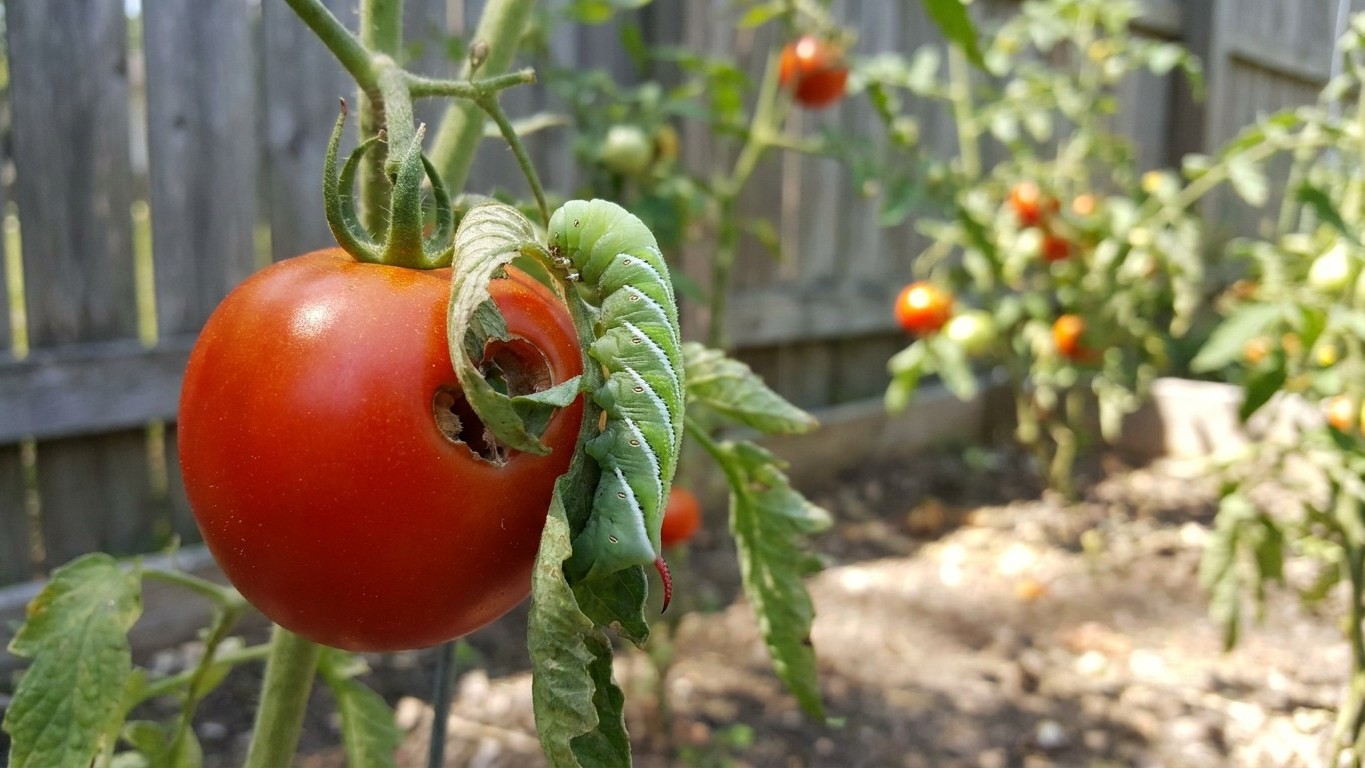
Tomato hornworms show up from midsummer on, feeding on foliage and green fruit. The caterpillar is large, up to four inches long, bright green with white diagonal stripes down each side and a curved horn on its back end. A single hornworm can strip a branch of leaves in a day, though it’s surprisingly hard to spot against the foliage until the damage is already done. Hand-picking works, but skip any hornworm covered in small white, rice-shaped cocoons. It’s already been parasitized by a beneficial wasp and is no longer feeding.
Stink Bugs
Stink bugs move in as fruit starts to size up, from midsummer into fall. The brown marmorated stink bug is shield-shaped, mottled grayish-brown, about five-eighths of an inch long, and both nymphs and adults pierce the fruit to feed. The damage shows as a hard, discolored, cloudy patch under the skin that doesn’t show until you slice into the fruit. There’s no quick fix once fruit is damaged. Removing nearby weedy hosts and picking ripe fruit promptly reduces the exposure window.
Tomato Fruitworm
Tomato fruitworm, the same species known as corn earworm, arrives late in the season and goes straight for ripening fruit. The caterpillar varies from green to brown to pink, striped lengthwise, and grows to about an inch and a half. It bores a clean entry hole near the stem end and feeds inside, out of sight. By the time you see the hole, the fruit is usually a loss. Picking fruit as soon as it ripens, rather than letting it hang, cuts down how long it’s exposed to egg-laying moths.
Working it out for your own garden
By the time you’re diagnosing a pest, you’ve likely already worked through the basics of growing tomatoes in Indiana, so the method here is just about telling one insect from another. Start with three questions: what part of the plant is damaged, how big is the culprit, and what point of the season you’re in. A stem chewed through at soil level in the first two weeks after transplant is almost always a cutworm. The same kind of damage on foliage in July points somewhere else entirely.
Timing lines up with the same frost window used for planting. Transplants go in late April to early May once the risk of a NOAA-tracked spring freeze has passed, and the planting calendar page walks through that Tomato Planting Dates in Indiana: Counting Back From Your Frost Window arithmetic in full. Fruit needs to finish before the October 21 to October 30 fall freeze closes the season around Indianapolis, and pest pressure on fruit builds right up against that same deadline.
Matching the damage to the pest
| Pest | Typical timing | Plant part damaged | Key sign |
|---|---|---|---|
| Cutworms | At transplant | Stem at soil line | Seedling cut clean through overnight |
| Flea beetles | Just after transplant | Young leaves | Small round shot-holes |
| Colorado potato beetle | Early season | Foliage | Orange, black-spotted larvae stripping leaves |
| Aphids | Mid-season, building | New growth, leaf undersides | Curled leaves, sticky residue |
| Spider mites | Hot, dry midsummer | Leaf undersides | Fine yellow stippling, webbing |
| Tomato hornworm | Midsummer on | Foliage, green fruit | Dark frass on ground below plant |
| Stink bugs | Fruit set through fall | Fruit | Cloudy patch under the skin |
| Tomato fruitworm | Late season | Ripening fruit | Small entry hole near stem end |
None of the disease resistance codes printed on a seed packet, gray leaf spot or Fusarium resistance among them, do anything against an insect pest. Those letters describe how the plant responds to pathogens, not to hornworms or aphids. Picking a variety for this state’s season length is a separate decision with its own tradeoffs, covered on the Tomato Varieties That Ripen in Time in Indiana page.
What changes across the state
Indianapolis is the reference point for every figure on this page, and it sits in the middle of the state, not at either edge. The USDA hardiness map puts Indiana as a whole across zones 5b to 7a, and that spread means southern counties along the Ohio River warm up and cool down on a different schedule than counties near the Michigan border.
Purdue Extension notes that southern Indiana’s frost dates run earlier in spring and later in autumn than the north, by a fortnight or more. That shifts every pest date on this page in the same direction. A gardener near the Ohio River can expect cutworm and flea beetle activity to start earlier than the Indianapolis window suggests, and stink bugs and fruitworm to keep working later into fall before frost shuts them down. A gardener in the far north should expect the opposite, a shorter season with pest arrivals compressed closer together on the calendar.
Elevation and local air drainage matter too, though there’s no single number for either across the whole state. A garden in a low frost pocket warms more slowly in spring, delaying cutworm and Colorado potato beetle activity a little compared with a garden on a nearby slope. None of this changes which pests show up, only when they show up, and that shift matters most for anything with a hard cutoff, like getting a row cover on before flea beetles find new transplants or picking the last fruit before frost gets to it.
The mistakes this state punishes

The biggest mistake is treating the Indianapolis frost window as a guarantee rather than a probability. Purdue Extension points out that even after the published spring frost date, there’s still roughly a 10 percent chance of a 32°F night, and a cold snap after transplanting stresses young plants right when cutworms and flea beetles are most likely to take advantage of a weakened seedling. Keep something on hand to cover transplants through the early part of that window.
A second mistake is skipping the cutworm collar because the bed looks clean at planting time. The larvae overwinter in the soil and don’t announce themselves until a stem is already cut. A collar costs almost nothing and prevents a loss that’s otherwise permanent for that plant.
A third is choosing a variety for flavor alone without accounting for how long it hangs on the vine exposed to late-season stink bugs and fruitworm. A long-season variety like Amish Paste, at 85 days from transplant, leaves less margin before the October 21 to October 30 fall freeze around Indianapolis than a shorter one, and every extra week on the vine is another week of exposure to fruit-feeding pests.
The last is waiting to look for hornworms until the damage is obvious. Their green color and vertical resting position hide them well against the foliage, and a plant can lose a branch’s worth of leaves between weekly checks. Checking leaf undersides and the soil for dark frass catches them before the damage is done.
Checking this against your county
Every figure on this page is measured at Indianapolis, and pest arrival dates shift earlier in southern Indiana and later in the north by roughly the margin Purdue Extension describes for frost dates. Your county extension office tracks pest activity specific to your area, sometimes through trap counts for moths like the tomato fruitworm, and that’s the most current word on what’s actually active near you this season.
Purdue Extension (extension.purdue.edu) publishes tomato pest and disease guides updated with current products and thresholds, and that’s the better source once you need a specific control recommendation rather than a general identification. Check with your county office before you spray anything, especially near a property line or a pollinator-heavy garden.
Common questions
What’s cutting my tomato seedlings off right at the soil line overnight?
That’s almost certainly a cutworm working after dark. Check the soil right around the stub for a curled, dull gray or brown caterpillar an inch or two long. If you find one, a cardboard collar pushed into the soil around the remaining transplants stops the rest of the row.
Should I kill every tomato hornworm I find?
Not if it’s covered in small white, rice-shaped cocoons standing up from its back. Those are the pupae of a parasitic wasp that’s already killed the caterpillar slowly from the inside, and leaving it in place lets the next generation of wasps go after other hornworms in the garden.
My tomato leaves have tiny yellow speckles late in the summer, what’s causing that?
That pattern, especially during a hot dry stretch, usually points to spider mites feeding on the leaf undersides. Look for fine webbing across the leaf axils in a heavy infestation, and hit the undersides of the leaves hard with a hose to knock populations back.
Do row covers actually keep pests off tomatoes?
They help against flying adults like flea beetles and the moths that lay hornworm and fruitworm eggs, but only while they’re on. Covers need to come off once the plant flowers so pollinators can reach the blossoms, and they do nothing against cutworms that are already in the soil at transplant.