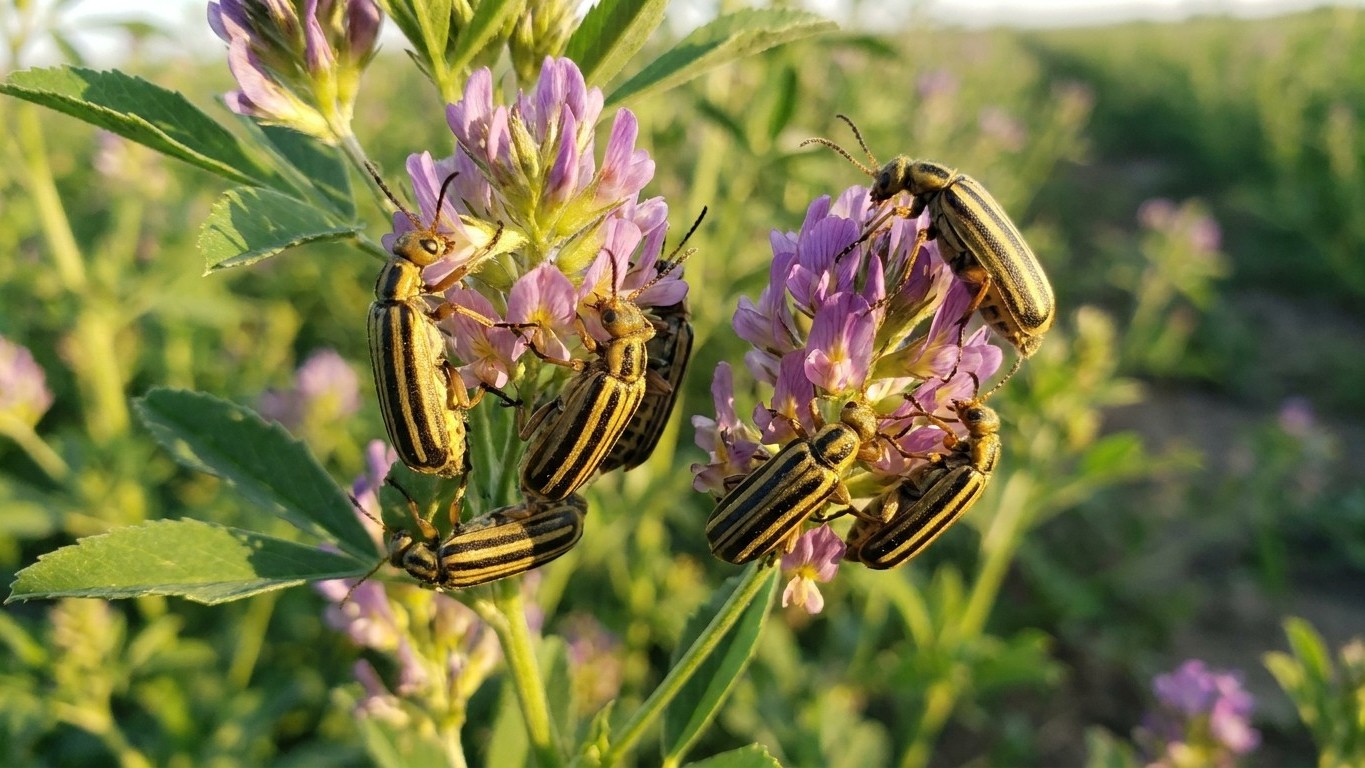

Blister beetles show up in Kansas gardens mostly in mid-summer, from July into September, arriving in sudden swarms rather than trickling in one or two at a time. Row covers installed before that window, plus quick hand-removal once you spot them, are the two moves that actually keep them off tomatoes, potatoes, and beans.
The weeks to watch

K-State’s pest calendar for Kansas vegetable gardens splits insects into two camps: those that overwinter as adults and show up early (striped cucumber beetle, squash bug, bean leaf beetle), and those that overwinter as eggs or pupae and arrive later in the season (stink bugs, twospotted spider mite, Grasshoppers, tomato hornworm, imported cabbageworm, corn earworm, squash vine borer). Blister beetles aren’t named in that split. The K-State S158 pocket guide and MF3480 fact sheet don’t publish a specific emergence window for this species, so there’s no county-level date to point to here.
What the general pattern tells you instead
Blister beetles fall biologically closer to the later group. Their life cycle runs through the soil over winter, and adults don’t appear until the ground has warmed well into summer. Kansas gardeners typically report the first swarms in July, with activity continuing into early September before it tapers off with a single generation per year. That’s consistent with the broader K-State pattern for late-arriving pests, even without a named line for blister beetles in the guide.
One practical note: because larvae of this insect actually feed on grasshopper eggs in the soil, a bad grasshopper year the season before often means more blister beetles the following summer. That’s a lagging indicator worth watching if you keep informal notes on your garden.
Reading the calendar from your last frost

Blister beetles respond to soil and air temperature, not to a date on a calendar, so a cold, wet spring pushes their appearance back and a warm one can bring them earlier. The frost date matters here mainly as the anchor point for when you’re transplanting warm-season crops in the first place, since that’s what puts tender foliage in the ground for beetles to find later.
NOAA’s 30-year climate normals for the reference weather station used in this guide put the last spring freeze between April 4 and April 18. That’s a normal, not a guarantee, and gardens outside the immediate metro area, especially at higher elevation or in low-lying rural spots, often see frost linger one to two weeks longer. Check your own county extension office for a local figure before you plan around this one.
- Start from your local last-frost date, using April 4-18 only if you’re near the reference station or adjust later for your county.
- Count forward roughly 10 to 14 weeks: that’s when transplanted tomatoes, potatoes, and beans reach the size and foliage density that draws in a blister beetle swarm, generally landing in the July-to-September window.
That gap gives you the practical planning window: covers should be ready to deploy by early July, not after the first swarm is already spotted feeding.
What it attacks, and what the damage looks like

The first sign most gardeners notice isn’t the beetle itself, it’s the damage. Plants show ragged, chewed leaf margins and rapid defoliation that can strip a section of foliage within a day or two, because blister beetles feed in tight groups rather than as scattered individuals. If you find a cluster of long, narrow beetles (often gray, black, or striped) packed together on a single plant, that’s the visual giveaway before you even confirm the species.
Adults do all the plant damage. The larval stage lives underground and feeds on grasshopper eggs, which makes it beneficial rather than destructive, so any treatment aimed at soil-dwelling larvae is wasted effort. Everything you do has to target the swarming adults directly.
Crops most commonly hit in Kansas gardens and fields include:
- Tomatoes
- Potatoes
- Peppers
- Beans
- Alfalfa (a particular concern for hay producers, since dead beetles baled into hay can sicken livestock)
Handling the beetles bare-handed also carries its own hazard: their body fluid contains cantharidin, which raises blisters on skin contact. Gloves aren’t optional here.
How Kansas sits in this pest’s range

Blister beetles are a widespread group across the central and eastern United States, and Kansas sits well within that range rather than near an edge of it. The reference materials used for this guide don’t break out a state-by-state count or rank for blister beetle pressure, so no claim here should be read as placing Kansas above or below its neighbors in severity. What widespread distribution actually means for a gardener is that the difference between one state and the next comes down to timing and local weather, not whether the insect shows up at all.
Kansas’s mix of row-crop agriculture and alfalfa production gives the insect plenty of habitat to move between fields and home gardens, which is part of why swarms can appear seemingly out of nowhere in mid-summer. Neighboring Plains states report the same late-summer pattern, driven by the same soil-temperature triggers rather than by anything unique to Kansas conditions.
What actually works against it

Cheapest, lowest-effort options come first here, since most gardeners want to know what to try before reaching for anything more involved.
- Scout weekly starting in late June. Swarms build fast, and catching a small cluster before it spreads to the whole row makes every later step easier.
- Install row covers before beetles arrive. This works only as a barrier method, so covers need to go on ahead of the swarm, not after beetles are already feeding underneath.
- Hand-pick with gloves and drop beetles into soapy water. Effective on small infestations, but cantharidin exposure makes bare-hand removal a bad idea, and crushing beetles against skin or clothing is worse than not touching them at all.
- Clear garden debris and mow field edges where grasshoppers lay eggs. Since blister beetle larvae feed on grasshopper eggs, reducing grasshopper habitat nearby can trim next year’s beetle numbers, though this is a longer-term effect, not an immediate fix.
- Rotate susceptible crops like tomatoes and potatoes to different beds each year to make it harder for swarms to return to the same predictable spot.
None of these measures matter once you’re past the adult-feeding stage and into fall, since the insect is already headed underground for the winter by then. And once a swarm has stripped a plant, there’s no treatment that reverses defoliation, only ones that stop the same plant from being hit again in the following days.
Common questions
Are blister beetles dangerous to touch?
Yes, in a specific way. Their body fluid contains cantharidin, a compound that raises blisters on bare skin. Gloves during hand-removal prevent this, and the risk disappears once the beetle is dead and dry.
Do blister beetles harm livestock, not just gardens?
They can. Dead beetles baled into alfalfa hay retain cantharidin, and horses in particular are highly sensitive to it. Hay producers in Kansas’s alfalfa-growing areas watch for swarms at cutting time for this reason.
Should I kill blister beetle larvae if I find them in the soil?
No. Larvae feed on grasshopper eggs and don’t damage plants. Any control effort should target the swarming adults on foliage, not anything found underground.