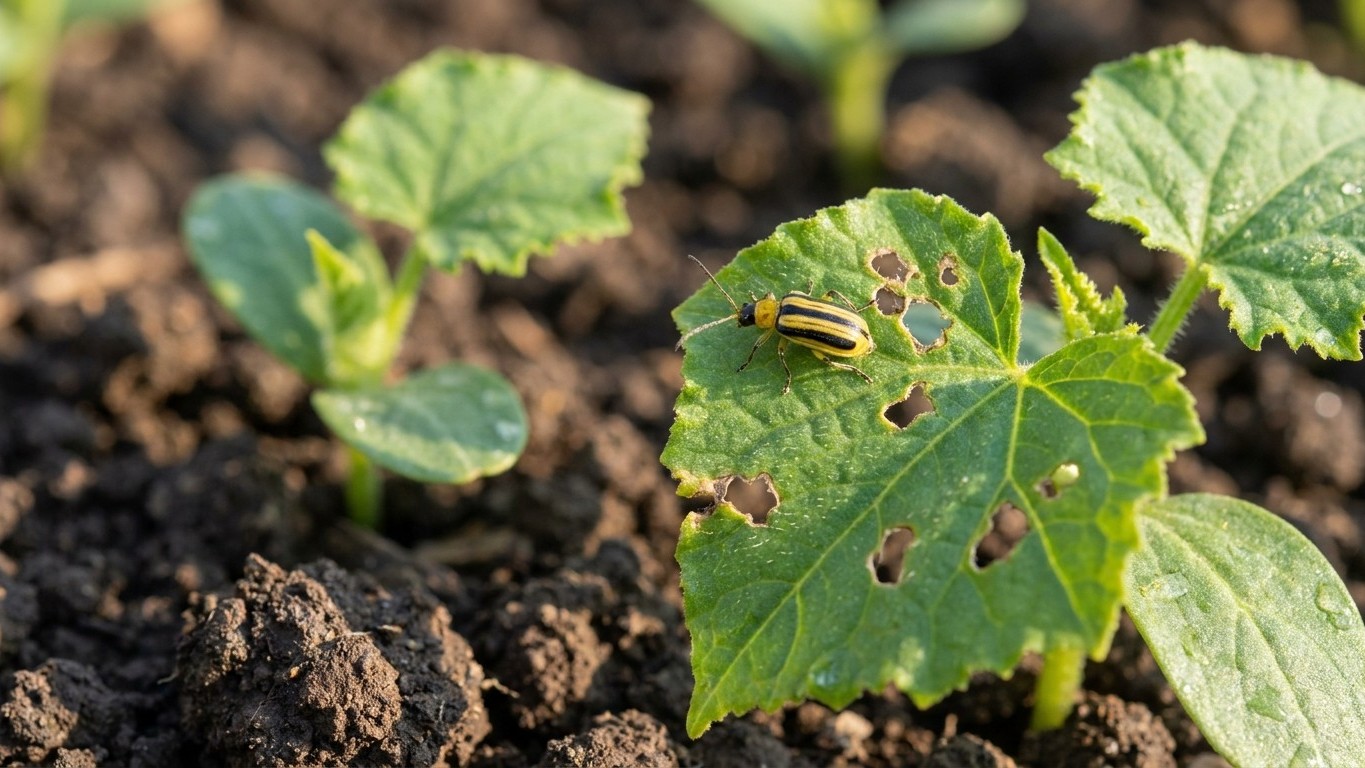

Striped cucumber beetles start crawling out of Kansas leaf litter and field margins as soon as soil temperatures hit the mid-60s, which typically lands somewhere between late April in the southern part of the state and mid-May farther north and west. They head straight for cucurbit seedlings, cucumbers, squash, melons, pumpkins, and gourds, and they don’t just chew leaves. The real threat is bacterial wilt, a disease they carry in their gut that can kill a healthy vine in days. Row covers, delayed planting, and a handful of targeted treatments are what actually keep populations under control.
When Striped Cucumber Beetles Show Up in Kansas

These beetles overwinter as adults, tucked into crop debris, grass clumps, and wooded field edges. Kansas winters rarely kill them off completely, so the population that emerges each spring is largely whatever survived the previous season. Once soil warms past roughly 65 degrees Fahrenheit, they become active and start looking for the first tender cucurbit growth available.
Timing varies across the state. In south-central Kansas, around Wichita and points south, gardeners often see the first beetles by late April. In the Kansas City area and points east, early to mid-May is more typical. Western Kansas, with its cooler nighttime temperatures and later soil warming, usually sees emergence push into mid-to-late May. Sandy or fast-draining soils warm quicker than heavy clay, so two gardens ten miles apart can see beetles a week or more apart depending on soil type alone.
The first wave targets seedlings at the cotyledon and first-true-leaf stage, the most vulnerable point in a cucurbit’s life. A second generation of adults, born from eggs laid at the base of plants in June, typically appears in late July through August. This second wave tends to feed more on foliage and fruit rind than on stems, but it still spreads disease and can scar melons and squash right before harvest.
Why This Pest Matters More Than the Bite Marks Suggest
A few beetles chewing on a full-grown squash plant is cosmetic. A few beetles on a two-inch cucumber seedling is a different story entirely. Striped cucumber beetles carry the bacterium Erwinia tracheiphila in their digestive tract, and every bite deposits bacteria into the wound. That bacteria clogs the plant’s vascular system, and within one to three weeks the vine wilts from the tip backward, even with adequate water. Cucumbers and muskmelons are the most susceptible; winter squash and pumpkins have more natural resistance to the wilt itself but can still lose yield to feeding damage and to squash mosaic virus, another disease these beetles transmit.
This is why extension entomologists at land-grant universities across the Midwest treat cucumber beetles differently than most garden pests. A single beetle on a seedling can matter more than a dozen beetles on an established plant. Kansas State University’s entomology program lists a rough economic threshold of about one beetle per plant at the seedling stage as justification for treatment, precisely because of the disease risk, not the chewing damage.
Cucumbers and cantaloupes lose the most to bacterial wilt. Yellow summer squash and zucchini are moderately susceptible. Pumpkins, winter squash, and watermelon tend to shrug off the disease better, though they’re still worth protecting from the beetles themselves, especially early on.
What Actually Stops Them in a Kansas Garden
Timing beats almost everything else. Planting cucurbits a week or two after the typical local emergence date, rather than rushing seeds into the ground the moment soil is workable, means seedlings emerge past the point of peak beetle pressure. It’s a small shift in schedule that avoids the most vulnerable growth stage entirely.
Physical Barriers and Trap Crops
Floating row covers, the lightweight spun-bond fabric sold at most Kansas garden centers, physically block adult beetles from reaching seedlings. The covers need to go on at planting and stay sealed at the edges with soil or landscape staples, because beetles will find any gap. The catch is timing removal. Cucurbits need pollinators to set fruit, so covers have to come off once flowers start opening, usually within three to five weeks of planting depending on the variety. That window, seedling to first bloom, is also the period when beetle damage matters most, so the cover does its job right when it’s needed and then steps aside.
Perimeter trap cropping works on a different principle. Blue Hubbard squash is far more attractive to cucumber beetles than cucumbers, zucchini, or melons. Planting a border ring of Blue Hubbard around the main cucurbit bed, seeded a week or so earlier so it’s already up and growing when beetles arrive, pulls the bulk of the population to the edge of the garden. Treating just that border row with an insecticide, rather than spraying the whole patch, cuts chemical use dramatically while still protecting the main crop.
Kaolin Clay and Organic Options
Kaolin clay, sold under trade names as a foliar spray, coats leaves and fruit in a fine white powder that beetles find irritating and confusing. It doesn’t kill anything, it just makes the plant an unappealing place to land and feed. Reapplication after rain is necessary, and it needs to go on before beetles arrive in force to be effective, not after damage is already visible.
Spinosad, an organic-approved insecticide derived from soil bacteria, gives home gardeners a treatment option that’s less harsh on bees than broad-spectrum products, provided it’s applied in the evening after flowers close for the day. Pyrethrin-based sprays work similarly but break down faster in sunlight, meaning more frequent reapplication during heavy pressure periods.
Conventional Insecticides and Application Timing
Carbaryl and permethrin remain common choices for heavier infestations, particularly on farms managing several acres of cucurbits rather than a backyard bed. Both are effective against adult beetles but carry real risk to pollinators if applied while flowers are open during the day. Kansas State University extension guidance consistently recommends evening applications, after bees have finished foraging for the day, as the standard practice for any insecticide used on flowering cucurbits.
Seed treatments and systemic insecticides applied at planting offer another route, protecting seedlings from the inside during that critical early window without requiring repeated foliar sprays. These tend to be more common in commercial operations than home gardens, partly due to cost and partly due to product availability at the retail level.
Monitoring, Rotation, and Reducing Next Year’s Population
Yellow sticky traps placed near seedlings give an early warning of beetle activity before damage becomes visible, which matters because by the time wilting shows up, the bacterial infection is already established and the plant usually can’t be saved. Checking traps every few days starting right around the local emergence window catches the first arrivals before they lay eggs.
Crop rotation helps limit the population that carries over from one season to the next, since beetle larvae feed on cucurbit roots in the soil and overwintering adults tend to cluster near where they fed as larvae. Moving cucurbit plantings to a different part of the garden each year, even a modest 20 or 30 feet, disrupts that cycle somewhat, though adult beetles can fly and will still find new plantings if pressure is high regionally.
Fall cleanup matters more than most gardeners realize. Removing and destroying old cucurbit vines, rather than leaving them to break down in place, eliminates a favorite overwintering site. Tilling garden beds in late fall exposes sheltering adults to freezing temperatures and predators, cutting into the population that would otherwise emerge the following spring ready to start the cycle over.
Resistant varieties exist for some cucurbits, particularly certain squash and melon cultivars bred with thicker rinds or bitter compounds that deter feeding, though true resistance to the beetle itself, as opposed to tolerance of the wilt disease it spreads, remains limited across most commercially available seed. Checking variety descriptions for bacterial wilt tolerance, rather than beetle resistance specifically, tends to be the more useful search when picking seed for a Kansas garden bed.