
Striped cucumber beetles start showing up in Kentucky gardens and fields as soon as soil temperatures climb into the mid-60s, usually somewhere between mid-April and late May depending on where you are in the state. Western Kentucky warms up first; the eastern and mountain counties lag a couple of weeks behind. The insect stays active through a second generation in July and August, which means the pressure doesn’t let up once the first wave passes. What actually stops it is a combination of timing (getting seedlings past their most vulnerable stage before the beetles peak), physical barriers like row covers, and, when populations cross a damage threshold, a targeted insecticide application at the seedling stage rather than broad spraying all season.
What the Beetle Looks Like and Why Kentucky Growers Deal With It Every Year

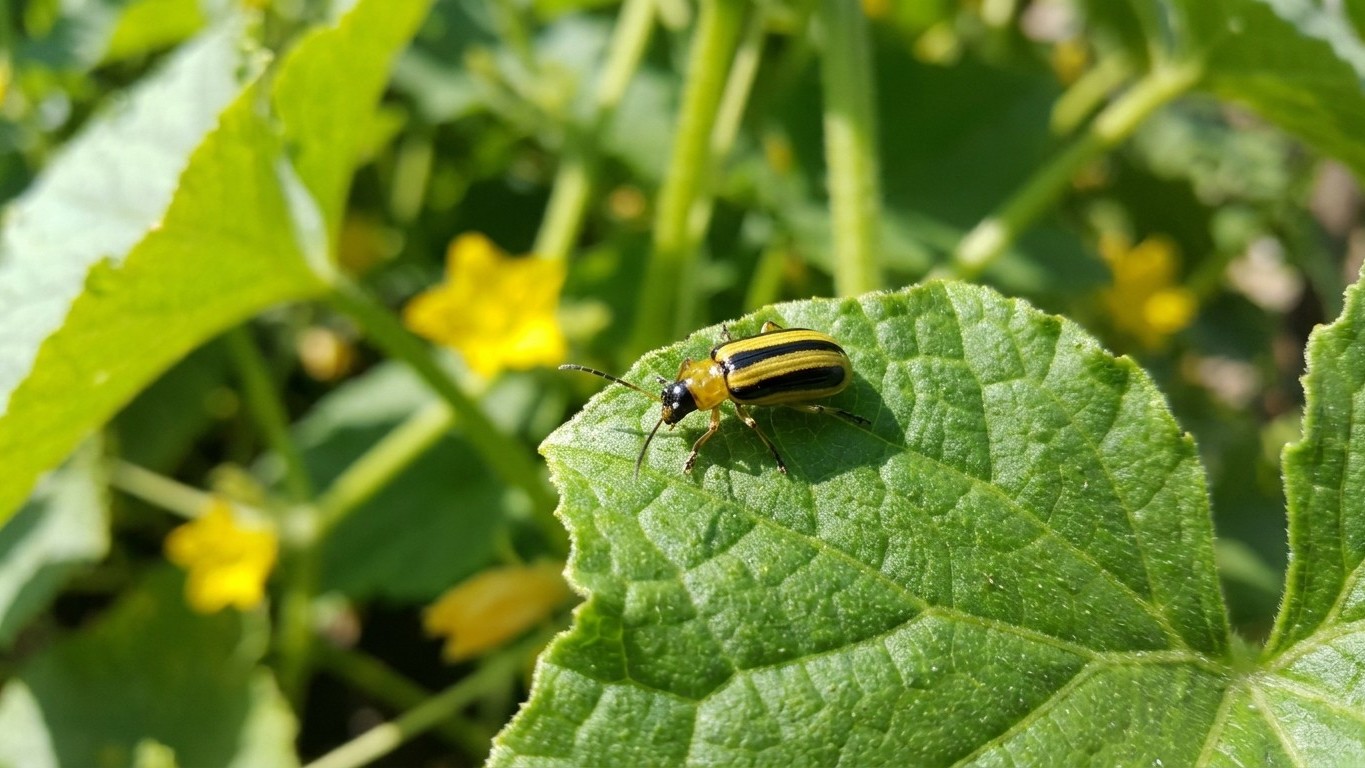
The striped cucumber beetle (Acalymma vittatum) is small, about a fifth of an inch long, with a black head and three bold black stripes running down a yellow back. It’s easy to confuse with the spotted cucumber beetle, which shows up in the same fields but carries spots instead of stripes and tends to be a less aggressive vector of disease.
Kentucky’s climate gives this beetle exactly what it needs to persist year after year. Adults overwinter in leaf litter, hedgerows, and crop debris at the edges of fields, then wake up and fly straight to the nearest cucurbit planting once the ground warms. Because the state’s growing season stretches from April through September, there’s enough time for two full generations, and sometimes a partial third in warmer western counties with long falls.
The Plants Most at Risk
Cucumbers, muskmelons, summer squash, winter squash, pumpkins, and gourds are all hosts, but they aren’t equally vulnerable. Cucumbers and muskmelons take the worst hit, both from direct feeding and from the bacterial disease the beetle carries. Squash and pumpkin varieties tend to tolerate feeding damage better, and some squash cultivars carry natural resistance that makes them far less attractive to the beetle in the first place.
The Real Threat Isn’t the Chewing, It’s the Bacteria
Feeding damage on a seedling looks alarming, ragged holes in cotyledons, chewed stems, sometimes a plant girdled right at the soil line. But the bigger problem lives in the beetle’s gut. Striped cucumber beetles carry Erwinia tracheiphila, the bacterium responsible for bacterial wilt in cucurbits. The bacteria overwinters inside the beetle itself, which means the very first beetles to emerge in spring can already be carrying it.
Transmission happens through the beetle’s feeding wounds and its frass. Once the bacteria gets into a plant’s vascular system, there’s no cure. Leaves wilt during the day, seem to recover at night, then wilt for good within a week or two. A single infected cucumber plant can collapse before it ever sets fruit. This is why controlling the beetle in Kentucky is less about cosmetic leaf damage and more about preventing an entire planting from wilting out in July.
Underground, the larvae add a second layer of stress. They feed on roots and can tunnel into the base of stems and even into fruit resting on the soil, though this damage is far less visible than what the adults do above ground and usually gets overlooked until harvest.
When to Expect Them: A Kentucky Timeline
Overwintering adults emerge once soil temperatures hold around 65 degrees for a stretch of days, which in most of Kentucky lines up with mid-April in the west and Purchase region, sliding into early May for central Kentucky, and mid-to-late May in the Appalachian counties. This first wave targets seedlings and transplants directly, which is exactly when cucurbit plants are least able to absorb damage.
A second generation follows in mid-to-late summer, generally July into August, as the offspring of that first wave mature. This second wave tends to be more diffuse across a planting rather than concentrated on tender seedlings, but it can still spread bacterial wilt to plants that escaped the spring infestation. Growers who direct-seed late-summer squash or fall cucumbers should watch for this generation just as closely as the spring one.
What Actually Stops the Beetle
No single tactic handles striped cucumber beetle on its own. Growers who keep damage low in Kentucky usually stack two or three of the following, timed around that spring emergence window.
Row Covers, Timed Precisely
Floating row covers installed at planting and sealed at the edges with soil or pins keep the first wave of beetles off seedlings entirely. The catch is timing: covers need to come off once flowers open, since cucurbits depend on bees for pollination and a sealed cover blocks them out too. In practice, that means covers work best on early transplants set out before the beetle’s spring emergence, then removed right as the first blossoms appear.
Trap Cropping
Blue Hubbard squash is disproportionately attractive to striped cucumber beetles compared to cucumbers or melons. Planting a border row of Blue Hubbard around the perimeter of a cucurbit patch, and treating just that border with an insecticide if needed, pulls beetles away from the main crop without spraying the whole field. This approach has been documented in university extension trials across the Midwest and works well on the small-to-medium scale common in Kentucky home gardens and market farms.
Kaolin Clay and Reduced-Risk Sprays
A kaolin clay particle film coats leaves in a fine white powder that disrupts the beetle’s ability to find and settle on host plants. It’s compatible with organic production and holds up reasonably well through Kentucky’s spring rains if reapplied after heavy storms. Neem oil and spinosad-based products offer another lower-impact option, though they generally need more frequent reapplication than a synthetic insecticide.
Crop Rotation and Sanitation
Because overwintering adults emerge close to where they spent the winter and often walk or make short flights before finding a host, planting this year’s cucurbits in a different part of the property than last year’s cuts down on the population that finds them immediately. Clearing old vines and leaf litter in fall removes overwintering sites, though this matters more on a farm scale than in a small backyard bed where beetles can simply fly in from a neighbor’s yard or a nearby fencerow.
Insecticide Timing, When Needed
When beetle counts exceed a rough threshold of one beetle per plant at the seedling stage, and especially in cucumber and muskmelon plantings where bacterial wilt risk is highest, a targeted insecticide application on seedlings can prevent losses that row covers or trap crops alone won’t catch in time. Products containing carbaryl or permethrin are commonly labeled for this use, but they should go on in the evening after bees have finished foraging for the day, and never during open bloom. For smaller plantings, pyrethrin-based options give a similar knockdown with a shorter residual, which suits gardeners who’d rather not maintain a spray schedule through the whole season.
Scouting: The Step Most Growers Skip
Checking plants every few days during the two-week window after seedlings emerge or transplants go in catches the beetle before it does real damage. Look at the underside of leaves and around the base of stems in early morning, when beetles are less active and easier to spot. A count of even a few beetles per plant at this stage, combined with any wilting on a nearby plant, is reason enough to act immediately rather than wait for a bigger outbreak. Once bacterial wilt symptoms appear on a plant, removing and destroying it, rather than composting it, keeps the bacteria from lingering in that spot for next season.
Kentucky State University’s small farm research programs have also noted that squash varieties bred with beetle resistance, sometimes marketed as “beetle-tolerant” summer squash, hold up with far less intervention than standard cucumber varieties, which is worth factoring in for anyone planning next year’s cucurbit rotation around fields with a known history of heavy beetle pressure.
Related guides
- Striped cucumber beetle in Indiana: When It Shows Up and What Stops It
- Striped cucumber beetle in Ohio: When It Shows Up and What Stops It
- Striped cucumber beetle in Maine: When It Shows Up and What Stops It
- Striped cucumber beetle in Manitoba: When It Shows Up and What Stops It
- Striped cucumber beetle in Kansas: When It Shows Up and What Stops It
- Striped cucumber beetle in New York: When It Shows Up and What Stops It