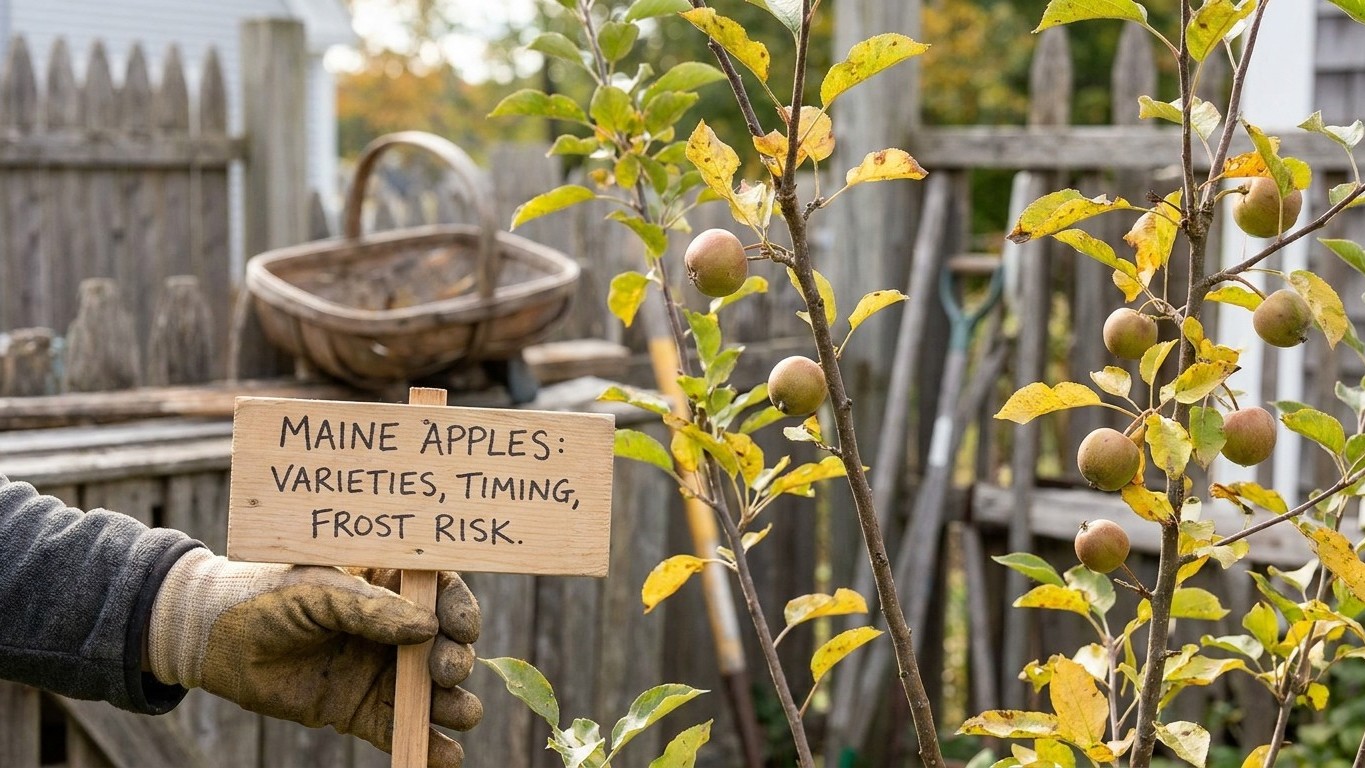

Apples in Maine? They grow fine, and they have for two hundred years — but “Maine” isn’t one climate, it’s a range running from mild coastal towns like Kittery to the hard interior cold of Aroostook County, and the variety that thrives in one can die in the other. So the real question isn’t whether apples grow here, it’s whether the tree in front of you was ever meant for your particular stretch of it. Start by finding out which end of that range your yard actually sits in before you fall in love with a variety.
Can you grow apples in Maine
Maine has grown apples commercially and in home orchards for well over two centuries, and the climate that makes that possible varies a great deal from one end of the state to the other. The USDA map places the state across zones 3b to 6a, and near Portland, at the mild end of that range, the coldest month averages a daily minimum of 13.4°F according to NOAA’s 1991-2020 normals. That figure is specific to the Portland station. The zone rating on a nursery tag only means something once you know which end of Maine’s range you are planting in.
Head inland toward the Sebago Lakes region and the western mountains, or north into Aroostook County, and winters run colder and the growing season shortens considerably. An orchard in Fort Kent faces a different tree list than one in Kittery or on Mount Desert Island. Where the climate gets genuinely demanding is that northern interior and higher elevation ground, and the answer there is not to skip apples but to plant toward the zone 3-4 end of the hardiness scale and favor varieties bred specifically for cold-winter regions, several of which trace back to breeding programs in Minnesota, Ontario and New Hampshire aimed at exactly this kind of winter.
Coastal and southern Maine, from Kittery up through Portland and into midcoast towns like Camden, sits at the milder end of the state’s range and can carry a wider variety list, including some selections that would struggle further inland. Maine also has its own heirloom apples suited to this climate: Black Oxford, a small, deep purple-black keeper apple with a dusty bloom on the skin, originated in the town of Paris, Maine, in the late 1700s and is still grown by home orchardists statewide. For a fuller rundown of what performs well region by region, see The Best Apple Varieties for Maine.
Site matters almost as much as variety. Apples want full sun and soil that drains rather than staying wet through the spring thaw, and a gentle slope that lets cold air drain away from the blossoms beats a low hollow every time, which matters most during the frost window covered in the Maine apple Calendar further down this page.
Which varieties suit this climate

Start with hardiness, then filter again by winter chill, because the two answer different questions. Hardiness is whether the wood survives a Maine winter. Chill is whether the tree flowers evenly the following spring, and it works in the opposite direction from hardiness risk here.
Cold-hardy varieties worth planting
Several varieties are widely catalogued as hardy to USDA zone 3 or 4, which covers Maine’s full range including the colder interior. Honeycrisp, Liberty, Freedom, William’s Pride and Northern Spy all appear on nursery hardiness lists at that level, and each carries its own catalogue traits worth knowing before you plant one.
| Variety | Catalog hardiness | Bloom timing | Harvest window | Disease notes |
|---|---|---|---|---|
| Honeycrisp | Zone 3 | Mid-season | Early to mid fall | Moderate scab susceptibility |
| Liberty | Zone 4 | Mid-season | Early fall | Bred for high scab resistance |
| Freedom | Zone 4 | Mid to late | Early to mid fall | Bred for high scab resistance |
| William’s Pride | Zone 4 | Early | Late summer | Bred for high scab resistance |
| Northern Spy | Zone 4 | Late | Late fall, long-keeping | Triploid, sterile pollen |
Why winter chill still matters even in a cold state
Winter chill measures how much sustained cold a tree needs to break dormancy evenly and bloom well, and Maine’s long winters supply it in abundance. That means the shortage problem never shows up here the way it does for a grower in Mississippi, where a variety bred for northern winters can sit underchilled and bloom thin and ragged. In Maine the risk runs the other way: a variety with genuinely modest chill needs can break dormancy earlier than the local frost calendar allows, pushing it into bloom before the last frost risk has passed. Treat the chill filter as a general rule rather than a numbered threshold, and lean on the hardiness rating and bloom timing in the table above as the practical stand-in.
Planting a pair that works here
Most apple varieties need a genetically different partner blooming at the same time to set a real crop, and at least one of the pair has to carry fertile pollen. That second part trips up more first-time growers than the first. A handful of well-known varieties, including Northern Spy in the list above, are triploids with sterile pollen, meaning they can receive pollen and fruit heavily themselves but contribute nothing useful to a neighboring tree.
Given the varieties that suit this climate, a few pairings are realistic. Honeycrisp and Liberty overlap closely enough in bloom timing to work as a pair, and both carry fertile diploid pollen, so either can pollinate the other. Freedom, bred as a companion to Liberty in the same disease-resistance breeding program at Cornell, blooms in the same mid-to-late window and makes a solid third tree if you have room. William’s Pride blooms earlier than that group, so it needs an early-flowering partner rather than being planted alongside the mid-season trees and left to guess.
Northern Spy is the one to watch. It blooms late and keeps well into winter, which makes it tempting as a single specimen tree, but its sterile pollen means it will never pollinate a neighbor and needs two other compatible, fertile varieties nearby to fruit itself. A flowering crabapple with a long bloom window and fertile pollen is a common workaround where space is tight, since it can pollinate several apple varieties across a wider bloom period than a second full-size apple tree would.
The frost that costs a crop here

Near Portland, NOAA’s 1991-2020 climate normals put the last spring freeze, the window where a 32°F freeze has a 30 to 70 percent chance of occurring, between April 22 and May 1. The same dataset puts the first fall frost between October 9 and October 21. Both figures come from the Portland station specifically, and inland and northern Maine push spring frost later and fall frost earlier, stretching the safe season shorter the further you get from the coast.
The frost that actually costs a Maine grower a crop rarely happens in the dead of winter. A dormant apple tree tolerates cold far below anything Maine sees in an average year. The real damage window opens once the buds show pink and stays open through bloom and petal fall, because open flowers and the swollen pink buds just ahead of them are far more frost-tender than the surrounding wood. A freeze that lands after pink kills the blossoms outright while leaving the tree itself completely undamaged, which is the cruelest version of the loss: the tree looks perfectly healthy all summer and simply carries no fruit.
There is not much to do about a hard, clear, still freeze once bloom is fully underway, but a few things shift the odds. Planting on a slope rather than in a low hollow keeps cold air draining away from the blossoms instead of settling around them. Covering a young tree with row cover or a sheet on a night frost is forecast during bloom can buy a few critical degrees. And the single most reliable protection available is choosing a variety that blooms late enough to miss the tail of the frost window in the first place, since a late-blooming selection flowering after the realistic last-frost date sidesteps a problem that no amount of covering fully solves for a full-size tree.
Growers further south in coastal Massachusetts, covered in our companion guide to growing apples in Massachusetts, generally work with an earlier and narrower version of this same spring frost risk. Maine’s window sits later in the calendar and the margin for a bloom-time freeze runs longer, which is exactly why late bloom timing carries so much weight on the variety list above.
The apple year in Maine
Timing an apple tree’s care by the calendar month is unreliable across a state this long north to south. The tree’s own stage, read against Portland’s frost windows as a reference point, is the better guide, and each stage calls for something different.
- Dormancy (late fall through late winter): prune while the tree is fully dormant and the wood is easiest to see.
- Green tip (first green shows at the bud tips as the ground thaws): apply any dormant oil or first scab treatment before green tissue is exposed.
- Pink (buds swell and show color, generally not long before the last-frost window closes): frost risk turns serious here, since buds this far along are far more tender than dormant wood.
- Bloom (flowers open, typically overlapping Portland’s April 22 to May 1 last-frost window per NOAA’s normals): watch the forecast closely and have frost cover ready.
- Petal fall (petals drop and fruit begins to set): this is when an insect spray, if one is needed, does the most good.
- Fruit set (small fruit visibly swelling): thin crowded clusters to one or two fruits each so the remaining apples size up properly.
- Harvest (variety-dependent, from late summer for early types like William’s Pride to well past Portland’s October 9-21 first-frost window for long keepers like Black Oxford): pick before a hard freeze damages fruit still hanging.
Because Portland sits at the mild end of Maine’s range, an orchard further inland or north should expect every one of these stages to arrive later in spring and finish earlier in fall, compressing the season overall. Keeping a simple log of when your own trees hit green tip and pink each year, rather than relying on a fixed date, is the most useful record a Maine grower can keep, since it shows exactly how much your own site differs from the coastal normals.
Local help
For a variety list built specifically for Maine’s growing conditions and current-season spray timing for scab, fire blight and insect pests, UMaine Cooperative Extension is the resource to check before you plant or spray. Call or check their site before applying any fungicide or insecticide, since spray timing tied to your own tree’s bud stage matters more than a date on a general guide.
Common questions
Can I grow an apple tree from seed I saved from an eating apple?
You can, but the resulting tree will not match the parent apple and can take many years longer to fruit than a grafted tree. Buy or graft a named cultivar on rootstock instead if you want a known apple and a predictable timeline.
Do I really need two trees, or can I get away with one?
Most varieties need a second, different, compatible variety blooming at the same time to set fruit, and a few marketed as self-fertile still crop better with a partner nearby. If you only have room for one tree, a neighbor’s apple or crabapple within normal bee-flying range can sometimes substitute, but planting your own second tree is the reliable option.
What rootstock should I use for Maine’s cold?
Dwarfing rootstocks are generally less winter-hardy at the root than semi-dwarf or standard seedling rootstocks, and root injury in an unusually cold winter is a real risk for a dwarf tree with poor snow cover. Many Maine growers favor a hardier semi-dwarf or seedling rootstock, or mound mulch over the root union going into winter, especially away from the coast.
My tree bloomed heavily but set almost no fruit. Why?
The most common causes are a frost after pink that killed the flowers without visibly damaging the tree, or cold, wet weather during bloom that kept bees from flying even without a hard freeze. Lack of a compatible, fertile pollinator nearby produces the same result, so rule that out first if the weather during bloom was decent.
How many years before a new apple tree fruits in Maine?
It depends mostly on rootstock rather than climate. A tree on dwarfing rootstock can flower within two to three years, while one on standard seedling rootstock commonly takes six to ten years to bear a real crop, with the same range holding across most of the country, not just Maine.