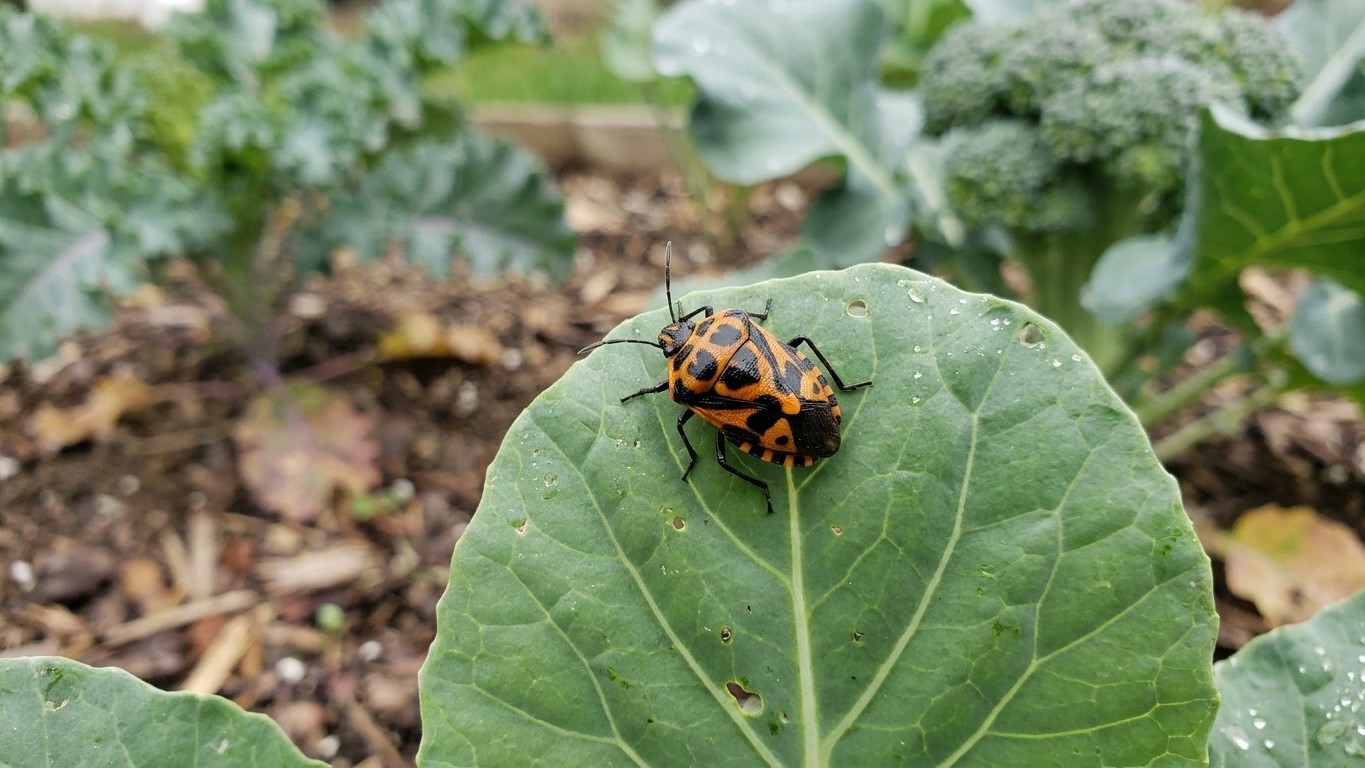

Harlequin bugs show up in Maryland as soon as soil temperatures warm in mid-to-late April, and they stick around through the first hard frost in October or November. Overwintering adults crawl out of leaf litter and garden debris once daytime highs settle into the 60s, head straight for the nearest brassica patch, and start laying eggs within days. If you grow cabbage, kale, collards, or broccoli anywhere in the state, from the Eastern Shore to the western panhandle, this is the pest that shows up uninvited every single spring.
What a Harlequin Bug Actually Looks Like

Adults are hard to mistake for anything else once you’ve seen one. They’re shield-shaped, about 3/8 inch long, and colored in bold black-and-orange (sometimes red or yellow) patterns that look almost hand-painted. That flashy coloring isn’t for show. It’s a warning signal, the same trick monarch butterflies use, telling birds and other predators that this bug tastes terrible thanks to the pungent compounds it absorbs from cabbage-family plants.
Nymphs are rounder, smaller, and lack wings, but they carry the same black-and-orange color scheme from the moment they hatch. Eggs are the giveaway most gardeners miss: tiny white-and-black barrel-shaped clusters, laid in neat double rows on the undersides of leaves, looking almost like miniature bee hives lined up in formation.
Where It Came From
The harlequin bug (Murgantia histrionica) isn’t native to Maryland or anywhere in the eastern United States. It originated in Mexico and Central America and spread north through agricultural trade routes over the past century and a half. Maryland’s humid summers and mild winters give it a climate close enough to its ancestral range that it now overwinters successfully in most counties, which is exactly why it’s become a fixture rather than an occasional visitor.
The Maryland Seasonal Timeline
Understanding the calendar matters more than most gardeners realize, because timing your defense wrong means fighting a battle you’ve already lost.
Adults emerge from winter shelter (weed patches, mulch, garden debris, even cracks in fence posts) once temperatures hold steady above 60 degrees. In most of Maryland, that lands somewhere between mid-April and early May. Mating starts almost immediately, and a single female can lay 150 or more eggs over her lifetime, spread across multiple clusters.
Eggs hatch in roughly one to three weeks depending on temperature. Nymphs go through several molts before reaching adulthood, a process that takes about four to nine weeks. Because Maryland’s growing season runs long, from April through October, the state typically sees two to three overlapping generations per year. By August, gardeners are often dealing with eggs, nymphs, and adults all on the same plant at the same time, which is exactly when infestations feel like they’ve exploded overnight.
The population usually peaks in late summer, right when fall brassica crops like kale and collards are getting established. That overlap is bad luck for anyone planting a fall garden, since young transplants are far more vulnerable to feeding damage than mature plants.
Why Brassicas Are the Only Real Target
Harlequin bugs are picky eaters, and that narrow diet is actually useful information for control. They feed almost exclusively on plants in the mustard family: cabbage, broccoli, cauliflower, kale, collards, mustard greens, turnips, radishes, and Brussels sprouts. Related weeds like wild mustard, shepherd’s purse, and pepperweed serve as backup hosts, which is one reason a weedy field edge near a garden can keep reintroducing the pest all season long.
Feeding damage looks distinctive once you know what to check for. Both nymphs and adults use piercing mouthparts to suck plant fluids, leaving behind pale, blotchy, wilted-looking patches on leaves. Heavy feeding causes leaves to brown, curl, and eventually die, and severe infestations can kill young seedlings outright before they ever get established.
Control Methods That Actually Work
No single tactic eliminates harlequin bugs completely, but combining a few approaches knocks populations down fast and keeps them from rebuilding.
Cultural and Mechanical Controls
Hand-picking is more effective than most people expect, especially early in the season before numbers build. Adults are slow-moving and don’t fly well, so a morning walk through the garden with a bucket of soapy water works surprisingly well. Checking leaf undersides for egg clusters and crushing them, or scraping them into the same bucket, stops the next generation before it hatches.
Removing garden debris and nearby weedy brassica relatives in fall eliminates overwintering shelter. This single step, cleaning up the bed edges and cutting back wild mustard along fence lines, reduces the number of adults that survive winter to start the cycle again in spring.
Floating row covers installed at planting time keep adults from reaching young transplants in the first place. Since harlequin bugs need direct contact with brassica leaves to feed and lay eggs, a physical barrier removes the problem for the most vulnerable weeks of a plant’s life. Row covers need to come off before flowering on crops that require pollination, so this works best on crops like cabbage and broccoli grown for the head rather than for seed.
Trap Cropping
Planting a sacrificial crop of mustard greens or collards along the garden perimeter, a few weeks before the main crop goes in, draws harlequin bugs away from the plants you actually want to harvest. Once the trap crop is heavily infested, pulling and destroying it (rather than composting it, which just relocates the problem) removes a large chunk of the population in one move. This tactic works because harlequin bugs prefer whatever brassica is most tender and available, and a trap crop planted early is usually more attractive than a later main planting.
Biological Control
Natural predators including parasitic wasps, birds, and some predatory insects will feed on harlequin bug eggs and nymphs, though none provide the kind of dramatic population crash that gardeners sometimes get with other pests. Encouraging general garden biodiversity, avoiding broad-spectrum insecticides that kill beneficial insects along with pests, helps these natural checks stay in place season after season.
Chemical Options
For infestations that outpace hand-picking, insecticidal soap and horticultural oil provide a lower-impact option that targets nymphs and adults on contact without leaving long residues. These work best applied directly to the bugs, since they have no residual effect once dry.
Pyrethrin-based products offer another contact option with a short window of effectiveness. Products containing carbaryl or permethrin provide longer control for severe outbreaks, but should be used sparingly and according to label directions, since these broader-spectrum chemicals also harm the pollinators and predatory insects that help keep other pest populations in check. The University of Maryland Extension recommends starting with the least toxic option that solves the problem and escalating only when necessary, a standard integrated pest management approach that applies just as well to harlequin bugs as to any other garden pest.
What Makes Maryland’s Situation Different
Coastal counties near the Chesapeake Bay tend to see earlier spring emergence and a longer season overall, thanks to milder winter temperatures moderated by the water. Gardeners in Somerset, Dorchester, and Talbot counties often report activity a week or two ahead of what growers see in Garrett or Allegany County in the western part of the state, where higher elevation and colder winters delay emergence and sometimes limit the pest to two generations instead of three.
Urban and suburban gardens in the Baltimore-Washington corridor face a different pressure: fragmented green space means fewer natural predator populations, but also fewer large-scale brassica plantings to sustain big outbreaks. Community gardens with mixed plantings tend to see lighter, more manageable infestations than dedicated brassica farms, where a monoculture gives the pest exactly what it wants with nothing to interrupt it.
One detail that surprises a lot of home gardeners: harlequin bugs rarely cause serious damage to crops grown for their roots, like turnips or radishes, since the edible part sits underground and out of reach. It’s the leafy brassicas and the heads of cole crops that take the real hit, which means a garden plan leaning more toward root vegetables in late summer can sidestep a chunk of the seasonal pressure entirely.