
Mississippi gardens run into a fairly short list of tomato pests, and the ones that matter follow the length of the growing season more than they follow geography. Flea beetles and aphids show up first, right after transplant, then hornworms, stink bugs and fruitworms take over as fruit sets, with whiteflies and nematode damage the two problems people usually catch too late. Check the undersides of leaves and the stem tips every few days once your plants are in the ground, before you ever see damage from a distance.
What this comes down to in Mississippi

Flea beetles, aphids, and spider mites are the three that actually give Mississippi tomato growers trouble, showing up in that order as the season heats up. Flea beetles riddle young transplants with shot-hole damage before the plant has enough leaf to shrug it off. Aphids follow on new growth, dragging sooty mold behind their honeydew. Spider mites arrive last, once the heat and dust settle in, and they’re the ones easiest to miss until the damage is already bronzing the leaves.
Flea beetles
Flea beetles hit seedlings and young transplants hardest, chewing tiny round holes that make leaves look like they took buckshot. The adults are shiny, black, barely a sixteenth of an inch long, and they jump like fleas when a leaf is disturbed, which is the easiest way to confirm you have them rather than something else. A plant with a strong stand of true leaves usually outgrows the damage, and a row cover over young transplants keeps the beetles off until it does.
Aphids
Aphids move in soon after, clustering on the undersides of leaves and on new growth, where they show up small, soft-bodied, and green or black depending on the population. They damage plants by feeding on sap and excreting a sticky honeydew that sooty mold grows on, curling and yellowing leaves under a heavy infestation. A strong hose spray knocks most of them off, which usually buys enough time for lady beetles and other predators to catch up before anything stronger is needed.
Spider mites
Spider mites show up with the first real heat of the season, and they’re hard to see without a hand lens, just pale or reddish specks with fine webbing on the underside of leaves. Their feeding stipples leaves with tiny yellow dots that can merge into bronzed, dry-looking foliage once the infestation is heavy. They thrive in dust and drought stress, so keeping plants watered through hot, dry spells does more to prevent them than any spray applied after the fact.
Tomato hornworm
Tomato hornworm is the pest most gardeners actually see, a caterpillar up to four inches long, green with white diagonal stripes and a curved horn on the back end, capable of stripping a branch of foliage overnight. It’s the caterpillar stage that does all the damage, feeding through the night and hiding low in the foliage by day, which is why a plant looks chewed before you ever spot the culprit. Hand-picking works fine at home garden scale, and Bacillus thuringiensis (Bt) controls the population if it gets ahead of you.
Stink bugs
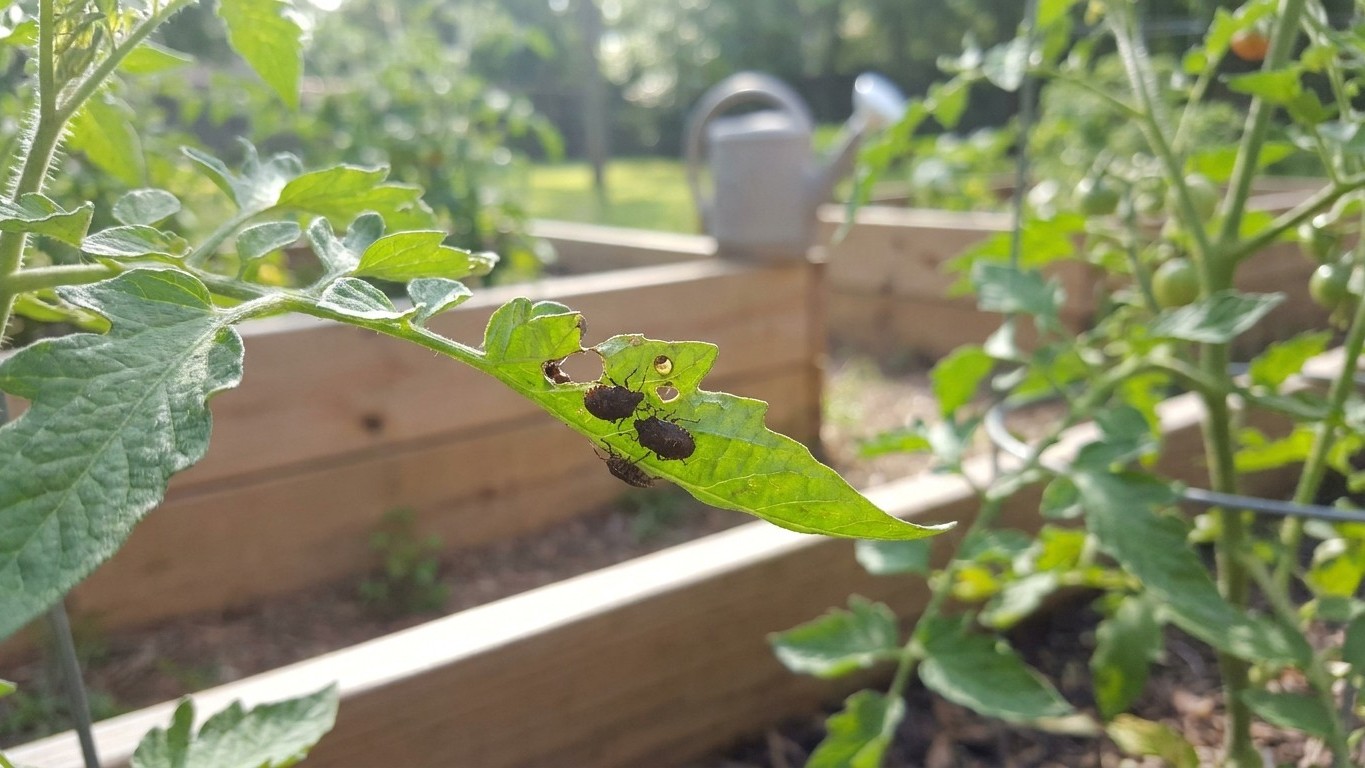
Stink bugs arrive as fruit starts to set, shield-shaped and green or brown, roughly half an inch to three-quarters of an inch long as adults, with young nymphs that look like small, rounder versions of the same shape. Both stages pierce ripening fruit to feed, leaving pale, cloudy blotches under the skin that become more obvious once the tomato colors. Keeping the bed clear of tall weeds nearby cuts down on where they build up before moving onto the fruit itself.
Tomato fruitworm
Tomato fruitworm, the same species known elsewhere as corn earworm, bores directly into fruit near the stem end, and the caterpillar itself varies from green to brown or pink with pale stripes running the length of its body. Damage often isn’t obvious from outside until the fruit is picked and opened, or until rot sets in around the entry hole. Picking off visible caterpillars and removing damaged fruit promptly keeps one generation from turning into several more.
Whiteflies
Whiteflies build up in the heat of midsummer, tiny white, moth-like insects that flutter up in a small cloud when a leaf is brushed, then settle straight back onto the underside. Both the winged adults and the flat, pale nymphs beneath the leaves feed on sap, weakening plants and leaving the same sticky honeydew aphids do. Yellow sticky traps catch the flying adults and give a fair read on how bad the population actually is before deciding whether spraying is worth it.
Root-knot nematodes
Root-knot nematodes never show themselves. They’re microscopic worms in the soil, and the only sign above ground is a plant that wilts in the heat of the day despite damp soil, with stunted growth and small, deformed fruit. Pulling a failing plant and checking the roots for swollen, bead-like galls confirms it, and since nematodes persist in soil for future crops, planting one of the tomato varieties that ripen in time in Mississippi that carries nematode resistance does more good than trying to treat the soil directly.
Working it out for your own garden
Start with where the damage is, not what you assume it is. Chewed leaves near the ground on a young transplant point one direction, cloudy blotches on a nearly ripe fruit point another, and a plant wilting at midday despite wet soil points somewhere else entirely. The table below sorts the state’s pests by where they actually leave a mark, which narrows the list faster than trying to match a photo of the insect itself.
| Pest | Where you’ll see it first | What it looks like |
|---|---|---|
| Flea beetles | Shot-holes in young leaves | Tiny jumping black beetles |
| Aphids | Curled new growth, sticky residue | Small soft green or black clusters |
| Spider mites | Stippled, bronzed leaves in heat | Fine webbing, barely visible specks |
| Tomato hornworm | Stripped branches overnight | Large green caterpillar, white stripes |
| Stink bugs | Cloudy blotches on ripening fruit | Shield-shaped green or brown bugs |
| Tomato fruitworm | Bored hole near the stem | Striped caterpillar inside the fruit |
| Whiteflies | Cloud of insects when leaf is brushed | Tiny white flying insects underneath |
| Root-knot nematodes | Daytime wilt, stunted growth | Galled roots, nothing visible above ground |
If the damage sits on the fruit itself, work backward from there: cloudy blotches under intact skin point to stink bugs, a hole near the stem points to fruitworm, and rot with no external mark at all is usually a crack that let something else in, not a pest at all. If nothing above ground explains a wilting plant, pull it and check the roots before assuming disease, since nematode galls settle the question in a few seconds.
Because Mississippi’s frost-free stretch runs from the last spring freeze NOAA’s normals put between March 6 and March 22 in Jackson to a first fall freeze between November 7 and November 22, most of these pests get through two or three generations in a single season. A small population caught early in a season that long has time to become a large one by August, so the real decision each week is whether a few beetles or a few caterpillars are worth treating now, or worth another few days of watching. Timing your tomato planting dates in Mississippi to get transplants in early also gets a head start on flea beetles and aphids, since a plant with several sets of true leaves shrugs off feeding that would stunt a small seedling.
What changes across the state
The frost window NOAA measures at Jackson is a starting point, not a state-wide fact. The Gulf Coast counties in the south typically see a later first fall freeze and an earlier last spring freeze than Jackson, which stretches the growing season further and gives pests like whiteflies and stink bugs more calendar to squeeze in extra generations. Farther north, toward the hill country and the Tennessee line, the season runs shorter at both ends, which tends to compress the same pest pressure into a narrower stretch rather than removing it.
Humidity matters as much as temperature for several of these pests. The Delta counties, with heavier, wetter soils and more standing humidity through summer, tend to see nematode and whitefly pressure build faster than the sandier soils of the piney woods further east, though soil type varies enough within a single county that this is a tendency rather than a rule. Coastal humidity off the Gulf runs even higher through the growing season, which favors the same pests along with fungal problems that show up on top of insect damage rather than instead of it.
None of this changes which pests are worth watching for, only how early in the season and how fast they build once they arrive. A gardener on the coast should start checking for aphids and flea beetles earlier than the Jackson-based windows above suggest, and a gardener in the northern hill counties can expect the season, and the pest pressure with it, to wind down sooner in fall.
The mistakes this state punishes

Skipping the early check on transplants is the most common one. Flea beetles and aphids move in fast enough after transplant that a week of not looking under leaves lets a manageable problem turn into a stand of stunted plants, and by the time it’s obvious from a distance, the plants have already lost the head start they needed to outrun the rest of the season.
Treating every caterpillar the same is another. Hand-picking a tomato hornworm off a plant costs nothing, but reaching for a broad insecticide at the first sign of any chewed leaf kills off the lady beetles and parasitic wasps that would otherwise keep aphids and hornworm eggs in check on their own. Spraying before confirming which pest is actually present tends to cost more in beneficial insects than it saves in damage.
The other mistake is assuming a wilted plant in August has a fungal problem, because that’s what wilting usually means. In a state where root-knot nematodes are common in home garden soil, a plant that wilts at midday in wet soil and never fully recovers is worth pulling and checking at the roots before spraying anything on the foliage, since a fungicide does nothing for a nematode problem and the season is too short to spend on the wrong fix twice.
Waiting too long into fall to stop worrying about stink bugs and fruitworm is the last one. Because Jackson’s first fall freeze, per NOAA’s normals, can run as late as November 22 in some years, both pests keep working on fruit well into what feels like the tail end of the season, and a plant left unharvested in October is still worth checking for damage, not assumed safe just because summer has passed.
Checking this against your county
Everything above is measured at or near Jackson, and NOAA’s own data shows other parts of Mississippi running warmer or cooler at both ends of the season. Check with your county office of Mississippi State University Extension at extension.msstate.edu for local pest reports and current spray guidance before you plan a season around any of the windows above, since they track outbreaks county by county in a way a state-wide page can’t. Their tomato-specific publications also cover chemical controls and rates for each pest by name, which falls outside what a general guide like this one can responsibly state.
Common questions
Do I need to spray for every pest I see on my tomatoes?
No. A handful of aphids or one flea beetle isn’t worth treating, since natural predators usually catch up before real damage sets in. Save spraying for populations that are visibly growing week over week or already damaging fruit.
Why are my tomato leaves curling but I don’t see any bugs?
Curling with no visible insects usually points to aphids feeding on the undersides of leaves or new stem tips, where they’re easy to miss without turning the leaf over. Check there before assuming it’s a watering or disease problem.
Can I use the same treatment for hornworms and fruitworms?
Both are caterpillars and both respond to hand-picking or Bacillus thuringiensis (Bt), but they’re found in different places. Hornworms sit on foliage and stems, while fruitworm caterpillars are usually already inside the fruit by the time you’d spot damage, so removing damaged fruit matters more for that one.
Will a resistant tomato variety keep nematodes out of my soil entirely?
No. Resistance in a cultivar reduces how much the nematodes affect that particular plant’s growth and yield, but the nematodes themselves stay in the soil for future plantings. Crop rotation and resistant varieties together do more than either alone.