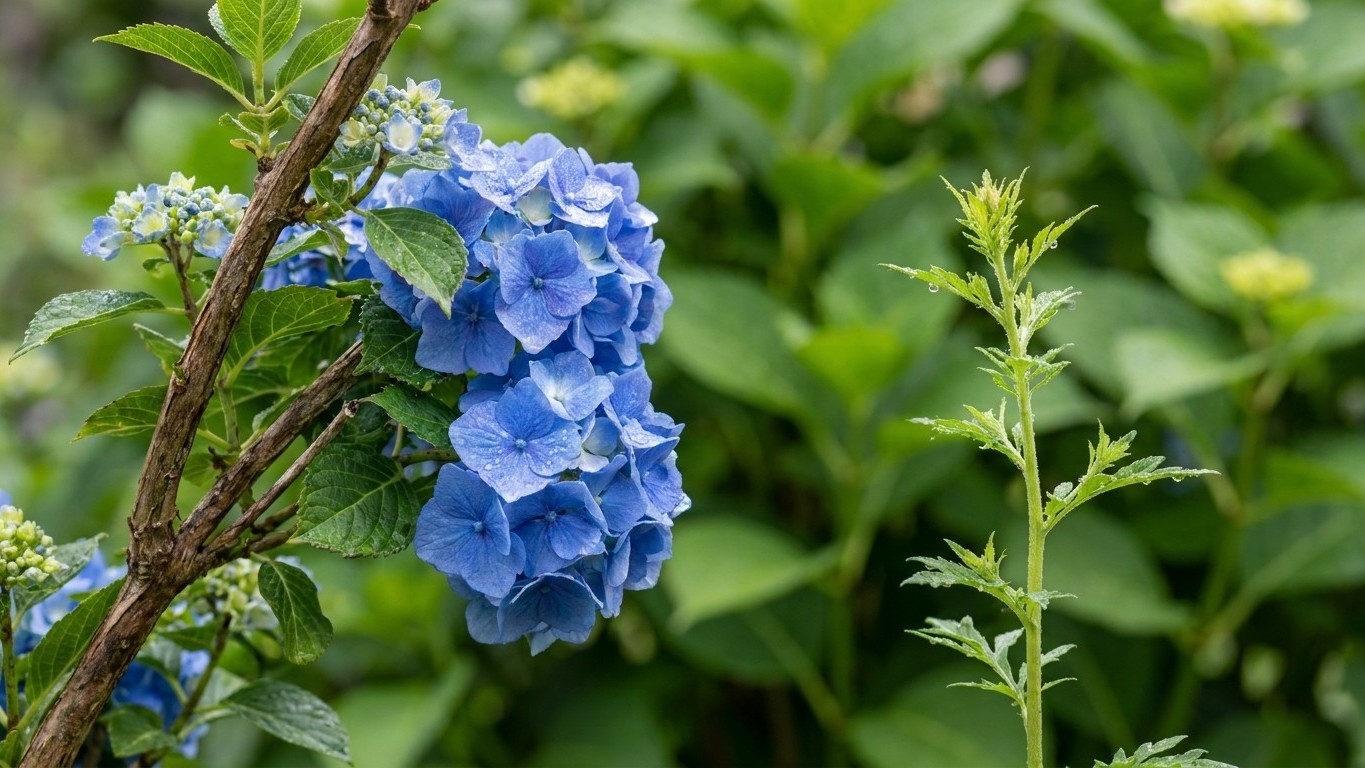

Bigleaf hydrangeas come out pink in Montana because most garden soil here is neutral to alkaline, and that chemistry keeps aluminum from reaching the plant. Without aluminum, the flower pigment stays pink. Blue is possible if you bring the soil pH down to roughly 5.0 to 5.5 and keep it there. It takes a season or more, and it only works on bigleaf and mountain hydrangeas.
What this comes down to in Montana

Hydrangeas are pink in Montana because the soil is too alkaline for the plant to take up aluminum, and the color is set during the growing season that runs from the last spring frost (April 29 to May 10 at Billings) to the first fall frost (October 1 to October 14). Billings is one of the milder valleys, so gardeners in colder mountain valleys work with a shorter stretch, and frost can arrive in any month.
How does soil pH change hydrangea color?
The flowers of bigleaf hydrangea (Hydrangea macrophylla) contain a pink-red pigment. When aluminum ions move up from the roots and bind to that pigment, the color shifts to blue. Nearly every soil holds aluminum, but it dissolves into a form roots can absorb only when the soil is acidic. As pH rises, aluminum locks into the soil and the flowers stay pink.
| Soil pH | Typical flower color | What is happening |
|---|---|---|
| Below about 5.5 | Blue | Aluminum dissolves and the plant takes it up |
| About 5.5 to 6.5 | Purple, or a mix of blue and pink on one plant | Aluminum is only partly available |
| Above about 6.5 | Pink to red | Aluminum stays locked in the soil |
Those breakpoints shift a little with variety and with how much aluminum your soil holds, so treat them as a guide. The pattern holds from one garden to the next.
Why is Montana soil so often alkaline?
Soils in dry climates keep their calcium and carbonates because there is too little rain to wash them out. Many Montana soils sit well above neutral, and some carry visible free lime. Irrigation water with a lot of dissolved minerals can push the pH up further over the years. The same alkalinity that keeps flowers pink also causes iron chlorosis, the yellow leaves with green veins that show up on many shrubs here. A hydrangea that is both pink and yellow-leaved is telling you the same thing twice.
Which hydrangeas can actually turn blue?
Only bigleaf and mountain hydrangeas (Hydrangea serrata) respond to soil chemistry. White varieties stay white. Panicle and smooth hydrangeas, the types that handle Montana winters most reliably, stay white, cream or green no matter what the soil does. When a panicle hydrangea blushes pink in late summer, that is the flower aging in cool nights, and soil has nothing to do with it. Bigleaf types also die back to the ground in many Montana winters, which affects whether they bloom at all. That is covered in Protecting Hydrangeas Through a Montana Winter and When to Prune Hydrangeas in Montana.
Working it out for your own garden
Start with a pH reading. Guessing wastes a season, and a soil that tests at 7.8 needs very different treatment from one at 6.4. A home test kit gives a rough number. A lab test through a county extension office is more accurate and often also reports lime content, which tells you how hard the soil will resist change. Take samples from the top 6 inches, close to the drip line of the shrub, and test again after you start treating.
How do you lower soil pH for blue flowers?
There are two tools, and they work at different speeds. Aluminum sulfate acts fast because it supplies aluminum and acidifies at the same time. Elemental sulfur works slowly, as soil bacteria convert it to acid over months. Many gardeners use sulfur to shift the baseline pH and aluminum sulfate to push color in a single season. Follow the product label for rates. Aluminum sulfate burns roots when applied too strong, and more is not better.
The soil matters more than the product. Sandy, low-lime soil can change within a season. Heavy clay with free lime pushes back, and every application gets neutralized. In that case, growing the hydrangea in a large container with an acidic potting mix is a far easier route to blue than trying to rebuild a bed.
When should you apply it, and when should you stop?
Roots take up aluminum only while they are active, so treatment belongs inside the growing season. At Billings, the last spring frost falls between April 29 and May 10. Waiting until leaves have opened and the soil has stayed warm, usually mid to late May, keeps you from feeding a plant that new frost could still cut back. Repeat applications every few weeks through early summer, because pH drifts back up.
Plan your last application by counting backward from the first fall frost. Take six to eight weeks off the October 1 to October 14 range and you land between early August and early September. Past that point, stop adding anything and let the wood harden before cold arrives.
Also check your fertilizer. High phosphorus ties up aluminum in the soil, so a balanced or low-phosphorus formula with more potassium suits blue-flowered plants better. Expect the first season to give you purple or mixed flowers. The full blue shows up the following year, once the plant has pulled enough aluminum into new buds.
What changes across the state
Montana covers a huge range of ground. Billings is the reference point for the frost window above, but a gardener in a high mountain valley deals with a shorter, colder season, and frost there can come in any month. The USDA Plant Hardiness Zone Map, which is built only on the average annual extreme minimum temperature, runs from 3a to 6b across the state. At the cold end, bigleaf hydrangeas rarely get far enough for color to matter, because the flower buds freeze before they open.
Elevation and cold air drainage matter more than latitude in many places. Low spots where cold air settles at night frost earlier and later than a slope fifty feet higher. A bed on the south side of a house, against a wall that holds heat, can run weeks ahead of the open yard.
Soil shifts too, though not in a tidy line. The plains east of the Continental Divide are drier, and their soils tend to be alkaline. Valleys west of the Divide generally get more moisture and can be less alkaline, but local geology varies so much that a neighbor three miles away may have completely different soil. Town water supplies differ as well. So your own pH test counts for more than any regional rule. A blue plant can be an easy project in one valley and a continuous chore in another.
The mistakes this state punishes

The first is applying aluminum sulfate to cold soil after a warm spell. A week of 70-degree weather in April wakes up the gardener long before it wakes up the roots, and a hard freeze can still arrive well into May. Material applied early either sits unused or burns tender roots, and any new growth it coaxes out gets caught by frost. Wait for leaves to open and for soil to stay warm.
The second is treating a bed with free lime in it as if it were ordinary soil. A single dose of aluminum sulfate may drop the pH for a few weeks, then the lime pulls it back up. Test first, and if the reading is high, move to a container or accept pink flowers. Pink bigleaf hydrangeas are lovely, and a healthy pink plant beats a stressed blue one.
The third is watering with hard water and not noticing. Irrigating with alkaline water undoes acidifying work gradually, and so do concrete foundations, which leach lime into nearby soil. Mulch with pine needles or shredded bark rather than anything with wood ash or lime in it. Rain barrel water helps when it is available.
The fourth is late-season treatment. Pushing growth or adding chemicals after the cutoff date worked out above, with the first fall frost expected between October 1 and October 14, leaves the plant poorly prepared for winter. The fifth is expecting every hydrangea to respond. If the plant is white, panicle or smooth, no amount of sulfur will change it.
Checking this against your county
The dates and numbers here come from Billings, and your county may differ by weeks. Soil in your yard may differ from soil down the road. Your local Montana State University Extension office can explain how to get your soil pH tested, tell you what is typical for your area and give you frost dates close to home. For general care once your color plan is set, see the guide to growing hydrangeas in Montana.
Common questions
How long does it take to turn a pink hydrangea blue?
Plan on at least one full growing season. The first year often produces purple or mixed flowers, and solid blue usually shows up the next year once new buds have formed under acidic conditions. In alkaline soil with free lime, keeping the color takes repeated treatments every season.
Will a white hydrangea turn blue if I acidify the soil?
No. White flowers contain little of the pigment that aluminum acts on. Soil changes will not tint them, and panicle and smooth hydrangeas stay white or cream however acidic the soil gets.
Do coffee grounds or vinegar turn hydrangeas blue?
Neither does much. Used coffee grounds are close to neutral and add very little acidity, and vinegar acidifies soil only briefly before the pH rebounds. It can also harm roots and soil life. A pH test followed by sulfur or aluminum sulfate at label rates gives far more reliable results.
Can I turn a blue hydrangea back to pink?
Yes. Raise the soil pH with garden lime (dolomitic lime also supplies magnesium), and use a fertilizer higher in phosphorus, which keeps aluminum from the roots. Because Montana soils are already alkaline in many places, a blue plant often drifts back to pink by itself once you stop treating it.