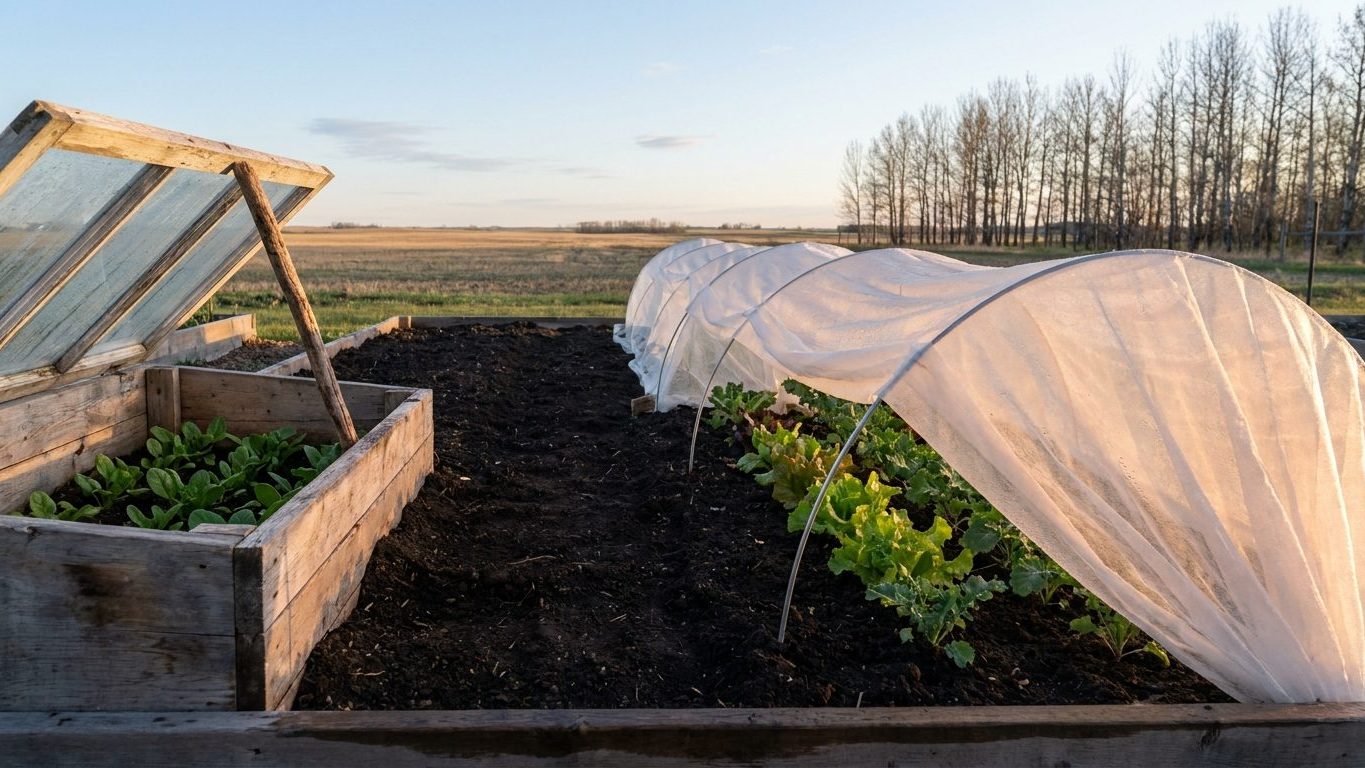

Floating row cover on hoops, low tunnels, and cold frames are the season extenders that pay off in Nebraska. Each one buys a few weeks at either end of the garden year. None of them turns a hard freeze into a mild night, and none makes tomatoes grow in January. This article covers what each does, what fails on the Plains, and how to adjust for your own ground. For the broader picture, see Extending the Growing Season in Nebraska.
The short answer for Nebraska
Start with row cover over hoops for spring and fall, add a cold frame for hardy greens, and use black plastic mulch to warm soil before squash and melons. Those three cover most of what a home gardener needs. Heavier tunnels are worth building only if you want greens from the garden in winter.
The timing starts with the frost dates. NOAA’s 1991-2020 climate normals for the Omaha airport station put the last spring freeze at 32°F between April 12 and April 23. Across that window, the chance of another 32°F freeze sits between 30 and 70 percent, which is close to a coin flip. The first fall freeze lands between October 15 and October 26, with the same odds band. These are reference-city numbers. Suburban and rural gardens usually freeze later in spring and earlier in fall, often by one to two weeks, and more at elevation.
What does each season extender actually do?
Covers work by trapping heat the soil stored during the day and by breaking the wind. On a clear, calm night that adds a few degrees. It will not save a tomato from a hard freeze, but it will carry lettuce, spinach, and peas through a frost that would otherwise burn the leaves.
| Extender | What it buys you | Best fit |
|---|---|---|
| Lightweight row cover on hoops | Protection on nights near 32°F, plus a barrier against insects | Early spring sowings, the tail end of fall crops |
| Heavier row cover or plastic low tunnel | More degrees of protection and wind shelter | Hardy greens, brassicas, and carrots in late fall |
| Cold frame | The most shelter of the group, with sun through a lid | Spinach, lettuce, and other hardy greens through winter |
| Black plastic mulch | Warmer soil in spring | Squash, melons, and other crops that sulk in cold ground |
The winter number explains why the cold frame sits at the top. At the Omaha station, the mean daily minimum of the coldest month is 15.2°F. A tightly built, unheated frame can hold hardy greens through that kind of cold. A single layer of thin fabric on wire hoops will not.
What will not work here
Most failures on the Plains come from three things: wind, sun on closed plastic, and expecting a cover to do more than a few degrees’ worth of work.
Why do thin covers fail in a Nebraska fall?
The first fall freeze arrives between October 15 and October 26 at the reference station, earlier in the country. After that, nights drop quickly, and the coldest month averages a daily low of 15.2°F. A single sheet of lightweight fabric cannot bridge a gap like that. It works for the first light freezes, which is a real use, but a gardener who relies on it alone will lose tender crops within days of a hard one. Pick heavier fabric or a second layer for anything you want to keep past late October. The timing of when to put covers on is covered in When to Cover Your Garden in Nebraska.
Can you plant tomatoes under cover in mid-April?
Not with good results. The April 12 to April 23 window is when a 32°F freeze is still a coin flip, and gardens outside the city run a week or two behind it. A cover keeps frost off the leaves, but it does little for cold soil. Tomatoes and peppers set out that early tend to sit and wait while the roots stay cool. Peas, spinach, and lettuce are a better use of an April cover.
What goes wrong with wind, heat, and dry soil?
Wind on open ground will lift loose fabric and fold flimsy hoops. Bury or weigh down every edge, and set hoops close enough that the cover cannot flap between them. Sun is the other trouble. A closed plastic tunnel on a clear spring day can get far hotter inside than outside, even when the night before was near freezing. Seedlings cook. Vent or open the ends by mid-morning, and close them again before dusk.
Covers also keep rain and snow off the bed. Soil under a tunnel can dry out while the rest of the yard is wet, so check it with a finger a couple of inches down. Last, the short days. At this latitude, midwinter daylight is too brief for much growth no matter how well the plants are sheltered. A cold frame keeps greens alive and harvestable. It will not make them grow fast in December.
What changes across Nebraska
Nebraska has no single answer. The USDA Plant Hardiness Zone Map (2023 edition, built on 1991-2020 normals) places the state in zones 4a through 5b, four half-zone steps. That map rests on one variable, the average annual extreme minimum temperature, so it describes winter survival of perennials. Frost dates, which drive season extension, are a separate matter, though the two tend to move together.
The frost figures above belong to Omaha, at 41.31 degrees north. A gardener far to the north, in the Panhandle, or at higher elevation will usually have a later spring and an earlier fall than the Omaha numbers suggest. Shift your plans that way: wait longer in spring before setting out anything tender, put covers on sooner in fall, and favor heavier fabric over lightweight. The farther north you go, the shorter fall days become, so late sowings of greens have less time to size up before growth slows.
Gardens in the south and east may track closer to the reference city, but a low spot where cold air pools can freeze weeks before a garden on a slope a quarter mile away. Day length matters for some crops too. Onions, for example, decide when to start bulbing based on daylight hours, so a variety that suits a location much farther south or north may bulb at the wrong time here.
To find your own zone, use the USDA Plant Hardiness Zone Map and enter your ZIP code. It takes a minute, and it will tell you more than any statewide range can.
Where to check this for your own county
The best local source is University of Nebraska–Lincoln Extension, the state’s land-grant extension service. It has offices that serve each county, and the staff know which frost dates and wind patterns apply to nearby gardens.
When you look, search for two things. The first is a local planting calendar for vegetables, which gives sowing and transplant windows for your part of the state instead of a single statewide guess. The second is any list of varieties trialled in your county. A variety that does well in a trial a few miles away has already been tested against your soil, wind, and summer heat. It saves you a season of guessing.
A county recommendation beats a state one. Statewide advice has to cover growing conditions from the Missouri River to the Panhandle, so it can only be a starting point. Treat the dates above as the outer frame, then tighten them with what the county office tells you.
If you call or visit, bring a few specifics: what you grow, where the garden sits (open field, near a windbreak, on a slope), and what you have tried so far. Extension staff can often speak to local problems, such as how late frosts have behaved in recent years, that no table can capture.
Checking this against your own garden
Your own observations outrank every date in this article. Three are worth watching, and none needs equipment.
Soil warmth by feel. Push your hand into the bed, a few inches down, in the morning. If it feels cold and damp, warm-season seedlings will stall no matter what the air does. Compare a bed against a south-facing wall and one in a low corner. The difference shows you which spot warms first and where a cover or black plastic helps most.
The first male squash flowers. Squash and other vines open male flowers before female ones. When they show up in your garden, the plants are getting enough heat to bloom. If neighbors in the same neighborhood see them a week earlier, your garden runs cooler, and your calendar should shift to match.
First true leaves. The first pair a seedling shows are seed leaves. The next set, which look different, are the true leaves. If seedlings under a cover take much longer to make them than expected, the tunnel may be too shaded, too cold at night, or too dry. If they stretch thin and pale, it is probably running too warm and dim. Adjust venting and the cover weight, then watch the next batch.
Keep a few notes from year to year, even just dates on a calendar. After two or three seasons, you will know your yard’s own frost dates better than any chart.
Common questions
Is row cover enough to protect plants from a hard freeze?
Lightweight fabric handles light frosts near 32°F. For harder freezes, use a heavier fabric, double the layers, or switch to a plastic tunnel or cold frame. Even then, tender crops like tomatoes and peppers should be harvested or moved before a deep freeze.
When should I put covers on in fall?
At the Omaha reference station, the first fall freeze falls between October 15 and October 26. Gardens outside the city often freeze one to two weeks earlier. Watch the forecast and have hoops in place before the first night that threatens 32°F, since covers are easier to set up on a calm afternoon than in the dark.
Can I grow vegetables through the winter in Nebraska?
Hardy greens like spinach can survive winter in a well-built cold frame, but they grow very little in midwinter because the days are short and the cold is deep. The coldest month at the reference station averages a daily low of 15.2°F. Plan on harvesting what you planted in fall and expect fresh growth to resume as days lengthen.
Should I use plastic or fabric on my hoops?
Fabric is more forgiving. It breathes, lets water through, and rarely overheats. Plastic holds more heat, which helps in winter and early spring, but it needs venting on sunny days. Many gardeners use fabric for most of the year and add plastic only for the coldest stretch.