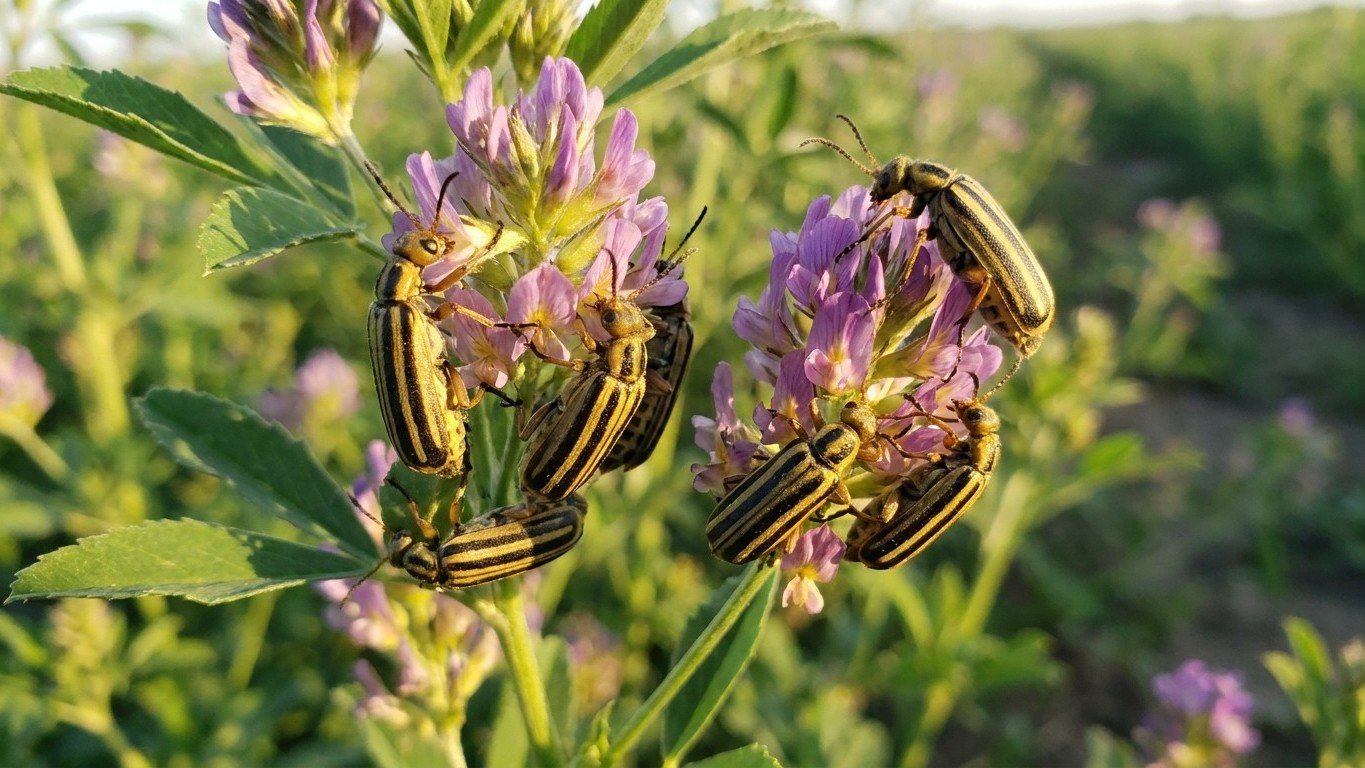

Blister beetles show up across Nebraska from mid-July through September, with the heaviest activity landing in August, right when alfalfa fields are blooming and ready for a second or third cutting. That timing is the whole problem. These beetles swarm into flowering alfalfa to feed, and if they get crimped or crushed into hay bales, the toxin they carry, cantharidin, stays potent for years and can kill a horse that eats even a handful of contaminated hay. For home gardeners, the risk is smaller but real: skin contact causes painful blistering, which is exactly how the insect got its name.
What Blister Beetles Look Like in Nebraska

Nebraska hosts several species, but three show up most often in fields and gardens. The striped blister beetle (Epicauta occidentalis or Epicauta vittata) has yellow and black stripes running the length of its body and is the one most linked to alfalfa hay poisoning because it tends to cluster in dense groups. The black blister beetle (Epicauta pensylvanica) is solid black, about half an inch long, and often seen on goldenrod, aster, and other late-summer bloomers. The margined blister beetle (Epicauta funebris) is gray to black with a pale border along the wing edges and shows up on soybeans and vegetable crops.
All three share a body shape that sets them apart from other beetles: narrow, elongated, with a soft-looking abdomen and a head that’s noticeably wider than the neck segment behind it. They move slowly and don’t fly off in a panic when disturbed, which is part of why they end up mowed into hay in the first place.
Why the Grasshopper Connection Matters
Blister beetle larvae feed almost exclusively on grasshopper eggs buried in the soil, so their population the following summer tracks pretty closely with how bad the grasshopper year was before it. A heavy grasshopper outbreak in eastern or western Nebraska one season often signals a bigger blister beetle problem the next. Extension entomologists at the University of Nebraska-Lincoln have flagged this link for years as a rough forecasting tool for hay producers deciding how carefully to scout their fields.
Where and When They Cause the Most Trouble
Nebraska’s irrigated alfalfa ground, concentrated in the Platte River Valley and the panhandle’s irrigated districts, sees the most beetle activity because those fields bloom reliably and offer the pollen and nectar sources beetles want. First-cutting hay, usually harvested in late May or June before beetles have emerged in numbers, carries the lowest risk. It’s the second and third cuttings, taken in July, August, and into September, that coincide with peak adult activity and blooming plants.
Beetles don’t spread evenly through a field. They tend to gather along field margins and near weedy edges where blooming plants persist after the alfalfa itself has been cut once, then move inward when a fresh cutting flowers. A field that looked clean in June can have a dense beetle swarm along one fence line by August, which is exactly why a single walk-through before harvest matters more than a general assumption that “we didn’t see any last time.”
Home gardens and landscape beds see a different pattern. Black and margined blister beetles show up on flowering perennials, tomato and potato foliage, and late-blooming ornamentals from midsummer on, often in small clusters of a dozen or so rather than the massive alfalfa swarms that make news in livestock circles.
Why Cantharidin Makes This a Livestock Issue First
Cantharidin is a defensive chemical blister beetles produce, and it’s brutally stable, it doesn’t break down when the beetle dies, gets baled, or sits in a barn for a year. A horse that eats hay with crushed beetles mixed in can develop colic, mouth and gut lesions, and in severe cases kidney failure within hours. Horses are far more sensitive than cattle or sheep to the same dose, which is why alfalfa hay fed to horses gets scrutinized in a way that beef cattle feed usually doesn’t.
The dangerous part isn’t seeing a beetle crawl across a bale. It’s the ones a mower or crimper crushed and mixed invisibly into the flakes. A horse owner buying alfalfa from an unfamiliar source in late summer has no reliable way to check every flake by eye, which is why most of the prevention has to happen at the field level, before the hay is ever cut.
What Actually Stops Blister Beetle Problems
For hay producers, the single biggest lever is cutting timing and equipment choice. Alfalfa cut before bloom, or cut using a sickle-bar mower without a crimper or conditioner, dramatically lowers the odds of beetles getting crushed into the windrow. Beetles that are just mowed over, rather than crimped, often crawl away before baling. Scouting field edges a day or two before cutting, especially after a grasshopper-heavy prior year, gives growers a chance to spot a swarm and adjust the cutting schedule or leave a weedy border uncut.
- Cut alfalfa before bloom stage whenever the growing window allows it
- Avoid crimpers and hay conditioners on fields with known beetle activity
- Scout field margins and weedy borders in the days before cutting
- Control broadleaf weeds and blooming plants along fence lines that draw beetles in
- Ask hay suppliers directly whether fields were scouted before a late-summer cutting
Weed management along ditches and fence rows does double duty here. Weedy borders with flowering plants act as a staging area where beetles gather before moving into the crop, so keeping those edges mowed or treated reduces the population that eventually drifts into the alfalfa itself.
Chemical control is possible but tricky, because insecticide has to be applied before the beetles have moved deep into the field and before the crop is ready for cutting, leaving a narrow window that often doesn’t line up with when the swarm actually gets noticed. Most Nebraska extension guidance treats spraying as a backup option rather than the main line of defense, with cutting practices and scouting doing most of the real work.
In home gardens, the fix is simpler. Hand removal with gloves, or knocking beetles into a container of soapy water, handles small infestations on tomatoes, potatoes, and flowering ornamentals without needing an insecticide at all. Bare-handed contact is the one thing to avoid entirely, since cantharidin causes blistering on skin within a few hours of contact, sometimes without the person even feeling the beetle land.
Handling Beetles Safely
Anyone dealing with a blister beetle swarm, in a field, a garden bed, or a barn where suspect hay is being unloaded, should wear gloves and avoid crushing the insects against skin. If a beetle does end up on bare skin, brushing it off gently rather than swatting it reduces the chance of it releasing cantharidin on contact. Blisters that do form usually clear up on their own, but they can be painful enough that most people who’ve dealt with one make a point of never handling these beetles bare-handed again.
For horse owners, the practical safeguard is knowing the cutting number and timing of any alfalfa hay before it’s fed. Hay from a first cutting taken before bloom carries far less risk than a third cutting baled in late August from an unscouted field, and asking that one question of a supplier does more to prevent poisoning than any treatment applied after the hay is already in the barn.