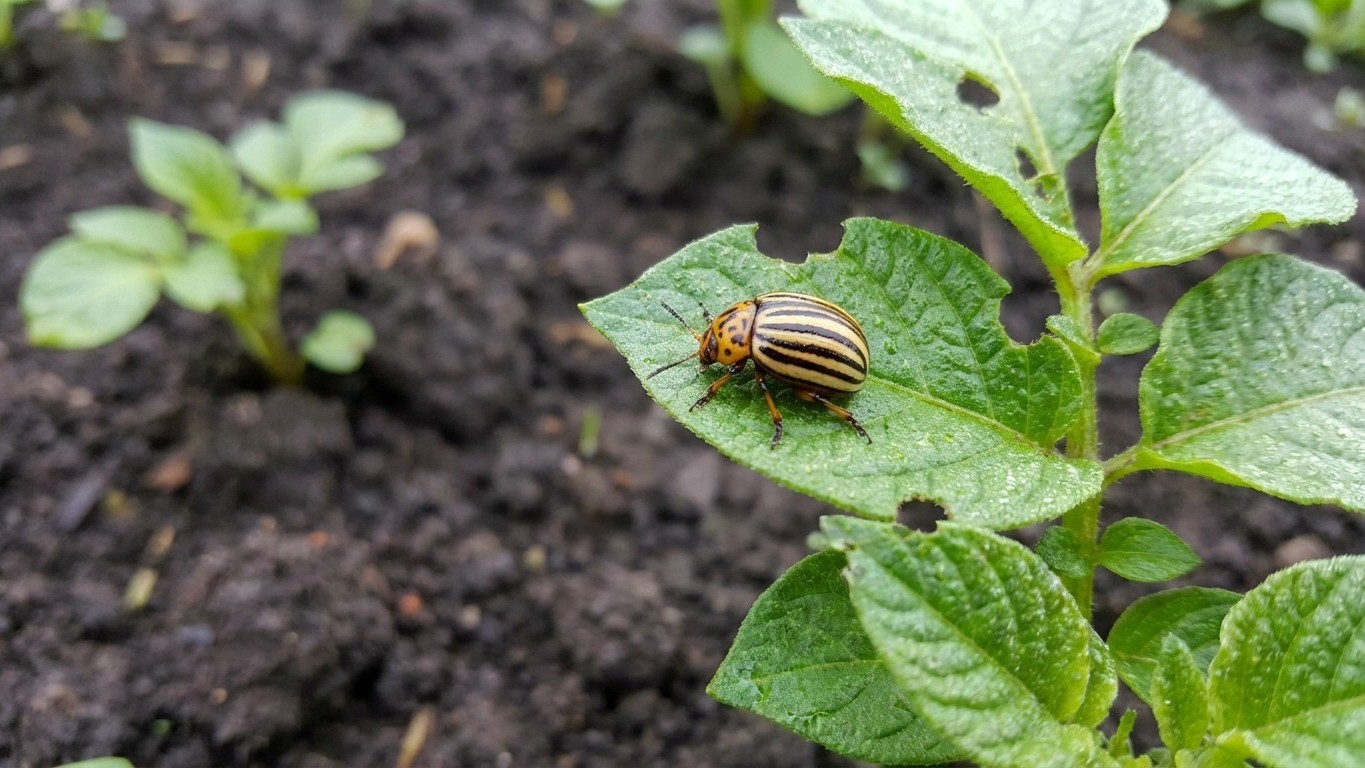

Colorado potato beetles start crawling out of Quebec soil the moment ground temperatures climb past roughly 50°F, which usually lands somewhere between mid-May and early June depending on the region. Overwintering adults dig up from 4 to 6 inches below the surface, and within days they’re feeding on the first potato shoots poking through. If you grow potatoes, tomatoes, or eggplant anywhere from the Montérégie to the Bas-Saint-Laurent, this is the window to start checking leaves.
When Colorado Potato Beetles Emerge in Quebec

The beetle doesn’t follow a calendar date so much as a soil temperature threshold. Once that 50°F mark holds for a few consecutive days, adults that spent winter buried near last year’s potato patch (often within 30 to 50 feet of where they fed the previous season) come up hungry. Quebec’s shorter, cooler growing season means the population typically manages one full generation per year, sometimes a partial second one in warmer pockets like the Montérégie or around Portneuf, where potato production is concentrated.
That’s actually good news compared to states further south, where two or three generations can stack up between May and September. Fewer generations means fewer total beetles by season’s end, but it also means the ones that do emerge are perfectly synced with young, tender plants, exactly when damage does the most harm.
Females start laying eggs within a week or two of emerging, and they don’t hold back. A single female can produce 300 to 500 eggs over her lifetime, laid in tidy clusters of 20 to 40 on the undersides of leaves. Those clusters are bright orange-yellow, roughly the size of a grain of rice, and easy to spot if you flip leaves over during a weekly walk-through. Eggs hatch in 4 to 10 days depending on temperature, and the larvae that emerge are the real destroyers, stripping foliage far faster than the adults ever do.
Why This Pest Thrives in Quebec Gardens and Fields
Potatoes are Quebec’s fourth-largest field crop by area, with production clustered in Portneuf, Île d’Orléans, Lanaudière, and parts of the Montérégie. That concentration of host plants year after year in the same regions gives the beetle exactly what it needs: a reliable, predictable food source close to where it overwinters. Crop rotation disrupts this cycle, but plenty of home gardens and even some commercial fields plant potatoes in the same bed season after season, which is basically an invitation.
The beetle’s biology also works against easy control. Larvae go through four growth stages, called instars, over about two to three weeks, and each stage eats more than the last. A fourth-instar larva can consume several times what a first-instar larva does in a day. That escalation means a field that looks fine on Monday can show serious defoliation by the following week if nobody’s watching.
Then there’s the resistance problem, and this is where the Colorado potato beetle earns its reputation among entomologists. It was one of the first insect species ever documented developing resistance to a synthetic insecticide, going back to DDT resistance cases in the 1950s. Since then it has built resistance to dozens of active ingredients across multiple chemical classes, including organophosphates, carbamates, pyrethroids, and more recently some neonicotinoids in certain populations. That track record is why relying on a single spray, year after year, tends to stop working within a few seasons.
What Actually Stops the Colorado Potato Beetle
Hand-picking still works, and it’s not as tedious as it sounds if you catch the problem early. Checking plants twice a week during peak emergence, crushing egg clusters and adults, keeps small home patches manageable without a single spray. For a 20-plant garden bed, this takes maybe ten minutes per visit.
Row covers placed immediately after planting block adults from finding the crop in the first place, since beetles walk to new plants more often than they fly early in the season. The catch is you have to remove the covers before flowering if you want pollinators reaching the blossoms, and by then some beetles may have already found a way in from nearby soil.
Straw mulch spread 3 to 4 inches thick around plants has shown real effect in field trials, apparently because it makes it harder for beetles to walk between plants and may confuse their host-finding behavior. It’s a low-cost tactic that pairs well with rotation.
Beneficial insects help more than most gardeners realize. Ladybird beetles, lacewings, and a parasitic wasp species all feed on Colorado potato beetle eggs and young larvae. Avoiding broad-spectrum insecticides preserves these predators, which is one more argument for reaching for targeted products first.
Chemical controls and the resistance problem
Bacillus thuringiensis subspecies tenebrionis (often labeled Bt-tenebrionis or Btt) targets beetle larvae specifically and leaves most beneficial insects alone. It works best applied when larvae are small, first or second instar, since older larvae eat enough plant tissue that a lethal dose of Bt matters less by the time symptoms show. Spinosad, derived from soil bacteria, offers another option with a different mode of action, which matters for rotation strategy.
Rotating between different chemical classes, rather than reusing the same product season after season, is the single most important practice for keeping any treatment effective long-term. Given how many active ingredients this beetle has already beaten, using the same spray for three years running is close to guaranteeing it stops working by year four. Growers who track which chemical class they used the previous season, and switch to a genuinely different one, get noticeably better results than those spraying whatever’s on the shelf.
Neem oil and insecticidal soaps offer softer options for home gardens, working best on young larvae and requiring more frequent reapplication than synthetic products. They won’t wipe out a heavy infestation on their own, but combined with hand-picking they keep small populations from building.
Prevention Strategies for Quebec Growers
Crop rotation remains the foundation, and distance matters more than most people assume. Moving potatoes at least 200 to 300 feet from last year’s location, or better yet to the opposite side of the property, forces overwintering adults to travel further to find food, and many simply won’t make the trip. A three-year rotation cycle, keeping potatoes, tomatoes, and eggplant off the same ground for three seasons, breaks the local population cycle far more effectively than a one-year gap.
Some potato varieties show partial resistance through denser leaf hairs or altered leaf chemistry that slows larval feeding. These varieties won’t eliminate the pest but can reduce damage enough to matter, especially combined with other tactics.
Timing planting to avoid the peak emergence window sounds appealing but rarely works in Quebec’s climate, since the growing season is already tight enough that delaying potato planting by several weeks costs yield. A more practical approach: plant a small trap crop, an early-planted row of potatoes set out before the main crop, which lures emerging beetles to concentrate in one spot where they’re easier to hand-pick or spray.
Fall cleanup deserves more attention than it usually gets. Removing plant debris and volunteer potato plants after harvest reduces the shelter and food available to beetles preparing to overwinter, and tilling the soil in affected beds can expose some overwintering adults to predators and cold before they’ve settled in deep enough to survive.
One detail that surprises a lot of gardeners: adult beetles that survive the winter can live and reproduce for two full growing seasons in some cases, meaning a beetle that emerges this May might still be laying eggs the following summer rather than dying off after its first season above ground. That extended lifespan is part of why populations can rebound quickly even after what looked like a thorough cleanup the year before.
Related guides
- Colorado potato beetle in Ontario: When It Shows Up and What Stops It
- Colorado potato beetle in New Brunswick: When It Shows Up and What Stops It
- Colorado potato beetle in Saskatchewan: When It Shows Up and What Stops It
- Colorado potato beetle in South Dakota: When It Shows Up and What Stops It
- Flea beetles in Quebec
- Colorado potato beetle in Minnesota: When It Shows Up and What Stops It
- Colorado potato beetle in Indiana: When It Shows Up and What Stops It