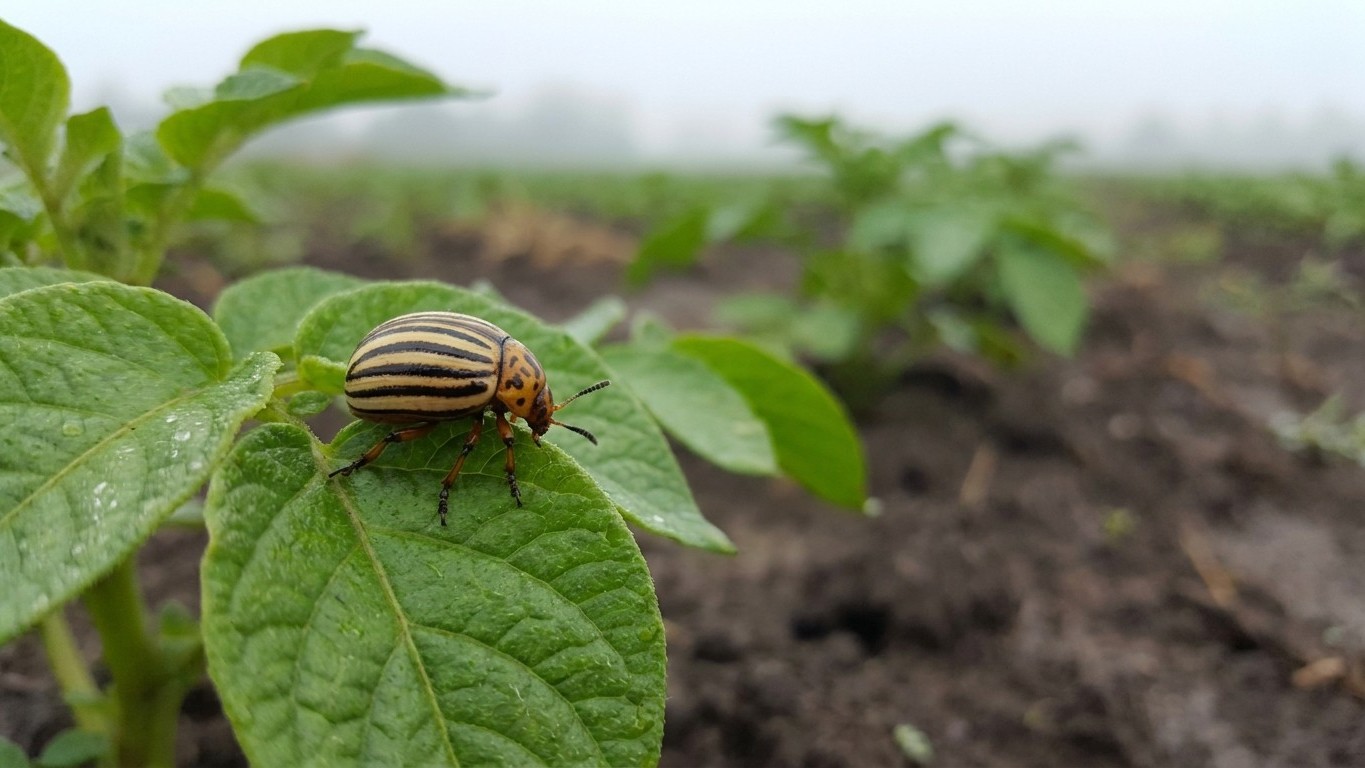

Colorado potato beetle has never established a self-sustaining population across most of Newfoundland and Labrador, and that’s not an accident. The island’s isolation, its short cool growing season, and strict provincial and federal seed potato inspection rules have kept this pest largely at bay compared to mainland Atlantic Canada. When it does turn up, it’s almost always tied to a specific introduction event, imported seed potatoes, hitchhiking on produce, or wind-assisted flight from infested areas, rather than a beetle population that overwinters and spreads on its own year after year.
That doesn’t mean growers and gardeners in the province can ignore it. Climate patterns are shifting, seed potato trade keeps expanding, and a single missed inspection could change the picture fast. Here’s what actually determines whether this beetle shows up in your garden, when the risk window opens, and what stops an infestation before it wipes out a potato patch.
Why Newfoundland and Labrador Has Stayed Mostly Beetle-Free

Colorado potato beetle (Leptinotarsa decemlineata) is native to the arid Southwest and spread across North America over the past century and a half by following potato cultivation. It’s now a fixture of the growing season in Quebec, New Brunswick, Nova Scotia, and Prince Edward Island, where the crop and the beetle’s biology line up perfectly. Newfoundland is a different story. The Cabot Strait and the Gulf of St. Lawrence create a genuine water barrier, and this beetle is a poor long-distance flier under its own power. It can travel a mile or two on a good thermal, but it generally needs a strong, sustained wind to cross open water of any real distance.
Add to that Newfoundland’s cooler, shorter summers, which limit the number of generations the beetle can complete even if a few adults do arrive, and you get a province where establishment has historically been rare and short-lived. Labrador’s climate is even less hospitable, with a growing season too brief and too cold for the beetle to complete its life cycle reliably.
The other piece of the puzzle is regulatory. Seed potatoes moving into and within Canada are subject to inspection protocols overseen by the Canadian Food Inspection Agency, and provinces with cleaner pest status, Newfoundland and Labrador among them, have leaned on certified seed sources and monitoring to keep it that way. Home gardeners who bring in seed potatoes from other provinces, or who receive mail-order tubers, are the most likely route for an accidental introduction.
When It Shows Up: The Seasonal Window That Matters
On the mainland, adult Colorado potato beetles overwinter a few inches deep in soil near old potato fields, emerging as soon as the ground warms in spring. In Newfoundland’s climate, that emergence window would run later, typically not before late May or June, once soil temperatures climb consistently above the mid-50s Fahrenheit. Adults fly or walk to the nearest host plants, feed for a short period, then mate and begin laying eggs in bright yellow-orange clusters of a few dozen on the undersides of leaves.
Eggs hatch within a week to ten days depending on temperature. The larvae go through four growth stages over roughly two to three weeks, and it’s this larval stage that does the real damage, stripping foliage down to bare stems if left unchecked. A single untreated infestation can defoliate a home garden potato patch in under a month during a warm stretch.
Why a Short Season Limits the Threat
On the mainland, the beetle often squeezes in two generations per year, sometimes a partial third in a hot summer. In Newfoundland’s compressed growing season, most areas would struggle to complete even one full generation before fall temperatures shut larval development down. That’s a meaningful difference: fewer generations means slower population buildup, and a slower buildup means a small introduction is far less likely to snowball into a province-wide problem the way it has in warmer regions.
What Actually Stops It
Control strategies that work elsewhere in Canada apply directly if the beetle ever does gain a foothold in Newfoundland and Labrador. The approach that holds up best combines several tactics rather than relying on one.
Cultural and Physical Controls
Crop rotation is the single most effective non-chemical tool. Moving potatoes, tomatoes, and eggplant to a new bed each year, ideally at least 200 feet from the previous year’s planting, forces overwintering adults to search farther for host plants, and many simply don’t survive the trip. Hand-picking adults and squashing egg clusters in the first few weeks after planting can keep small home gardens under control without any spray at all, since the beetle’s bright coloring and clustered eggs make it easy to spot during a daily walk through the rows.
Straw mulch has shown some benefit in research trials by making it harder for emerging adults to locate host plants and by supporting populations of ground beetles and other predators that eat eggs and young larvae. Floating row covers installed at planting and removed only for pollination can physically exclude adults during the critical early weeks.
Biological and Natural Predators
Several native predators, including ladybird beetles, lacewings, and predatory stink bugs, feed on Colorado potato beetle eggs and small larvae. Parasitic wasps and certain fly species also target the pest in parts of its range. Gardeners who avoid broad-spectrum insecticides tend to see stronger natural predator populations build up over a season, which helps suppress beetle numbers without additional intervention.
Chemical Controls and the Resistance Problem
Colorado potato beetle is notorious among entomologists for developing resistance to insecticides faster than almost any other agricultural pest, with documented resistance to dozens of active ingredients across multiple chemical classes in various parts of North America. That history is a major reason growers everywhere, Newfoundland included should any population establish, are advised to rotate between different modes of action rather than applying the same product repeatedly within a season. Products based on Bacillus thuringiensis var. tenebrionis target young larvae specifically and spare many beneficial insects, making them a reasonable first-line option for home gardens. Spinosad-based products offer another rotation option with a different mode of action.
Commercial growers dealing with heavier pressure typically follow a resistance management plan set by provincial agriculture extension guidance, applying no more than one or two treatments of a given chemical class per season and switching classes for any follow-up application.
What Growers and Gardeners in the Province Should Watch For
The clearest early warning sign is finding adult beetles, roughly a third of an inch long, with distinctive black-and-yellow-striped wing covers, on emerging potato plants in late spring. A second sign is the egg clusters themselves: neat rows of bright orange-yellow eggs stuck to the underside of leaves near the plant’s center. Catching either at this stage, before larvae hatch and start feeding, is what keeps a would-be infestation from turning into a defoliated crop.
Anyone bringing in seed potatoes from outside the province, whether through a mail-order supplier, a seed exchange, or a personal trip to the mainland, should inspect tubers and surrounding soil closely before planting. That single habit does more to protect Newfoundland and Labrador’s relatively clean pest status than any spray program ever could. Reporting an unusual beetle sighting to the provincial Department of Fisheries, Forestry and Agriculture also helps track whether an isolated find is a one-off or the start of something that needs a coordinated response.
Labrador’s growers face even less pressure given the region’s short, cold season, but the same seed-sourcing caution applies. A beetle population doesn’t need ideal conditions everywhere in a territory, just one warm, sheltered garden bed where a few overwintering adults can survive long enough to lay eggs the following spring.
Related guides
- Colorado potato beetle in New Jersey: When It Shows Up and What Stops It
- Colorado potato beetle in New York: When It Shows Up and What Stops It
- Striped cucumber beetle in Newfoundland and Labrador
- Squash vine borer in Newfoundland and Labrador
- Colorado potato beetle in West Virginia: When It Shows Up and What Stops It