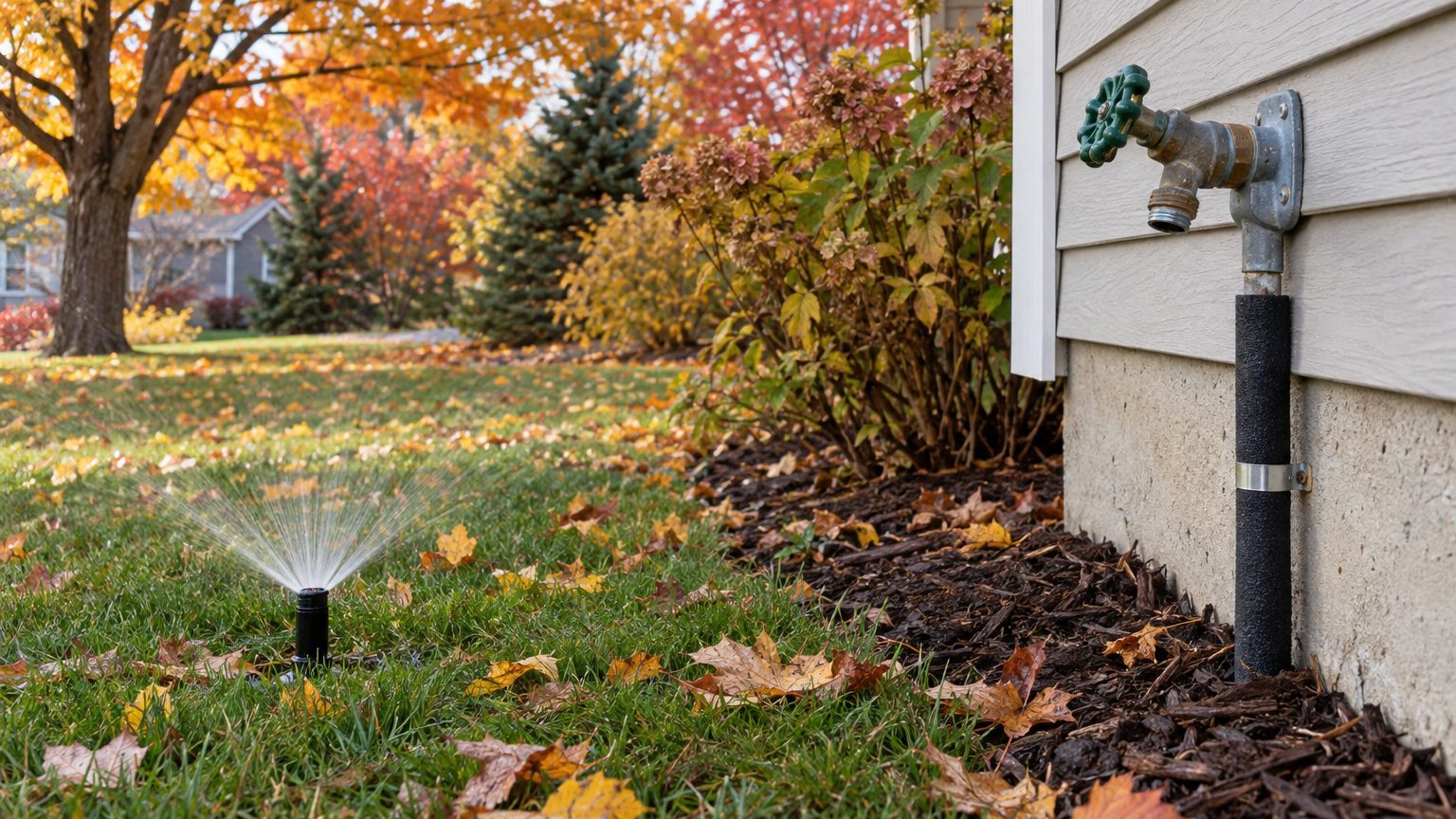

Finish both jobs ahead of the first freeze. At Manchester’s airport weather station, that freeze becomes likely between October 13 and October 26, according to NOAA’s 1991-2020 climate normals. Farther north and higher up, it arrives sooner. The practical plan fits in one weekend: hoses off, outdoor taps drained, sprinkler lines cleared with compressed air. In New Hampshire, skipping the blowout is a gamble the climate rarely lets you win.
When to do it in New Hampshire
The window and the rule
Aim to finish both jobs before the October 13 to October 26 window when Manchester’s first 32°F freeze becomes likely. The rule is before the first hard freeze, not after the first light one.
That window comes from the NOAA NCEI U.S. Climate Normals for 1991-2020, which give the dates on which a 32°F freeze reaches a 30 to 70 percent probability. The station is the Manchester airport. Treat it as a reference city, not a statewide guarantee. Suburban and rural yards typically see their first fall frost one to two weeks earlier than the airport does, and hillsides and higher ground see it earlier still. The colder your location (farther north, higher up), the sooner your deadline falls. Look up your own county’s normals before you pick a weekend.
A light frost is a warning, not the main event. One clear night just below freezing may leave a thin crust on the grass and nothing worse. A hard freeze that settles in and holds for hours is what turns water in a pipe into ice. The trouble is that you can’t tell in advance which one a given night will be. If you wait for the light frost to prove the season has turned, the hard one can show up before you’ve pulled the compressor out of the garage.
Why a full blowout is not optional here
Manchester’s mean daily minimum in the coldest month is 17.1°F (NOAA NCEI Climate Normals 1991-2020). That’s an average, so plenty of nights run colder. The USDA Plant Hardiness Zone Map 2023 places New Hampshire between zones 3b and 6a, a system built on a single variable, the average annual extreme minimum temperature. It’s a statewide range, so the southern tier and the northern hills sit at very different points on it.
The conclusion is blunt. In a place where winter nights routinely sit well under freezing, water left in an irrigation line or an outdoor tap will freeze at some point. The only open question is which night. There’s no shortcut such as leaving a trickle running or hoping for a mild year. The work that counts is clearing the lines, draining the taps, and shutting the water off at the source.
Work backward from your deadline. Hoses come off first, since that takes minutes and costs nothing. Run the sprinklers for as long as the lawn still needs water, then shut the system down. If a cold forecast shows up early, move the date up instead of defending the original plan. The lawn has its own fall schedule too, covered in Winterizing a Lawn.
Sprinkler lines: drain or blow out
What freezing does to the system
Ice takes up more room than the water it came from. In an open yard that doesn’t matter. Inside a sealed length of pipe, a valve body or a fitting, it matters a great deal, because the expanding ice has nowhere to go but outward. Something gives, usually at the weakest point: a threaded joint, a fitting, the plastic body of a valve, or the above-ground backflow assembly that sits exposed at the edge of the house.
The damage stays hidden. A cracked line sits quietly under frozen ground all winter. You find out in spring, when the system pressurizes and a geyser shows up in the middle of the lawn, or a zone never seems to build pressure at all.
Three ways to clear the water
A manual drain relies on drain valves installed at the low points of the system. You shut off the supply, open the valves, and let gravity do the work. It works only if the system was installed with those valves in the right places, and only if the pipes slope toward them.
An automatic drain valve opens by itself when water pressure falls, letting the pipe empty at that spot. It’s convenient, but it only empties what’s near the valve. Dips, sags, and flat runs can hold water that never reaches it.
A compressed-air blowout pushes the water out through the sprinkler heads, zone by zone, with air from a compressor connected at the system’s blowout port. It clears the lines regardless of how they were laid out.
| Method | How it clears water | Fit for New Hampshire |
|---|---|---|
| Manual drain | Gravity, through low-point valves you open by hand | Acceptable only if the system was built for it and slopes correctly |
| Automatic drain | Valves open when pressure drops | Leaves pockets of water in dips and flat runs; a weak stand-alone choice |
| Compressed-air blowout | Air pushes water out through the heads | The standard answer for a climate this cold |
Which one this climate calls for
With a coldest-month mean minimum of 17.1°F in Manchester, and colder nights farther north, a compressed-air blowout is the sound default for a New Hampshire system. If your system has well-placed manual drains, you can use them, but treat that as a decision you’ve confirmed against how the system was built, not an assumption. Automatic drains are a backup to the main plan, not the plan itself.
Whatever the method, the sequence matters. Shut off the water supply to the system first, then drain the backflow assembly, then clear the zones one at a time. Air pressure is the main hazard, because too much can damage heads and fittings, and too long in a single zone heats and wears the parts. Wear eye protection, and never stand over a head while it’s under pressure. Afterward, set the controller to its off or rain mode so it doesn’t try to run through the winter.
A professional is the sensible choice if you don’t own a compressor, if you aren’t sure what pressure your heads and fittings can take, or if you can’t locate the shutoff and blowout port. The same goes for systems with drip lines, a long run of zones, or a backflow assembly you’ve never had to open. Book the blowout for a date before the October 13 to October 26 window, not during it. A mistake with compressed air costs a lot more than a service call.
Outdoor faucets and hoses
The sequence, using only valves
This job asks for nothing more than turning things by hand, and it takes about as long as a cup of coffee. The steps are the same for every outdoor tap, and the full walkthrough lives in Winterizing Outdoor Faucets Before the First Freeze.
- Disconnect every hose, splitter, and sprayer from every outdoor spigot.
- Find the interior shutoff valve that feeds each outdoor tap (often in a basement, crawl space, or utility area) and close it.
- Go outside and open the tap fully so the water in the line can drain out.
- Leave the tap open through the winter.
Drain the hoses too, coil them, and store them under cover. A hose left in the yard holds water in its low spots and degrades faster in the cold. If a tap has no interior shutoff, or the shutoff won’t turn, stop there. Fixing or adding a valve is plumbing work, and it belongs to a plumber. Disconnect every hose, close the interior shutoff, and leave the outdoor tap open, and you’ve done everything a homeowner needs to do.
Why a frost-free faucet still fails with a hose attached
A frost-free tap puts its shutoff valve deep inside the wall, on the warm side, at the end of a long stem. When you close the tap, the water behind the valve is supposed to drain out of the sloped barrel and away. That design works only if the barrel can empty. With a hose screwed on, the nozzle end is blocked, so air can’t get in behind the draining water. The water stays in the barrel, freezes, and splits the pipe, often where it passes through the cold part of the wall.
The result is a trap: the tap looks like it’s off, and you won’t know otherwise until spring. Even a short hose, a splitter, or a hose-end timer will do it. More about how these fixtures work is in Frost-Free Outdoor Taps. If a pipe does freeze and you suspect a split, close the interior shutoff and call a plumber before you try to thaw anything. The thawing basics are in Frozen Pipes.
Foam insulating covers add a margin on very cold nights, but they don’t replace the steps above. They slow heat loss. They don’t empty a pipe.
What goes wrong here
The early cold snap
The airport’s October 13 to October 26 window is an average, and yards outside the airport’s footprint often hit freezing one to two weeks earlier, more at elevation. So a homeowner who aims for the middle of the window may be late by the time the first hard night arrives. In spring, the damage shows up as a cracked backflow assembly, a geyser at a split fitting, or a zone that loses pressure. The prevention is to treat the start of the range as the deadline, not the end of it. Treat the start of the October 13 to October 26 window as your deadline, and move it earlier if you live north of Manchester or up a hill.
The forgotten hose
One hose left on one spigot is enough. It might be the one behind the shed, the one on the side of the garage, or the one in a bed that nobody has watered in weeks. In spring, the clue is a hiss or a drip from the wall when you open the tap, or a damp ceiling or wall in the room on the other side. The prevention is a walk-around before the deadline. Check every outdoor tap, including the ones you never use, and look at each one rather than trusting memory.
The flooded valve box
Sprinkler valves sit in plastic boxes set into the ground. Rain, snowmelt, and groundwater can fill those boxes, and a valve sitting in water through freeze and thaw cycles can crack. In spring, a flooded box shows up as a valve that won’t close, a zone that runs when it shouldn’t, or a visible leak where the box lid meets the soil. Before the blowout, check that each lid is in place and seated, and bail out any standing water you can see. If a box floods again and again, ask a pro about drainage. That job goes beyond a weekend fix.
Common questions
Can I wait until the first snowfall?
No. Snow isn’t the trigger, freezing temperatures are. In New Hampshire, a hard freeze commonly arrives before the first snow that sticks, so the deadline for draining comes earlier than most people expect. Use the frost window, not the snow forecast.
I already had a light frost. Is it too late?
Do it now. A light frost usually does no harm to lines and taps on its own, but it tells you the window is open. The next cold night may be the hard one. Take the hoses off and drain the taps today, then schedule the sprinkler blowout for the next dry day.
Do I still need a blowout if my system has automatic drain valves?
Plan on one. Automatic drains empty the water near each valve, but dips and flat runs in the pipe can hold water that never reaches a drain. In a climate where the coldest month averages a 17.1°F nightly minimum at Manchester, a blowout is the safer way to be sure the lines are empty.
Do the Manchester dates apply to my town?
They’re a reference point, not a rule for every address. The October 13 to October 26 figure comes from the airport station, and suburban and rural yards typically see the first fall frost one to two weeks sooner, more at higher elevations. Check your own county’s normals and move your deadline earlier if you’re farther north or higher up. More local guidance is collected in the New Hampshire guides.