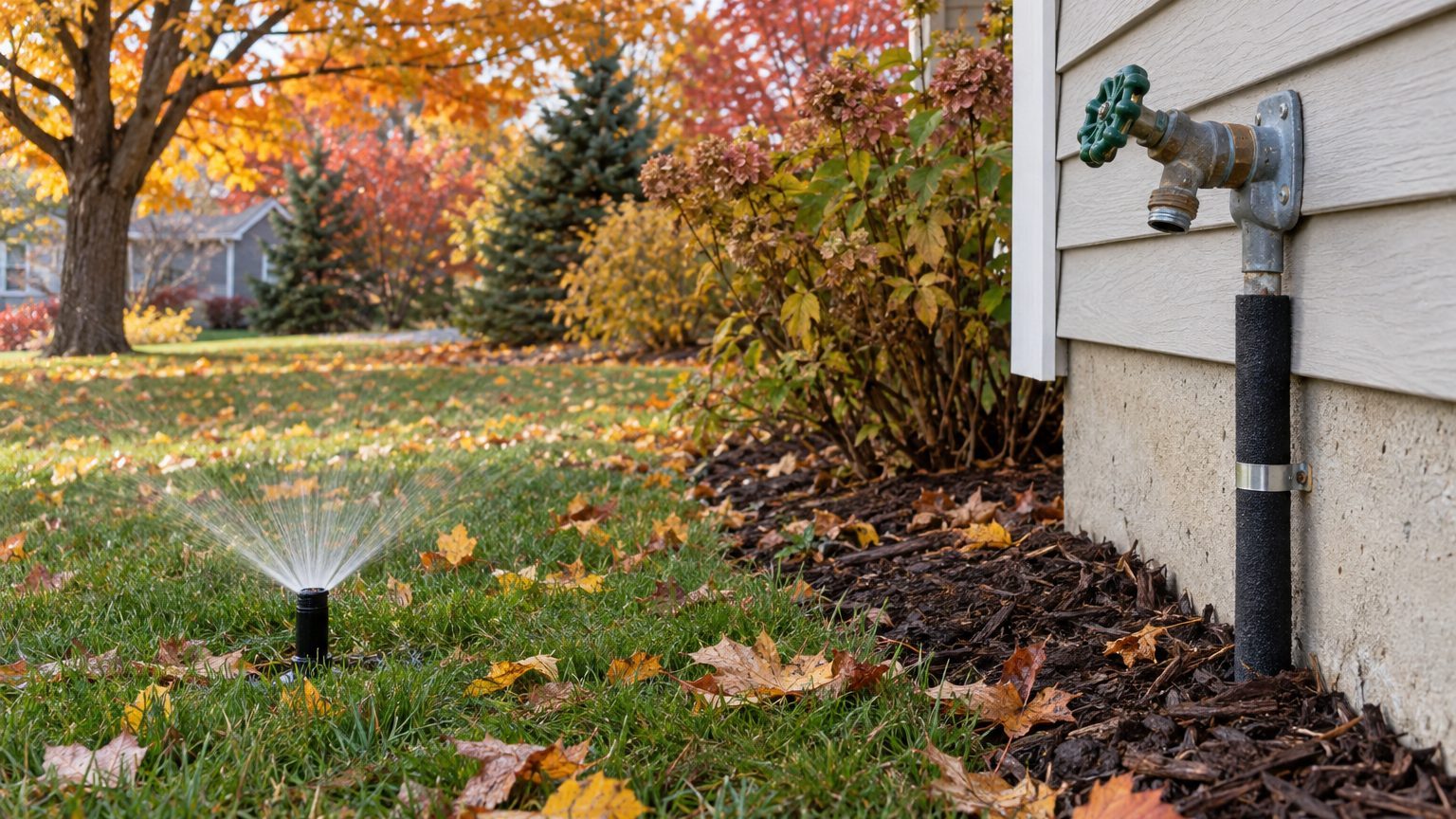

Vermont sprinkler lines and outdoor spigots need to be shut down and drained before the first hard freeze. Around Burlington that points to early October. In the Green Mountains and the Northeast Kingdom, it points sooner. A light frost on a clear morning is a warning, not permission to wait another weekend. The job takes an afternoon. Skipping it can mean split pipe, a cracked valve body, or a leak inside a wall that nobody notices until spring.
When to do it in Vermont
Finish before the first hard freeze, not after the first light one. For Burlington, NOAA NCEI’s 1991-2020 Climate Normals put the first 32°F freeze between October 3 and October 13, the stretch covered by the 30-70% probability band. The work belongs in the days before that window opens.
That is a Lake Champlain number, and Burlington is the mildest corner of the state. The Green Mountains and the Northeast Kingdom run substantially shorter seasons, so the first freeze arrives earlier there and every fall job moves earlier with it. A homeowner in a hill town should treat Burlington’s window as the latest possible date, not the target. The valley thermometer says very little about a yard a few hundred feet higher.
Anyone reading this in the first days of October 2026 is standing right at the edge of that Burlington window. Write this down: finish the sprinkler and faucet shutdown before the October 3 to October 13 first-freeze window in the Burlington area, and earlier in hill towns and the Northeast Kingdom.
Some parts of the country can skip the full blowout because winter nights never come close to freezing. Vermont is not one of them. NOAA’s 1991-2020 normals for Burlington put the mean daily minimum of the coldest month at 12.9°F. That is an ordinary night in the coldest month, not a record low, and it is far below freezing. Water left in a line will freeze here, and the only question is whether the pipe survives it.
The USDA Plant Hardiness Zone Map (2023 edition) runs from 3b to 5b across the state, a range built on a single variable: the average annual extreme minimum temperature. Because that is a territory-wide span, Burlington anchors the dates in this article. A town in the hills may sit in a colder zone with a noticeably earlier first freeze, and its owner should plan accordingly.
The first 32°F reading is often a frost that blackens basil and leaves the ground alone. The cold that does damage tends to follow, sometimes within days, and a clear, calm evening can drop much faster than the afternoon high suggests. Waiting for the first frost to prompt you means starting a job that is already behind schedule. Start it earlier and the first frost becomes a non-event.
Order matters too. Sprinkler lines take the longest, so they go first. Hoses and spigots take minutes and go last, ideally the same weekend.
Sprinkler lines: drain or blow out
Water expands as it turns to ice, and a buried pipe has nowhere to give. Pressure builds against the pipe wall, a fitting, or a valve body, and the weakest point lets go. Often that is a fitting or a valve rather than the middle of a run of pipe. The same physics behind Frozen Pipes inside a house plays out underground, except the split stays hidden. Nothing shows until the system is pressurized in spring and a zone comes up wet, weak, or silent.
Give the lawn its last deep watering first, then shut the supply. The wider fall routine for turf is covered in Winterizing a Lawn. Once the supply to the system is off (a valve you turn, usually near where the line enters the house), you have three ways to get the remaining water out.
| Method | How it works | Fit for Vermont |
|---|---|---|
| Manual drain | You open drain valves at the low points of the system and gravity empties the lines | Works only if the system was built with those valves and its pipes slope toward them |
| Automatic drain | Valves open on their own when line pressure falls and let water out at low spots | A useful backup, but it can leave water in heads and flat runs |
| Compressed-air blowout | Air pushes water out through the heads, one zone at a time | The method most systems here call for |
Drain valves are fine as far as they go. The trouble is that water follows gravity only where the pipe slopes, and plenty of lawns are rolling or the lines have flat stretches and low pockets. Heads can also hold a small amount of water. In a place where an average night in the coldest month sits at 12.9°F, a little trapped water is enough. My recommendation is simple: blow out every zone with compressed air before the first hard freeze, and treat drain valves as a backup rather than the plan.
A blowout has rules. Wear eye protection and keep your face and body away from heads while they pop up under air pressure. Work one zone at a time, and don’t leave air running through a zone any longer than it takes to clear it, because heads running dry can overheat. Stay within what the system is rated for. A compressor that is too small will leave water behind, and one that is too strong can burst fittings. This is the step where a mistake costs the most.
Hiring a professional is the sensible choice in several situations. You may not know where the low drains are, or the system may include a backflow preventer, which is a plumbing component that belongs in a licensed trade’s hands. You may not have a compressor matched to the system, or you may have had leaks the previous spring. In any of those cases, a pro who blows out the lines in the days before the first-freeze window opens is cheaper than a spring excavation. Whether you hire it out or do it yourself, the deadline stays the same.
Outdoor faucets and hoses
The faucet side of the job is simpler, and nothing in it goes beyond turning valves and unscrewing hoses. Anything more than that is a plumber’s work.
- Disconnect every hose, splitter, and timer from every outdoor tap, and drain the hoses before coiling them indoors or in a garage.
- Find the interior shutoff valve for each outdoor tap, usually in a basement or crawl space, and close it.
- Open the outdoor faucet fully so the water left in the line can run out.
- Leave the outdoor faucet open through winter so any trace of moisture has room to expand.
A frost-free faucet does not make step one optional. Its valve seat sits well inside the warm side of the wall, and when it is closed the water in the long stem drains out through the spout. Attach a hose and that drainage is blocked. The barrel stays full right where it passes through the cold wall, and a hard freeze can split the pipe behind the faucet. The evidence appears in spring as a leak inside the wall, not a drip at the spigot. The detail is covered in the piece on Frost-Free Outdoor Taps.
A faucet cover or insulated cap is a reasonable extra layer, and it helps with wind and cold on exposed brass. It does not replace draining. A covered faucet attached to a full line still holds water.
Timing follows the same rule as the sprinklers. Disconnect the hoses and close the interior valves before the first hard freeze, which for Burlington means ahead of October 3 to October 13 and for hill towns means sooner. The longer walk-through is in Winterizing Outdoor Faucets Before the First Freeze.
If a faucet drips after you’ve closed the interior valve and opened the outdoor tap, or if the interior valve won’t turn, stop there. A valve that leaks or sticks is a repair, not a winterizing step. Call a plumber and leave that line alone.
What goes wrong here
The early cold snap
The most common failure is simply bad timing. A cold night lands before the weekend you meant to spend on it, and the lines are still full. Spring shows it in a zone that comes up with weak pressure, a head that geysers, or a wet patch that appears the first day the system runs. The fix is to schedule the work to the colder end of your local range rather than Burlington’s mild one, and to do it before the first frost warning appears in the forecast.
The forgotten hose
One hose left on one tap is enough. In spring the sign is water running inside the wall or dripping in the basement when you open the interior valve, and at that point the damage is already there. Prevention is dull: walk the entire outside of the house once with a checklist, including the back corner nobody looks at, the garden tap, and the one the contractor installed.
The valve box that floods
The in-ground box holding the sprinkler valves can fill with meltwater or runoff and freeze around the valves. Spring brings cracked valve bodies, a damaged manifold, or a box that won’t hold the lid. Make sure the valves are drained, the lid is seated, and the box isn’t sitting full of water when the freeze arrives. Standing water in the box is a drainage problem, and a pro should look at it.
One habit covers all three. After any frost forecast, recheck the spigots, hoses, and valve boxes the same day. More fall guidance for the state is gathered in the Vermont guides.
Common questions
Can I wait until the first snow to winterize the sprinklers?
No. The first 32°F freeze in Burlington arrives between October 3 and October 13 by NOAA’s 1991-2020 normals, and a hard freeze can follow soon after. Snow makes a poor calendar because the freeze comes first. If the work isn’t done by the time the first hard freeze is forecast, do it before the next night, or call a pro the same day.
Does a light frost mean it’s too late?
Not necessarily. A light frost usually means the cold has arrived, not that every line has frozen through. It is the signal to finish the job immediately: shut the supply, drain or blow out the lines, and disconnect the hoses. Don’t put it off for another weekend.
If I have automatic drain valves, do I still need a blowout?
In Vermont, a blowout is the safer choice. Automatic drains empty the low points but can leave water in heads and level sections of pipe. With a mean daily minimum of 12.9°F in the coldest month at Burlington (NOAA NCEI, 1991-2020), even a small amount of trapped water can crack a fitting. Treat the automatic valves as a backup and the air as the plan.
Is my town on the same schedule as Burlington?
Probably not. Burlington sits on Lake Champlain, the mildest corner of the state, and the Green Mountains and the Northeast Kingdom see substantially shorter seasons. The USDA Plant Hardiness Zone Map (2023) spans 3b to 5b across Vermont. In colder, higher towns the first freeze comes earlier, so drain and blow out before Burlington’s October 3 to October 13 window opens, not within it.