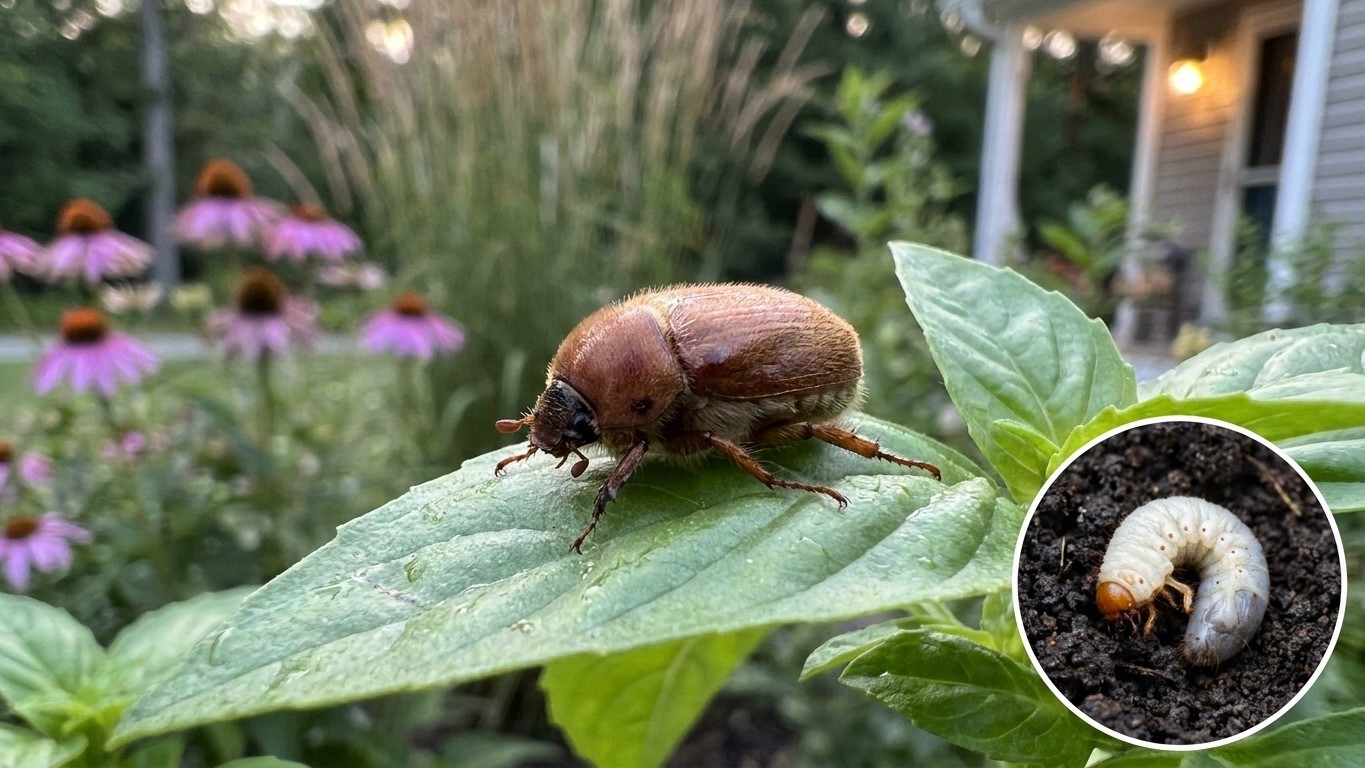

Asiatic garden beetle adults become active in New Hampshire from early July through late August, feeding at night on foliage and flowers while their grub-stage offspring chew through grass roots from September until the ground freezes. Nothing wipes out an established population overnight, but a combination of targeted grub treatments in late summer, reduced night lighting, and beneficial nematodes applied to soil gives homeowners real control within a season or two.
Identifying the Asiatic Garden Beetle in New Hampshire Yards

The Asiatic garden beetle (Maladera formosae) arrived in the United States around 1921, first spotted in New Jersey, and has spent the past century working its way north through the Northeast corridor. New Hampshire sits near the current edge of its established range, which means some yards in the Seacoast and southern tier counties see heavy pressure while others farther north barely notice it yet.
Adults measure roughly 3/8 inch, about the size of a watermelon seed, with a velvety, cinnamon-to-chestnut brown shell that catches porch light in a way Japanese beetles don’t. Where Japanese beetles flash metallic green and copper in daylight, Asiatic garden beetles are drab and nocturnal, which is exactly why so many homeowners miss them until damage shows up. Flip one over and you’ll notice fine hairs on the underside of the body, a detail that separates it from similar-looking brown beetles.
The larvae are white grubs with a brown head capsule, curled into the classic C-shape when disturbed. They’re smaller than Japanese beetle grubs, typically under 3/4 inch at full size, and they tend to stay closer to the soil surface, usually within the top 2 to 4 inches, which matters when timing any treatment.
The New Hampshire Timeline: Eggs to Adult Beetles
New Hampshire’s shorter growing season shifts this insect’s calendar later than what gardeners in Maryland or southern New Jersey experience. Overwintering grubs, tucked below the frost line in lawns and garden beds, resume feeding once soil warms in April and May. They pupate in the soil through June, and adults typically start emerging in the first two weeks of July, a few weeks behind mid-Atlantic populations.
Peak adult activity in New Hampshire runs from mid-July through mid-August. That’s when you’ll find the beetles clustered under porch lights, attracted to any white or yellow bulb left burning past dusk. Adults feed almost exclusively at night, hiding in mulch, thatch, or leaf litter during daylight hours, which explains why plants look chewed but the culprit is nowhere in sight at 2 p.m.
Females lay eggs in soil throughout late July and August, favoring turf areas over bare dirt. Those eggs hatch into first-generation grubs by September, and this is the stage that does the real lawn damage before winter. Unlike Japanese beetles, which produce one generation per year with a single damaging grub period, Asiatic garden beetle grubs feed aggressively through fall right up until the ground freezes, usually sometime in November in southern New Hampshire and earlier farther north.
Signs of Damage on Plants and Lawns
Adult beetles favor a specific menu: they’ll skeletonize the leaves of asters, chrysanthemums, dahlias, marigolds, roses, and strawberries, leaving behind a lace-like pattern where only the veins remain. Vegetable gardeners in New Hampshire often see damage concentrated on beans, corn silks, and turnip greens during peak beetle weeks. The feeding pattern looks almost identical to Japanese beetle damage, so the giveaway isn’t the leaf, it’s the timing. If leaves are getting shredded overnight in July and August but you can’t find beetles during the day, that’s the signature of this species.
Turf damage shows up differently. Grub feeding on grass roots produces irregular brown patches that peel back like loose carpet when tugged, since the root system holding the sod in place has been chewed away. Because this species tolerates a wider range of soil conditions than Japanese beetle grubs, including drier, sandier soils, lawns that seemed too dry or too well-drained for typical white grub problems aren’t necessarily safe.
One practical field test: cut a one-square-foot section of turf about 2 inches deep on a warm September afternoon and count the grubs. University turf research generally sets the treatment threshold for white grubs at 8 to 10 per square foot in home lawns, though thinner or already-stressed turf can justify action at lower counts.
What Actually Stops Asiatic Garden Beetles
Control works best when it targets the grub stage in the soil rather than chasing adults around the yard at night, though a layered approach covering both life stages produces the most noticeable results.
Lawn Grub Control
Beneficial nematodes, specifically Heterorhabditis bacteriophora, applied to moist soil in late summer offer a biological option that doesn’t rely on synthetic chemicals. Nematodes need consistently damp soil to move through the root zone and infect grubs, so watering before and after application matters more than the product label sometimes suggests. Milky spore disease, often marketed for grub control, targets Japanese beetle grubs specifically and has shown limited effectiveness against Asiatic garden beetle larvae, so it’s not a reliable standalone fix for this particular pest.
Chemical grub control products containing chlorantraniliprole or imidacloprid work when applied in late July through early August, ahead of egg hatch, because they need time to move into the root zone before grubs start feeding. Applying these products in September, after grubs are already established and feeding, produces weaker results since the active ingredient has less time to reach target depth before cold weather slows everything down.
Keeping lawns on the taller side, mowing at 3 to 3.5 inches rather than scalping the grass, encourages deeper root systems that tolerate some grub feeding without visible dieback. Overseeding thin patches each fall also helps turf recover faster from whatever grub damage does occur.
Adult Beetle Management
Since adults are drawn to light, the single most effective and lowest-cost step is switching porch and landscape lighting to warm-toned LED bulbs (2700K or lower) or motion-activated fixtures instead of leaving white or blue-toned lights burning all night during July and August. Beetles navigate by light attraction, and cutting that signal dramatically reduces the number that congregate near the house and, by extension, near vulnerable plants nearby.
Floating row covers over vegetable beds during peak flight weeks physically block adults from reaching foliage, which matters most for high-value crops like beans and strawberries where a few weeks of protection prevents the bulk of seasonal damage. Hand removal after dark, using a flashlight and a bucket of soapy water, sounds tedious but works surprisingly well on small properties since the beetles are sluggish and slow to fly once located.
Pheromone traps marketed for Japanese beetles don’t attract Asiatic garden beetles, since the two species respond to different chemical cues, so skip traps sold for the wrong insect. Broad-spectrum insecticides labeled for adult beetle control can help on ornamental plantings under heavy pressure, but treating at dusk, right before beetles become active, produces better contact results than daytime spraying when the insects are hiding.
Watching for It Season to Season
Because New Hampshire populations are still expanding rather than fully established statewide, damage severity varies a lot from one town to the next and even one yard to the next. A property near a wooded edge with mixed leaf litter tends to see heavier adult activity than an open, mowed lot with little cover for daytime hiding.
Tracking beetle counts under porch lights during the first two weeks of July gives a rough early warning for how heavy the coming grub season might be, since more adults mating and laying eggs in August generally means a bigger grub population feeding through fall. Homeowners who’ve dealt with a bad year often start their nematode or grub-control applications a week or two earlier the following summer rather than waiting for visible turf damage to confirm the problem is back.