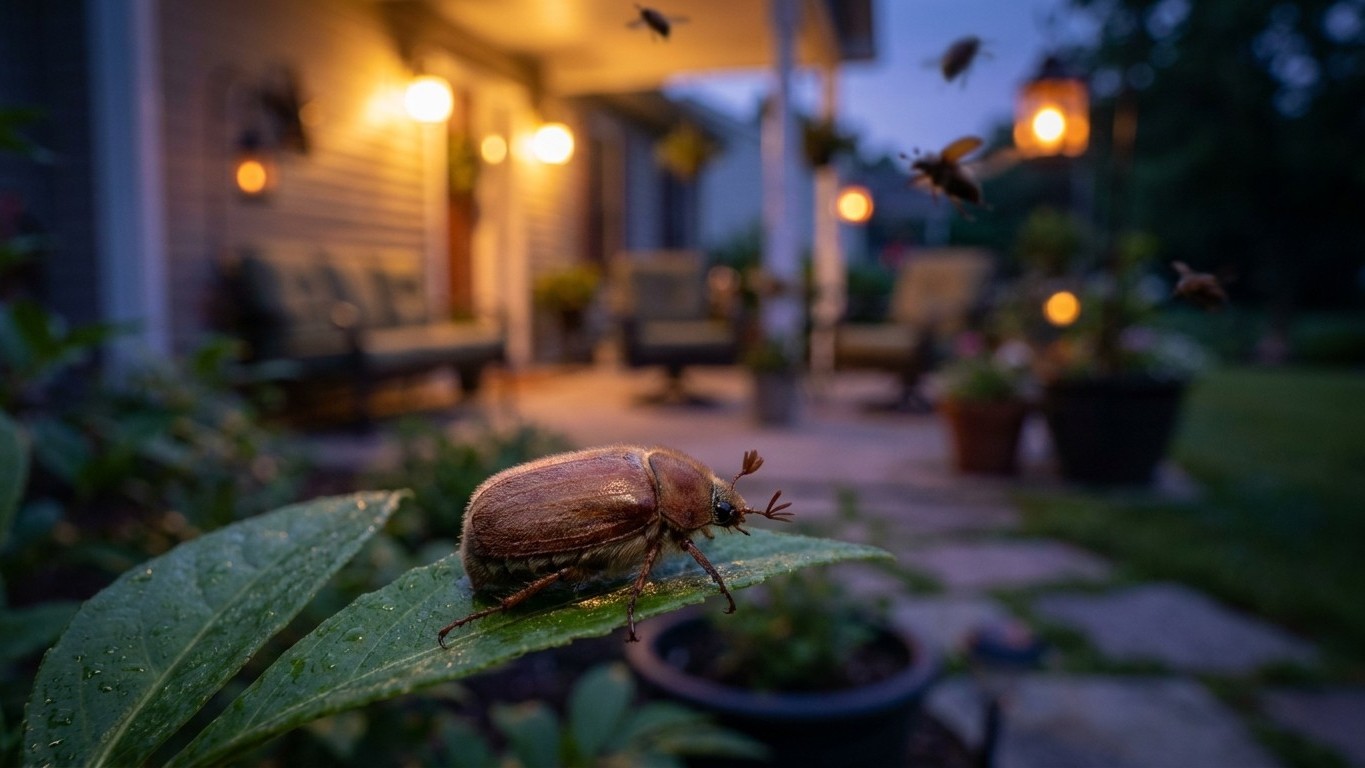

Asiatic garden beetles show up in Ontario landscapes starting in late June through August, with peak activity in July when adults emerge from the soil at dusk and swarm porch lights, lawn chairs, and anything glowing near a patio. The grubs that hatch from their eggs spend the fall and following spring chewing through grass roots and garden plant roots, which means the damage often gets blamed on other pests before anyone spots the actual culprit.
This beetle isn’t native to North America. It arrived from Japan and China decades ago and has since spread through the northeastern United States and into southern Ontario, where warmer summers and sandy or loamy soils give it exactly the conditions it needs to thrive.
What the Asiatic Garden Beetle Looks Like and How It Behaves

Adult beetles measure about 1/3 inch long, roughly the size of a pencil eraser. Their color ranges from cinnamon brown to a dull chestnut, and the wing covers have a slightly velvety texture if you look closely. Unlike Japanese beetles, which are bigger, metallic green, and active during the day, Asiatic garden beetles are strictly nocturnal.
That nighttime habit is the biggest clue homeowners miss. You won’t find them chewing leaves in broad daylight. Instead, they hide in mulch, thatch, or loose soil during daylight hours and come out after sunset to feed on foliage, flowers, and low-growing plants. They’re drawn hard to artificial light, so a porch bulb left on in July can pull in dozens of them in a single evening.
Their feeding pattern on leaves creates ragged, irregular holes rather than the neat skeletonized damage Japanese beetles leave behind. Asters, dahlias, roses, strawberries, and turf grasses are among their preferred targets, but they’ll feed on a wide range of ornamentals when populations are high.
The Grub Stage Does the Real Damage
Adult feeding is annoying, but it’s the larval stage that causes the lawn damage most Ontario homeowners actually notice. Females lay eggs in the soil during summer, and the grubs that emerge feed on grass roots and organic matter through fall. They overwinter deeper in the soil, then move back up near the surface in spring to resume feeding before pupating into adults by early summer.
A lawn with a heavy grub infestation develops soft, spongy patches that pull up easily, almost like a loose carpet. Brown, irregular patches appear in late summer or early fall, often mistaken for drought stress or disease. Raccoons, skunks, and birds digging up patches of turf at night are frequently a sign that grubs are feeding underneath, since these animals are hunting the larvae.
When Asiatic Garden Beetles Are Active in Ontario
Timing matters more than most people realize when dealing with this pest. Adults typically begin emerging in late June, with populations building through July and tapering off by mid-to-late August. This window lines up closely with warm, humid summer nights, since cooler or drier conditions tend to suppress activity.
Egg-laying happens throughout the adult flight period, meaning new grubs are hatching into the soil continuously from July through September. Peak larval feeding on roots occurs in September and October, right as many homeowners are fertilizing lawns for fall, unaware that grubs are already established underneath.
Spring feeding by overwintered larvae picks back up once soil temperatures rise, generally in April, and continues until the grubs pupate in late spring. This two-season feeding pattern (fall and spring) is part of why lawn damage from this beetle can look confusing compared to species with a single feeding window.
Why Southern Ontario Sees More Activity
The beetle’s spread into Canada has concentrated in southern Ontario, where longer, warmer summers give both the adult and larval stages enough time to complete their life cycle. Areas with sandy or well-drained loamy soil tend to see heavier grub populations than heavy clay regions, since females prefer looser soil for egg-laying. Urban and suburban lawns with irrigation systems, which keep soil consistently moist through summer, can inadvertently create ideal conditions for larval survival.
What Actually Stops Asiatic Garden Beetles
Control works best when it targets the life stage that’s actually causing the problem you’re seeing. Adult beetles swarming lights don’t respond well to lawn treatments, and grub damage in turf won’t be fixed by spraying foliage.
Reducing Adult Attraction
Since adults are drawn to light, switching porch and landscape lighting to yellow “bug” bulbs or motion-activated fixtures cuts down on how many beetles congregate near the house on summer nights. Turning off unnecessary outdoor lighting during peak flight weeks in July reduces the numbers landing on nearby plants.
Hand-picking adults off vulnerable plants in the early morning, when the beetles are sluggish and still clinging to foliage from the night before, can knock back a localized population without chemicals. Dropping them into a bucket of soapy water is enough to kill them.
Managing the Grub Stage in Lawns
Grub control depends on timing treatments to when larvae are small and actively feeding near the soil surface, which is late summer into early fall. Products containing insect growth regulators or certain biological controls are generally applied preventively in July or August, before eggs hatch, according to extension guidance from land-grant universities that track white grub species including the Asiatic garden beetle.
Beneficial nematodes, specifically species used against soil-dwelling grubs, offer an option for homeowners avoiding synthetic chemicals. These need moist soil and warm temperatures to be effective, so timing application right before or during a rainy stretch in late summer improves results. Cornell University’s entomology extension notes that grub-targeting nematodes work best when soil temperatures stay above 60°F, which fits the fall feeding window for this species. More detail on grub biology and control timing is available through Cornell University’s turfgrass and pest management resources.
Milky spore, a bacterial treatment often marketed for Japanese beetle grubs, does not reliably control Asiatic garden beetle larvae, since the two species respond differently to that particular bacterium. Homeowners hoping for a one-product fix across both pests often end up disappointed.
Cultural Practices That Make a Real Difference
Healthy, deep-rooted turf tolerates grub feeding far better than stressed lawns. Mowing at a taller height (around 3 to 3.5 inches for most cool-season grasses grown in Ontario) encourages deeper root systems that can withstand some larval feeding without visible dieback. Overwatering, on the other hand, creates the soft, moist soil conditions grubs prefer, so switching to less frequent, deeper watering can make a lawn less attractive to egg-laying females in the first place.
Reducing thatch buildup through periodic dethatching or aeration removes some of the organic material adult females favor for depositing eggs, and it improves how well any grub treatment reaches the root zone where larvae actually feed.
- Switch outdoor lighting to yellow or motion-sensor bulbs during July flight season
- Apply grub controls (nematodes or growth regulators) in late July through August, before eggs hatch
- Mow turf taller and water less frequently to encourage deep, resilient roots
- Dethatch or aerate in early fall to disrupt egg-laying sites
- Hand-pick adults from foliage in early morning hours
Telling It Apart From Other Ontario Lawn Pests
Japanese beetles and European chafers also cause grub damage in Ontario lawns, and their feeding windows overlap enough to cause confusion. The clearest way to separate them is by adult behavior and timing. Japanese beetle adults feed during the day and skeletonize leaves, leaving lace-like patterns behind, while European chafer adults fly at dusk in June, slightly earlier than Asiatic garden beetle’s July peak, and rarely swarm lights the way this species does.
Digging a small section of damaged turf and checking for C-shaped white grubs with brown heads can confirm larval presence, but species identification at the grub stage typically requires looking at the raster pattern (the arrangement of tiny hairs on the underside of the last abdominal segment), which is something local extension offices or pest management professionals can help verify if damage is severe enough to warrant targeted treatment.
One detail that trips up a lot of Ontario gardeners: Asiatic garden beetle adults will feed on plants that Japanese beetles typically ignore, including some groundcovers and low ornamentals, which is often the fastest way to suspect this species before ever seeing one up close.