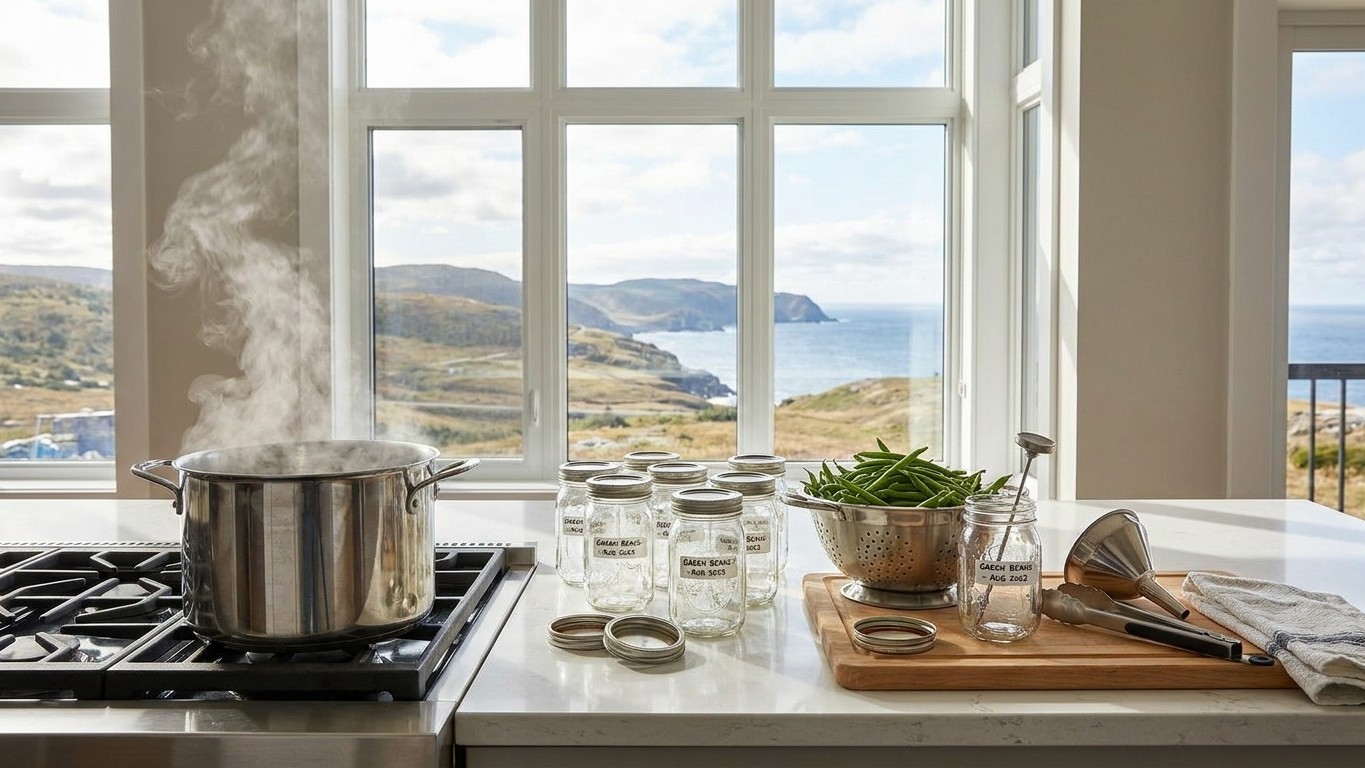

Water boils at 212°F at sea level. In St. John’s, Newfoundland and Labrador, sitting at 115 feet above sea level, the boiling point falls somewhere in the 208°F to 212°F range published for elevations between 0 and 2,000 feet. At that height, the drop is small enough that it doesn’t force a change to most tested canning processes. But that number belongs to one city, not to the whole province.
The short answer

St. John’s, the reference city for this figure, sits at 115 feet, and USDA’s published boiling-point data places that elevation inside the 0-to-2,000-foot band where water boils somewhere between 208°F and 212°F. That’s a difference of at most 4 degrees from sea level, which is why home canning guides typically don’t require any adjustment for boiling-water processing until an elevation passes 1,000 feet. A cook working in St. John’s kitchen, at 115 feet, is close enough to sea level that the standard processing times printed in a tested recipe apply as written.
That doesn’t mean every kitchen in Newfoundland and Labrador is in the same position. A province is not a single elevation, no matter how convenient it would be to treat it that way. St. John’s gives us a measured, sourced number for one point on the map, but Newfoundland and Labrador stretches from coastal lowlands to interior highlands and the Labrador plateau, where elevations run higher than the coast. Nobody canning green beans on a hillside outside a coastal town is canning at 115 feet just because the capital is.
This matters because the boiling-point relationship isn’t a rounding error. It’s linear and it’s real: the higher you go, the cooler the boil, and the cooler the boil, the less heat actually reaches the food inside the jar during processing. At 115 feet, the effect is close to nothing. At a few thousand feet, it starts to matter for boiling-water canning. At higher elevations still, it changes pressure-canner settings too. The number for St. John’s tells you where the coast sits on that curve; it doesn’t tell you where your own kitchen sits.
Why this figure comes from a city, not a coordinate on a map
Elevation data gets published for named places because that’s how geocoding works: a city or town has a fixed point, a state or province doesn’t. When a canning guide or a geography source gives “Newfoundland and Labrador’s elevation,” what it almost always means is the elevation of a specific reference point, usually the capital or another well-documented city. Treating that number as if it applied to a rural property forty miles inland, or up a slope, is where processing errors start. The fix isn’t complicated, but it does require a separate step, which the next sections cover.
Why a lower boil is a weaker process
Canning safety comes down to heat delivered over time. A boiling-water canner works because water at a rolling boil holds a specific temperature, and that temperature, sustained for the length of time in a tested recipe, is what destroys the organisms and enzymes that spoil food or make it dangerous. The mechanism that changes with elevation is simple: air pressure drops as you climb, and water boils at a lower temperature when the pressure pressing down on it is lower. At sea level, boiling water sits at 212°F. Ten thousand feet up, it boils at roughly 194°F. Every point in between falls somewhere on that line.
Here’s the part that trips people up: boiling water harder does not make it hotter. Once water reaches its boiling point at a given elevation, it stays at that temperature no matter how vigorously it’s bubbling. A rolling boil and a gentle boil, at the same elevation, are the same temperature. Cranking up the burner just makes more steam escape faster; it doesn’t push the water past its ceiling. That means a cook at higher elevation can’t compensate for a cooler boil by boiling more aggressively. The ceiling itself is lower, and no amount of stovetop heat changes where that ceiling sits.
A lower boiling point means less heat is reaching the jar’s contents during every minute of processing. If the process time on the jar label was calculated for a 212°F boil and the actual water in the pot is boiling at 208°F, the food inside receives measurably less thermal destruction of spoilage organisms and pathogens over that same stretch of time. The process, as printed, becomes weaker than it was designed to be. This is why the standard fix for boiling-water canning is to extend the time in the canner as elevation rises, and the standard fix for pressure canning is to raise the pressure, not the temperature target. Pressure canners get around the boiling-point ceiling entirely by pressurizing the whole vessel, and the extra pressure lets the water reach a hotter temperature than 212°F even at altitude. That’s why pressure canning tables adjust pounds of pressure per elevation band, while boiling-water tables adjust minutes.
Finding your own elevation
The elevation that matters for your canner is the one under your kitchen, not the one under St. John’s city hall. Here’s how to get an accurate figure for your own property.
- Start with your street address or the nearest named town, since most elevation lookup tools work from a location search rather than raw coordinates.
- Use the National Center for Home Food Preservation’s “Find Your Elevation” page, built specifically for canners who need this number for processing decisions rather than for general geography.
- Enter your location as prompted and note the elevation figure returned, in feet.
- Round up rather than down if your result falls near the edge of a stated elevation band. Tested canning charts group elevations into bands, and rounding up keeps you on the safe side of the line.
- Write the number down somewhere you’ll actually see it again, a card taped inside a cupboard, a note in the recipe binder, so you’re not re-searching it every canning season.
- Recheck if you move, even a short distance within the same town, since elevation can shift meaningfully over a few miles in hillier parts of the province.
The point of this exercise isn’t precision to the foot. Tested recipes work in bands, typically grouped in 1,000-foot increments, so what matters is knowing which band you fall into, not your exact altitude to three decimal places. Once you have that number, it becomes an input you carry into every recipe’s altitude adjustment chart, the same way you’d note your own oven’s tendency to run hot or cold.
What goes wrong
- An under-processed jar that looks perfectly normal. A jar sealed at the wrong process time for its elevation can seal properly, look clear, and sit on a shelf for months showing no sign of a problem, while still failing to have received enough heat to be safe. The remedy is following the elevation-adjusted time from a tested source before the jar ever goes into the canner, not inspecting it after the fact, since visual inspection can’t detect an under-processed jar.
- A recipe pulled from a sea-level source without adjustment. Recipes shared online, in older community cookbooks, or from a friend in a coastal town at low elevation often carry processing times calculated for near sea-level conditions. Using that time unchanged at a higher elevation inland silently weakens the process. The remedy is checking the source’s assumed elevation, if it states one, and applying your own elevation’s adjustment from a tested chart regardless of what the recipe printed.
- Reading a pressure gauge as if elevation didn’t exist. Dial-gauge and weighted-gauge pressure canners both require different pressure settings depending on elevation band, and a cook who sets the canner to a sea-level pressure at a higher elevation is running a weaker process even though the gauge needle looks “normal.” The remedy is matching the canner type and elevation band to the pressure listed in a tested recipe’s altitude table, every time, not just the first time a new pressure canner is used.
- Assuming St. John’s elevation applies province-wide. Because St. John’s sits low enough that many boiling-water recipes need no adjustment there, a cook elsewhere in the province might assume the same holds for their kitchen. The remedy is looking up the specific elevation for the property where the canning actually happens, using the steps above, rather than borrowing the capital’s number.
Where the exact adjustment comes from
This page won’t give you a processing time or a pressure setting, and that’s intentional. The correct adjustment depends on the specific food being canned, its acidity, jar size, and the method, and those variables belong to a tested recipe, not to a general elevation guide. Guessing at an adjustment, or applying one food’s altitude table to a different food, is how safe-looking jars turn dangerous.
The National Center for Home Food Preservation, at the University of Georgia, publishes elevation adjustment tables for both boiling-water and pressure canning tied to specific tested recipes and the USDA Complete Guide to Home Canning. Use the elevation figure you found for your own property, in the earlier section, and match it against the specific food’s chart on their site before processing anything.
The stakes are why this matters more than most kitchen shortcuts. Botulinum toxin, the danger an under-processed low-acid jar can harbor, has no taste and no smell. A jar can look, smell, and taste completely fine and still be unsafe. There’s no way to catch the mistake at the table; the only way to prevent it is getting the process right before the lid goes on.
Common questions
Does St. John’s elevation apply to the rest of Newfoundland and Labrador?
No. St. John’s, at 115 feet, is the reference city used for this published figure, but the province includes coastal lowlands and interior highlands at other elevations. Look up your own property’s elevation rather than relying on the capital’s number.
At what elevation do canning times actually need to change?
Tested USDA canning charts, published through the National Center for Home Food Preservation, typically begin adjusting boiling-water processing times above 1,000 feet and adjust pressure canner settings at similar thresholds. Check the specific food’s chart on the NCHFP site against your own elevation.
Can I just boil the water harder to compensate for altitude?
No. Once water reaches its boiling point at a given elevation, it stays at that temperature regardless of how vigorously it’s boiling. A harder boil produces more steam, not a hotter liquid, so it can’t substitute for the time or pressure adjustment a tested recipe calls for.
Why does pressure canning use pounds of pressure instead of extra minutes to adjust for altitude?
A pressure canner raises the boiling point of water above 212°F by sealing the vessel and building pressure inside it, which sidesteps the altitude ceiling that limits boiling-water canning. Because of that, pressure canning tables adjust the pounds of pressure per elevation band rather than extending the processing time.