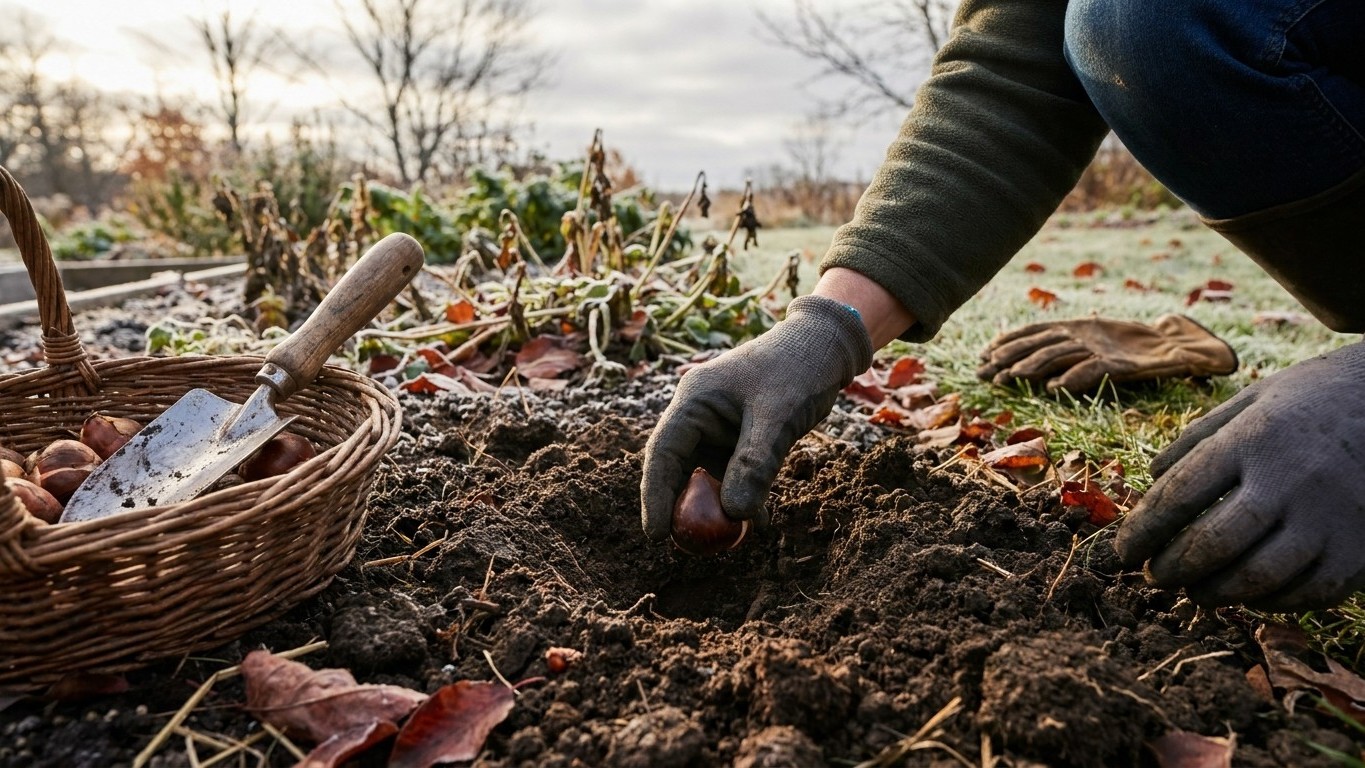

Fall is bulb-planting season in Nova Scotia, and the province’s long, steady cold season is actually an advantage: most hardy spring bulbs get more chilling here than they need to bloom. The real work is nailing the planting window around the first frost and knowing which bulbs are built for a Maritime winter, and which ones will rot, sulk, or vanish after one season.
When to plant bulbs in Nova Scotia

The average first fall frost at Halifax Stanfield International Airport lands on October 18, based on Environment and Climate Change Canada’s 1981-2010 climate normals for that station. That date is the anchor for the planting window, not a deadline in itself. Soil needs to cool down before bulbs go in the ground, and that cooling generally follows close behind the first frost.
The workable stretch runs from roughly the time soil temperatures drop into the 50s, often not long after that mid-October frost, through about six weeks before the ground freezes solid, which for most of the province means sometime in November. Six weeks is the number that matters here, because it’s the minimum amount of time roots need to establish before the ground locks up for winter.
What goes wrong at either end
Plant too early, while soil is still warm from summer, and bulbs can push top growth before winter arrives. That growth gets killed back by the first hard freeze, and the bulb spends energy recovering instead of building the flower it was supposed to produce in spring. Plant too late, after the ground has already started to firm up, and the bulb goes in without enough time to grow roots. It may sit dormant through winter with no anchor, heave out of the soil during freeze-thaw cycles, or simply come up weak and short the following spring.
None of this is exact. October 18 is a mean date pulled from three decades of records, which means in roughly half of all years the frost arrives later than that, sometimes considerably later. Treat it as the middle of a window, not a line you can plan against with confidence. A gardener working from the calendar alone, rather than watching actual soil conditions, risks planting into ground that’s still too warm or, in a cold-snap year, missing the window entirely. Checking soil temperature directly with a simple thermometer, rather than trusting the date alone, removes most of that guesswork.
Whether your winter is cold enough
Spring bulbs don’t just tolerate cold, they require it. Most need somewhere between twelve and fourteen weeks with soil temperatures below about 45°F to complete the internal process that turns a dormant bulb into a flowering one. Skip that cold exposure and the bulb often still grows leaves, but the flower stays undeveloped, or it emerges on a stem too short to notice above the foliage. This is the number every gardener needs before choosing a bulb, no matter where they garden, because it’s the yardstick for judging any — and it’s also why gardeners without the right outdoor conditions turn to Forcing Spring Bulbs Indoors in Nova Scotia as an alternative variety on a nursery shelf.
Nova Scotia clears that bar by a wide margin. The mean daily minimum temperature in the coldest month at the Halifax reference station is 13.3°F, and the province sits in Canadian plant hardiness zone 6b according to Natural Resources Canada’s 1991-2020 normals for the reference city. That’s the Canadian zone system, built from seven climate variables rather than the single minimum-temperature measure used in the American system, and the two scales don’t convert to each other in any simple way. What matters practically is the raw number: 13.3°F, sustained across a winter that reliably runs from the October frost well into spring, delivers far more than twelve to fourteen weeks below 45°F for almost any bulb sold as winter-hardy.
What that margin buys
Because the cold is abundant rather than marginal, gardeners here don’t need to pre-chill hardy spring bulbs in a refrigerator before planting, a workaround that gardeners in warmer regions rely on. Pre-chilling means storing bulbs at refrigerator temperature for about twelve weeks, kept away from apples, pears, or other ripening fruit, since the ethylene gas they release will kill the flower bud forming inside the bulb. Nova Scotia’s ground does that job on its own. The margin also means the list of workable varieties is long: virtually anything sold as a standard hardy spring bulb will get the cold exposure it needs here, provided it also survives the winter itself, which is a separate question covered below.
| Bulb | Cold required to flower | What Nova Scotia delivers | Verdict |
|---|---|---|---|
| Tulip | 12-14 weeks below 45°F | Winter runs well past that, coldest-month min 13.3°F | Chilling need met, no pre-chill needed |
| Daffodil / Narcissus | 12-15 weeks below 45°F | Comfortably exceeded | Chilling need met |
| Hyacinth | 13-15 weeks below 45°F | Comfortably exceeded | Chilling need met |
| Crocus | 8-15 weeks below 45°F, depending on species | Comfortably exceeded | Chilling need met |
| Allium | 10-12 weeks below 45°F | Comfortably exceeded | Chilling need met |
Which bulbs suit Nova Scotia
Since cold exposure isn’t the limiting factor here, the more useful question is which bulbs are built to survive a Nova Scotia winter outright, meaning wet ground, freeze-thaw cycles, and salt-laden coastal wind in some districts. The following bulbs are widely sold with hardiness ranges, published on the USDA scale by North American growers, that comfortably cover the actual winter lows measured here.
- Tulips (Tulipa hybrids), hardy zones 3 to 8
- Daffodils (Narcissus), hardy zones 3 to 9
- Crocus — hardy zones 3 to 8
- Grape hyacinth (Muscari), hardy zones 4 to 8
- Ornamental onion (Allium), hardy zones 3 to 8
- Dutch hyacinth (Hyacinthus orientalis), hardy zones 4 to 8
- Snowdrops (Galanthus), hardy zones 3 to 7
A few bulbs sold alongside these in the same fall displays will disappoint. Freesia, ranunculus, anemone coronaria, and ixia are typically rated hardy only to zone 8 or warmer, and planted outdoors here for winter they either rot in cold, wet soil or freeze outright before spring. They’re better treated as spring-planted, dig-up-in-fall stock, not fall-planted bulbs. Fritillaria imperialis is a middle case worth flagging on its own: it’s rated hardy enough on paper, and it often puts on a striking first-year display after a fresh purchase, but it’s prone to rot in the heavy, poorly drained clay common in parts of the province, and gardeners frequently find it doesn’t come back a second spring.
None of these ranges are hard lines. A bulb rated to the edge of its zone can survive for years against a south-facing foundation wall or under a hedge that blocks wind, and the same variety can fail in an open, low-lying spot a few hundred feet away where cold air pools and drainage is poor.
What digs them up here
Squirrels and voles raid bulb beds constantly in Nova Scotia, but they’re picky, and the pattern isn’t random. Daffodils and anything in the onion family contain compounds that are toxic or simply unpalatable to rodents, which is why those bulbs sit undisturbed through the fall even in yards with heavy squirrel traffic. Tulips and crocus have no such defense. They’re starchy, sweet, and high on the list of what a hungry squirrel digs for the moment the soil is loose.
- Squirrels and voles usually take: Tulips, Crocus
- Squirrels and voles usually leave: Daffodils/Narcissus, Allium, Fritillaria, Snowdrops, Hyacinth
For anyone planting the bulbs on the vulnerable list, one measure actually holds up over a full season: laying a sheet of galvanized wire mesh directly over the planting bed, pinned down at the edges, and leaving it in place until the ground freezes hard enough that digging is no longer worth the effort for a rodent. Repellent sprays and granules, by contrast, wash off with the first rain or watering and need constant reapplication to do anything at all, which makes them a poor match for a fall planting season that’s often wet from the start.
Where to check for your own county
Every figure on this page, the October 18 frost date, the 13.3°F coldest-month minimum, the zone 6b rating, comes from measurements at or near Halifax. Nova Scotia stretches across coastal, inland, and upland terrain, and conditions at the reference station don’t hold everywhere. A planting date built around Halifax’s normals can run a couple of weeks off in a colder inland valley or a milder coastal pocket, and that gap matters when the whole point of the window is getting bulbs into the ground before the soil hardens.
The province’s land-grant style resource for this is the Nova Scotia Department of Agriculture, at novascotia.ca/agri. Local extension contacts and county-level agricultural offices are the practical way to confirm frost timing and soil conditions for a specific address, rather than leaning on a single provincial reference point that was never meant to describe the whole map.