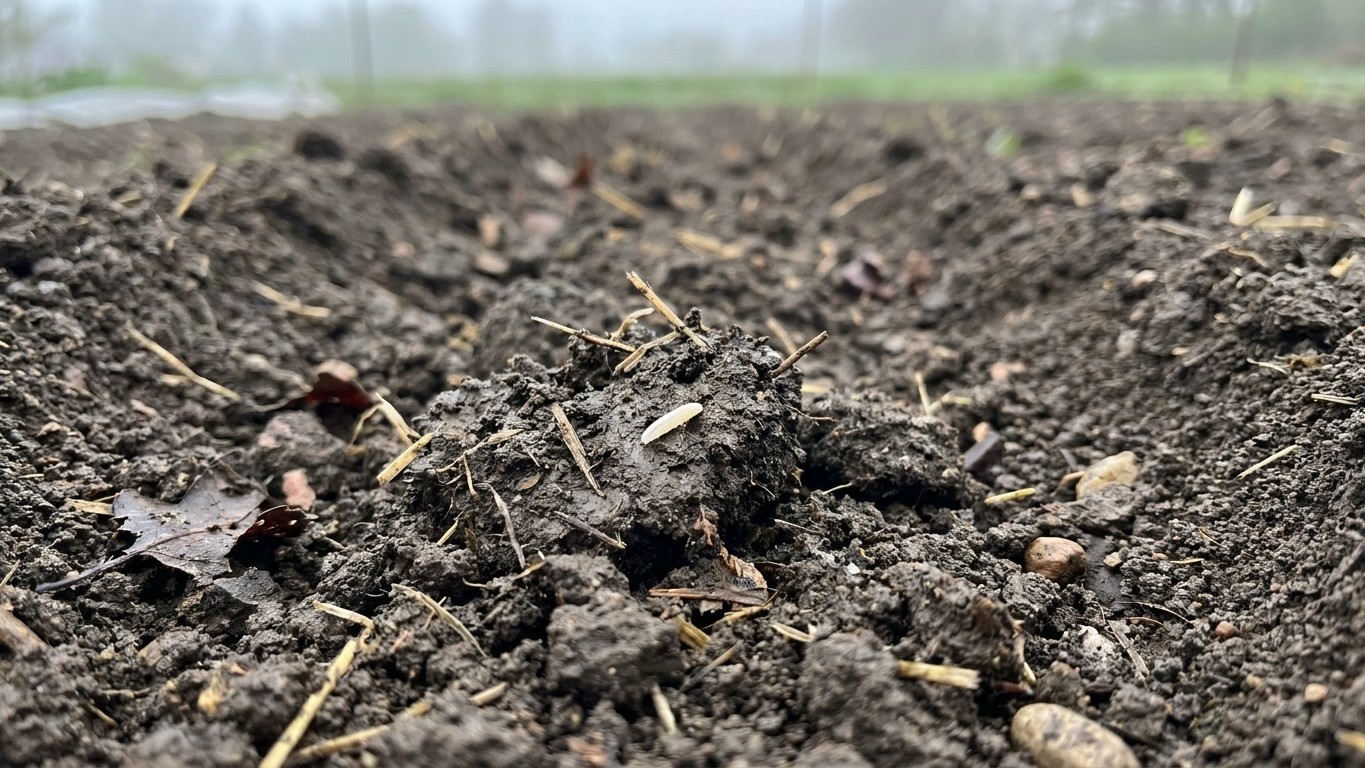

The seedcorn maggot doesn’t wait for warm weather in Nova Scotia. It shows up right when the ground first turns workable, usually from mid-April through late May, and it does its worst damage in exactly the fields gardeners and farmers rush to plant first: cool, wet, recently tilled soil with fresh organic matter mixed in. The fix isn’t a spray you reach for after the fact. It’s timing your planting to skip the fly’s peak egg-laying window and cutting off the rotting-organic-matter smell that draws females in.
That’s the short version. The longer version explains why Nova Scotia’s maritime spring makes this insect more predictable than most, and why the standard advice from warmer growing regions doesn’t always translate directly to the Maritimes.
Why Nova Scotia’s Cool Spring Sets the Calendar

Delia platura, the fly behind the seedcorn maggot, spends winter as a pupa a few inches down in the soil. It doesn’t need a hard freeze to survive. Nova Scotia’s mild, damp winters and slow-to-warm spring soils actually favor it, because the insect thrives in the exact conditions the province specializes in: raw, wet ground that takes its time reaching planting temperature.
Adult flies emerge based on accumulated heat, not the calendar date. Entomologists track this with degree-day models using a base temperature around 39°F (4°C). In practice, that means the first flight in the Annapolis Valley or around Truro tends to land somewhere between mid-April and early May, earlier in a mild year, later if a cold snap drags on. A second generation typically follows in June, and in warmer seasons a partial third generation can show up by midsummer, though it’s the first flight that causes almost all the economic damage because it coincides with early seeding of corn, beans, and peas.
The insect’s real trigger isn’t temperature alone. Female flies key in on decomposing organic material, the smell of a freshly turned field, manure spread ahead of planting, or a cover crop just tilled under. That’s why the same field can be low-risk one year and a magnet the next, depending on what was worked into the soil and when.
Spotting the Damage Before You Blame Something Else
Above ground, seedcorn maggot damage looks like poor germination. Rows come in patchy, seedlings emerge stunted or twisted, or nothing comes up where you know you planted. Growers often assume it’s bad seed, a planting depth error, or a late frost. Pull a few unsprouted seeds and you’ll usually find the real story: small, yellowish-white maggots, about a quarter-inch long, tunneling directly into the seed or the germinating shoot before it ever breaks the surface.
Corn is the crop that gave the insect its name, but in a Nova Scotia garden or market farm, beans and peas often take the harder hit because their large, soft seeds are an easy target during the slow, cool germination period typical of a Maritime spring. Cucurbits like squash and cucumber, along with brassica transplants set out too early, are also vulnerable, particularly in fields that got a manure application shortly before seeding.
One detail that trips people up: once a seed has sprouted and pushed a healthy stem above ground, the risk drops sharply. The insect attacks seeds and the earliest shoot tissue, not established plants. So a slow, cold week right after planting is far more dangerous than a slow week two weeks in.
What Actually Stops It
Timing and Soil Prep
The single most effective, and cheapest, control is delaying planting until soil temperatures climb past the range where germination drags on for more than a week. Fast-germinating seed spends less time exposed to egg-laying females and hatching larvae. In much of Nova Scotia, that argues for holding off on corn and bean seeding until soil consistently reads in the mid-50s°F rather than pushing seed into ground that’s still in the mid-40s just because the calendar says it’s late April.
Fresh manure or a green cover crop turned under within a couple of weeks of planting is close to an open invitation. If manure application is part of your rotation, spreading it in fall or working it in well ahead of spring seeding, rather than right before, cuts the attraction considerably. The same goes for tilling under a cover crop: give it three to four weeks to break down before seeding into that ground, if the schedule allows it.
Seed and Row-Level Protection
Commercial seed treatments (insecticidal seed coatings applied by the seed producer) remain the most reliable chemical option for row crops like corn, and they’re widely used precisely because they protect the seed during the exact narrow window when it’s vulnerable, without requiring a foliar spray later. Home gardeners generally don’t have access to these treatments and instead lean on cultural tactics: shallower planting depth so seedlings emerge faster, pre-sprouting seed indoors before transplanting outside, and avoiding double-planting into ground that already failed once this season, since a failed stand usually means the maggots are still active there.
Rotation and Residue Management
Because the fly is drawn to decomposition, not to a specific crop family, rotation alone won’t eliminate risk the way it does with some soil pathogens. What helps more is residue management: incorporating crop debris and organic amendments early enough that they’ve largely broken down before the next planting, rather than working them in fresh right before seed goes in the ground.
Growers who monitor degree-day accumulation, information available through provincial and regional agricultural extension resources, can time seeding to land after the first flight peak has passed, which meaningfully lowers the odds of a female laying eggs right at the row.
Crops on the Front Line in Nova Scotia
Sweet corn growers in the Valley have long treated the first two weeks after planting as the critical exposure window, which is part of why many hold seeding back a week or two past what growers in warmer parts of Ontario or the northeastern U.S. would consider late. Snap beans and peas face similar pressure, especially direct-seeded plantings that go in before soil has shed its early-spring chill.
Home vegetable gardens across the province run into this insect most often in raised beds or plots amended with fresh compost or manure right before spring planting, exactly the setup that smells most appealing to an egg-laying female fly. Waiting even five to seven days after amending a bed, and choosing a mild, sunny stretch rather than a cool damp one to plant into it, measurably lowers the odds of a wiped-out row.
Transplants sidestep most of the risk entirely, which is one reason experienced growers start brassicas and cucurbits indoors rather than direct-seeding them into cold Maritime soil in early spring. A transplant already has true leaves and an established root by the time it goes in the ground, well past the stage where the maggot can do meaningful damage.
The pattern worth remembering isn’t really about the insect at all. It’s about soil temperature and organic matter timing, two things every Nova Scotia grower already tracks for a dozen other reasons. Seedcorn maggot pressure just happens to spike exactly when those two variables line up against you: cold, wet ground that’s freshly loaded with something rotting.